
Insights on Business Growth, Go-to-Market and AI RevOps Enablement
Grouped by subject. Narrow the list by topic, or search across every article and every answer on the site.
- 40 articles
- 182 questions & answers
- 6 subjects
Latest article
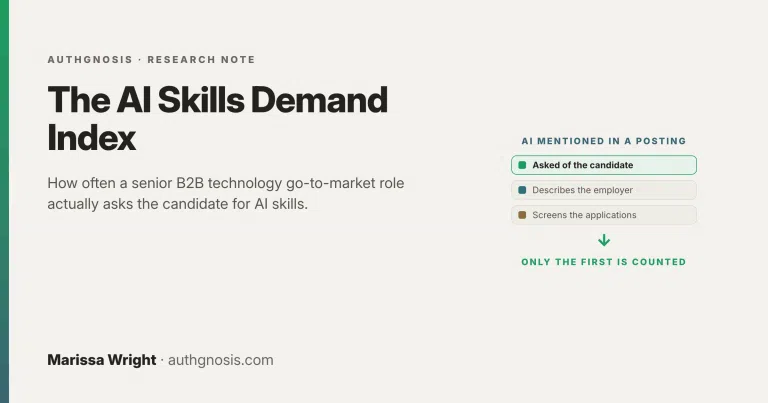
AI Skills in Senior B2B Technology Go-to-Market Roles
There is a growing AI skills gap between what companies need from their RevOps leadership and what is available from the market: the technologies are new, but employers need the skills now.

1 article
Business Growth Consulting
Business growth consulting spans revenue operations (RevOps), business strategy and planning, seed- through Series A capital fundraising, and AI-enablement of RevOps processes and platforms. The work runs from current-state diagnostics through future-state planning to implementation and systems integration, and extends to fractional leadership where teams need support to execute.
Questions answered in this section
4 questions. Each link opens the answer on the article that owns it.

6 articles
Go-to-Market and Revenue Leadership
Go-to-Market defines who the ideal customers are, where they are located, why they will buy, how the product is priced, how it is delivered, and how the revenue funnel is filled and managed from lead-to-close.
Revenue leadership covers how sales and marketing teams are onboarded, developed and managed for performance and consistency, and how revenue forecasts are made dependable against the target numbers. The two necessarily integrate the sales, marketing and delivery channels into a continuous revenue growth flywheel.
- Integrating Sales Processes and a CLTV-Focused Customer Lifecycle
- The Nine Stages of the AISDALS/L Enterprise Sales Lifecycle
- Four Sales Methodologies, One Integrated System
- Selling Is a Team Sport: Cross-Functional Orchestration
- Exit Criteria, Forecast Quality, and a CLTV Growth Flywheel
- Sales Process-Customer Lifecycle CRM Visualization
Questions answered in this section
39 questions. Each link opens the answer on the article that owns it.
- How do decision criteria and exit criteria improve sales coaching?
- How is the AISDALS/L loop a flywheel rather than a funnel?
- What are "exit criteria" in a sales or marketing process?
- What's the difference between optimizing for ACV and optimizing for CLTV?
- Why are decision criteria and exit criteria the critical success factors of sales forecast quality?
- How does SPIN fit into the model?
- What does Challenger add that MEDDPICC lacks?
- What does MEDDPICC contribute, and where does it attach?
- What role does Sandler play in an integrated sales process?
- Which four sales methodologies does the model integrate?
- Why combine four sales methodologies instead of adopting just one?
- How does Rogers' Diffusion of Innovations apply to the AISDALS/L customer lifecycle?
- How does the AISDALS/L customer lifecycle shift the focus from ACV to CLTV?
- How is AISDALS/L different from Kotler's 5A model?
- What is the AISDALS/L customer lifecycle model?
- Why do classic marketing funnels like AIDA fall short for enterprise tech sales?
- Why does the Search stage matter so much in enterprise selling?
- Does this work for direct-led sales, partner-led sales, and hybrid direct-partner selling?
- How do leads get generated and enter the sales process?
- How does the sales process recycle?
- How does this process create self-healing, accurate, and reliable forecasts?
- How is pipeline leakage detected?
- How is sales cycle friction detected?
- What are the remaining friction points that affect the length of a sales cycle?
- What is the expected efficiency gain from the AI and non-AI automations?
- What should be surfaced to VP and Sales Manager dashboards?
- Would this work for Enterprise, SMB, and Public Sector sales cycles?
- How does Marketing act as an early-warning system after the sale?
- How does post-sale customer advocacy drive CLTV growth?
- How is Marketing's role different from a traditional top-of-funnel function?
- What does Field Engineering own in the cycle?
- Which cross-functional teams run alongside the Sales lane?
- Who owns customer outcomes?
- How does a deal progress through the early stages (Awareness, Interest, Search)?
- How does the AISDALS/L lifecycle become a repeating revenue flywheel?
- What are the exit milestones in the Desire and Action stages?
- What are the nine stages of an AISDALS/L enterprise sales lifecycle?
- What happens after the sale?
- What happens in the Signals stage?

18 articles
Growth Strategy
Growth strategies are conscious, intentional plans to grow a business. A strategy provides a clearly rationalized competitive position that growth initiatives can anchor to.
Without one, ad-hoc initiatives pull a company in conflicting directions, sapping valuable time and cash resources and working against its own growth objectives and timelines. A growth strategy is a rationalized decision-making tool: it establishes which initiatives to say yes to, and which to decline as off-axis.
- The Six Drivers That Drive Business Growth
- How Can I Grow My Business? (TL;DR)
- Driver 1: Products
- Driver 2: Markets
- Driver 3: Partnerships
- Driver 4: Business and Pricing Models
- Driver 5: Business Processes
- Driver 6: Financing
- What Are the Barriers to Growth?
- Which Growth Drivers Have the Biggest Impact?
- Which Drivers Depend on the Others, and Which can be Invested in Independently?
- Which Growth Drivers are Cheap, and Which Require Significant New Capital?
- Which Growth Drivers are Most Overlooked?
- Which Growth Drivers Pay Off Fastest?
- Business Growth Strategies
- A Special Case: Growing a Technology Service Firm
- The Bottom-Line
- An interactive model for business growth options and decisions
Questions answered in this section
43 questions. Each link opens the answer on the article that owns it.
- How do you scale a service firm without diluting quality?
- What is a professional service firm (PSF)?
- Why can't service firms grow the way product companies do?
- How do you decide what the viable growth targets for a business are?
- How do you build a growth strategy when runway is tight?
- Why do most growth failures come down to sequencing rather than strategy?
- How do you tell real product-market fit from early enthusiasm?
- If AI makes building cheap, where does durable product advantage come from now?
- Why do well-funded products still fail?
- Why does entering new markets often accelerate a company's decline?
- Why does land-and-expand work for some companies and stall for others?
- How should partnership strategy change as a company matures?
- When is a partnership a growth lever versus a hidden liability?
- Why do channel partnerships so often disappoint early-stage companies?
- How do you raise prices without triggering churn?
- What is the most common pricing mistake founders make?
- Why does rapid growth sometimes speed up a company's collapse?
- Where should a growth-stage company start with automation?
- Why are process advantages harder to copy than product features?
- How do SR&ED and IRAP actually work together on the same project?
- How do you decide between dilutive and non-dilutive capital?
- Why can raising too much money hurt a startup?
- What tells you a company is ready to move from 'win' to 'extend'?
- Why does the order of growth investments matter more than the investments themselves?
- How long does your Strategic Growth Plan engagement take from start to finish?
- How much does it cost?
- Our financial data is sensitive and non-public. Can you work without it?
- What does your Strategic Growth Plan engagement look like to my organization: who is involved, how is it decided, and how is it delivered?
- What information has to be gathered for a Strategic Growth Plan?
- When is the best time to do this work?
- How do you decide which of the six drivers to work on first?
- Why do growth efforts fail even when the individual tactics are sound?
- Are external or internal barriers more likely to kill a startup?
- How do you tell a real constraint from a symptom?
- What happens if you invest in a dependent driver before its prerequisites exist?
- Which growth investments are reversible, and why does that matter?
- Does cheaper-to-build, thanks to AI, mean easier to win?
- If the cheapest levers have the highest ROI, why doesn't everyone use them first?
- What do the most overlooked growth levers have in common?
- Can a strong driver make up for a weak one?
- Why is the highest-impact growth driver often not the one founders focus on?
- How do you balance short-term and long-term growth investments?
- Why shouldn't you rely only on the fast-payoff levers?

3 articles
AI RevOps Enablement
AI-Native RevOps enablement is a complete re-imagining of go-to-market workflows across the sales, marketing and delivery motions. It maps current-state processes at the most granular level and re-builds them from first principles, with guardrails for cybersecurity, automations, accuracy and customer relationships at the forefront.
It is a function led by domain experts rather than by IT. Future-state processes are defined with the company's own RevOps leaders, then either implemented directly or specified as tools, integrations and cybersecurity requirements for an IT team or service provider to build.
- Why I Didn’t Build a Multi-Agent AI Role-Based Development Architecture
- Why Long AI Sessions Cost So Much More Than Short Ones
- The Evolution of AI over 80 Years
Questions answered in this section
19 questions. Each link opens the answer on the article that owns it.
- How mature are autonomous AI agents in 2026?
- Should I generally provide AI licenses for ChatGPT and Claude to all of my employees?
- What AI technologies can be used to drive business value?
- How are agent activities run?
- Is a multi-agent AI framework better than a single agent?
- What is a human-in-the-loop AI architecture?
- What is the main risk of a multi-agent AI system?
- What repos do you use?
- Can AI scope drift be detected before it costs you?
- Does a bigger project justify longer sessions?
- How long should an AI working session be?
- How much does splitting a session actually save?
- Is it cheaper to remove the human from the loop?
- What is a token?
- What is a turn?
- What is context, and why does it cost money?
- What is session length, or session size?
- Why does the same question cost more later in a session?
- Why is the total cost of a session quadratic?

3 articles
Capital Funding
For firms seeking seed- through Series A funding, investor readiness requires preparation substantial enough to distract from go-to-market activity.
The work covers writing or re-shaping the business plan and economic model, identifying the ideal investor profile, identifying prospective investors and networks, preparing the due-diligence data room, automating the investment paperwork workflow, coaching the team on the investor pitch, and creating an investor relations workflow that keeps investors engaged post-money.
Related reading

12 articles
Research Notes
Quality research work involves knowing what data is required, where and how to get reliable data, and how to structure the data within proven frameworks to make better business decisions.
This section will include research notes related to my own scope of work as well as non-confidential research related to past client work.
- Canada’s Venture and Growth Capital Plan for BC Founders
- Love: Retention and Customer Lifetime Value
- Share: Expansion, Referrals and Advocacy
- Like: Delivering the Value That Was Promised
- Action: Closing Without Losing to No Decision
- Desire: Proving Value Before the Proposal
- Search: Building Consensus in the Buying Group
- Interest: Discovery and Qualification
- Awareness: Reaching Buyers Before the Shortlist
- Signals: Capturing and Answering Buying Signals
- Success and Failure across the Customer Lifecycle
- AI Skills in Senior B2B Technology Go-to-Market Roles
Questions answered in this section
70 questions. Each link opens the answer on the article that owns it.
- Do closing techniques work in large B2B sales?
- How do you close a deal with an indecisive buyer?
- How many forecast deals actually close?
- What happens to the win rate when a deal slips?
- What is the JOLT effect in sales?
- What percentage of B2B deals are lost to no decision?
- What resources does a company need to implement AI-native RevOps tooling?
- What skills should be required of Sales and Marketing leaders to implement AI-native RevOps initiatives?
- Do buyers avoid suppliers that send irrelevant sales outreach?
- Do phone calls improve cold email reply rates?
- How far through the B2B buying process are buyers before they contact a vendor?
- How often does the first vendor a B2B buyer contacts win the deal?
- What percentage of B2B buyers prefer a rep-free buying experience?
- What percentage of booked sales meetings don't go ahead as scheduled?
- Can a venture round affect a company’s SR&ED tax credits?
- Does the Venture and Growth Capital Plan funding have special due-diligence requirements?
- How can a company receive capital from the Venture and Growth Capital Plan?
- What is Canada’s Venture and Growth Capital Plan?
- What is the deadline for the Regional AI Initiative and the growth stream consultation?
- When will Venture and Growth Capital Plan money reach companies?
- Which companies benefit most from the Venture and Growth Capital Plan?
- Does SPIN selling training improve sales results?
- Features vs benefits: which leads to more sales?
- How does talking about product features affect win rate?
- How long should a seller talk without interruption in a sales demo?
- How much does early discounting hurt win rate?
- When should a seller present ROI to the economic buyer?
- How much do agreed next steps improve close rates?
- How much does MEDDPICC qualification improve win rates?
- How much should a sales rep talk on a discovery call?
- What is a MAP?
- What is an Executive POV?
- What percentage of B2B deals are lost at the discovery and qualification stage?
- What separates a successful discovery call from an unsuccessful one?
- When should you bring up price in a B2B sales cycle?
- Does pressure to close affect customer satisfaction?
- How common is buyer's regret after a technology purchase?
- How does net revenue retention relate to company growth?
- What is the difference between NRR and GRR?
- What percentage of new ARR comes from expansion revenue?
- Are long-term customers always more profitable?
- Does NPS predict customer retention?
- How much can reducing customer defections increase profits?
- How much does customer retention affect company value?
- What drives performance in B2B customer relationships?
- What is a good net revenue retention rate for B2B SaaS?
- How does the size of the buying group affect the chance of a B2B purchase?
- How much does multi-threading improve sales win rates?
- How often is procurement the final decision maker in B2B purchases?
- What happens to win rates when no decision maker is involved in a deal?
- What percentage of B2B purchases stall?
- Why does consensus in the buying group matter for closing a deal?
- Are referred customers more valuable than other customers?
- Does joining a referral programme make customers more loyal?
- How do you choose the right customer reference for a prospect?
- What percentage of B2B buyers use reviews before they buy?
- Why does customer advocacy matter in B2B buying?
- Does adding phone calls to email follow-up improve lead response rates?
- How fast should you respond to an inbound lead?
- How often do marketing and sales teams collaborate?
- What is the average speed to lead for inbound inquiries?
- What percentage of companies never respond to inbound leads?
- What percentage of leads are sales-ready when they convert?
- How do you use a CRM to solve market coverage, pipeline leakage, deal qualification, win/loss, and retention problems?
- How does the number of stakeholders affect the likelihood of a B2B purchase?
- How far through the buying journey are B2B buyers before they talk to a sales rep?
- How many B2B deals end in no decision?
- How much is improving customer retention worth to a company?
- What percentage of B2B sales failures are within the seller's control?
- Where does pipeline leakage happen most often in B2B sales?
Let’s have a conversation.
Share your business challenges, and ask me how I can help.