
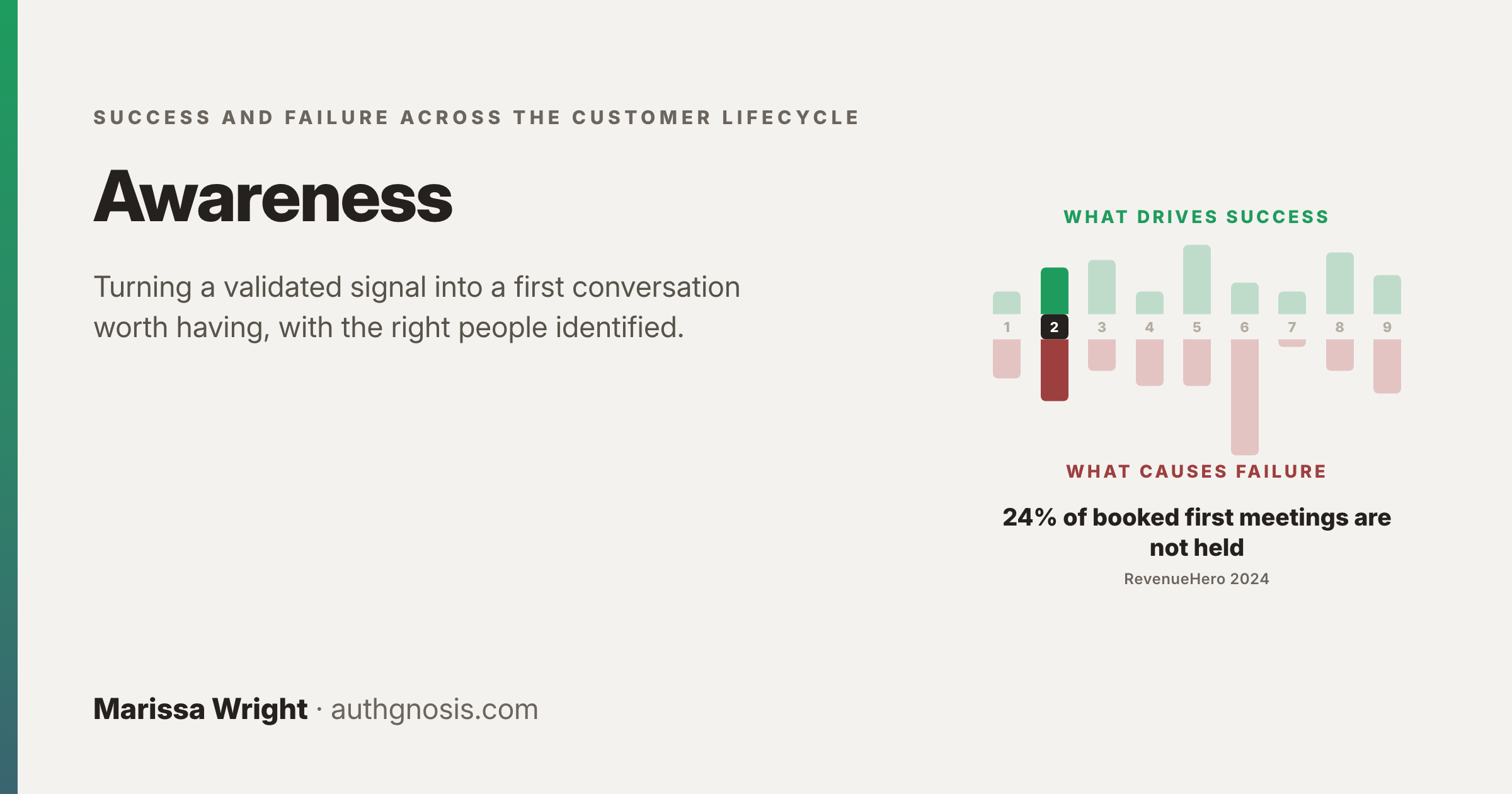
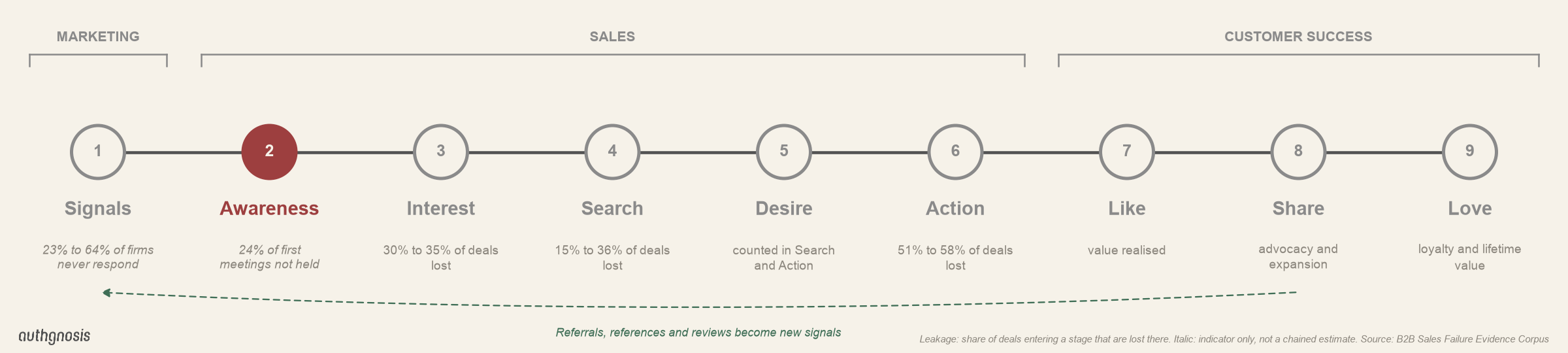
This post is part of Success and Failure across the Customer Lifecycle, which tests each stage of the AISDALS/L customer lifecycle against 172 data points from 98 primary sources. The lifecycle itself is set out in the series that begins with Integrating Sales Processes and a CLTV-Focused Customer Lifecycle.
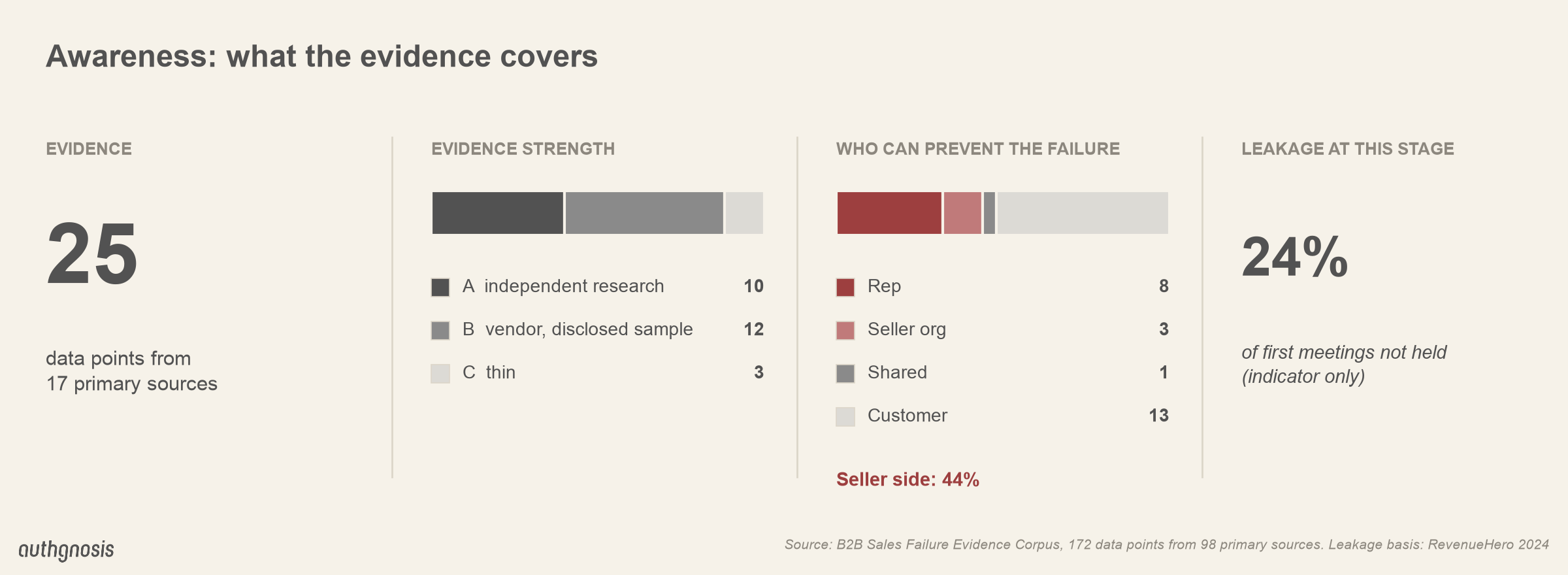
What the evidence covers
SQL qualification at Awareness has little direct evidence. Pain, economic-buyer and champion qualification at Awareness can stop downstream MQL-to-SQL leakage: most leads aren't ready at conversion (MarketingSherpa 2012), and a long qualification stage raises slip risk (Ebsta and Pavilion 2024). But no study measures champion identification at the first call - at this stage, a Champion should be considered tentative and re-confirmed downstream.
As the starting point for the Sales process, Awareness is used as the baseline for measuring downstream leakage. However, 24% of first call appointments are “no-shows”, which can be considered Marketing-owned MQL leakage.
Success at Awareness
Success means turning a validated signal or target account into a first conversation the buyer finds worth having and leaving it with the right people identified and a discovery call booked.
- The initial account and contact research is done from an AI augmented skill
- The Reframe email is sent via campaign or 1:1 out of band by a rep;
- The Awareness call is held to qualify the MQL;
- Pain is identified;
- A champion is identified or tentatively confirmed as the MQL contact.
Failure at Awareness
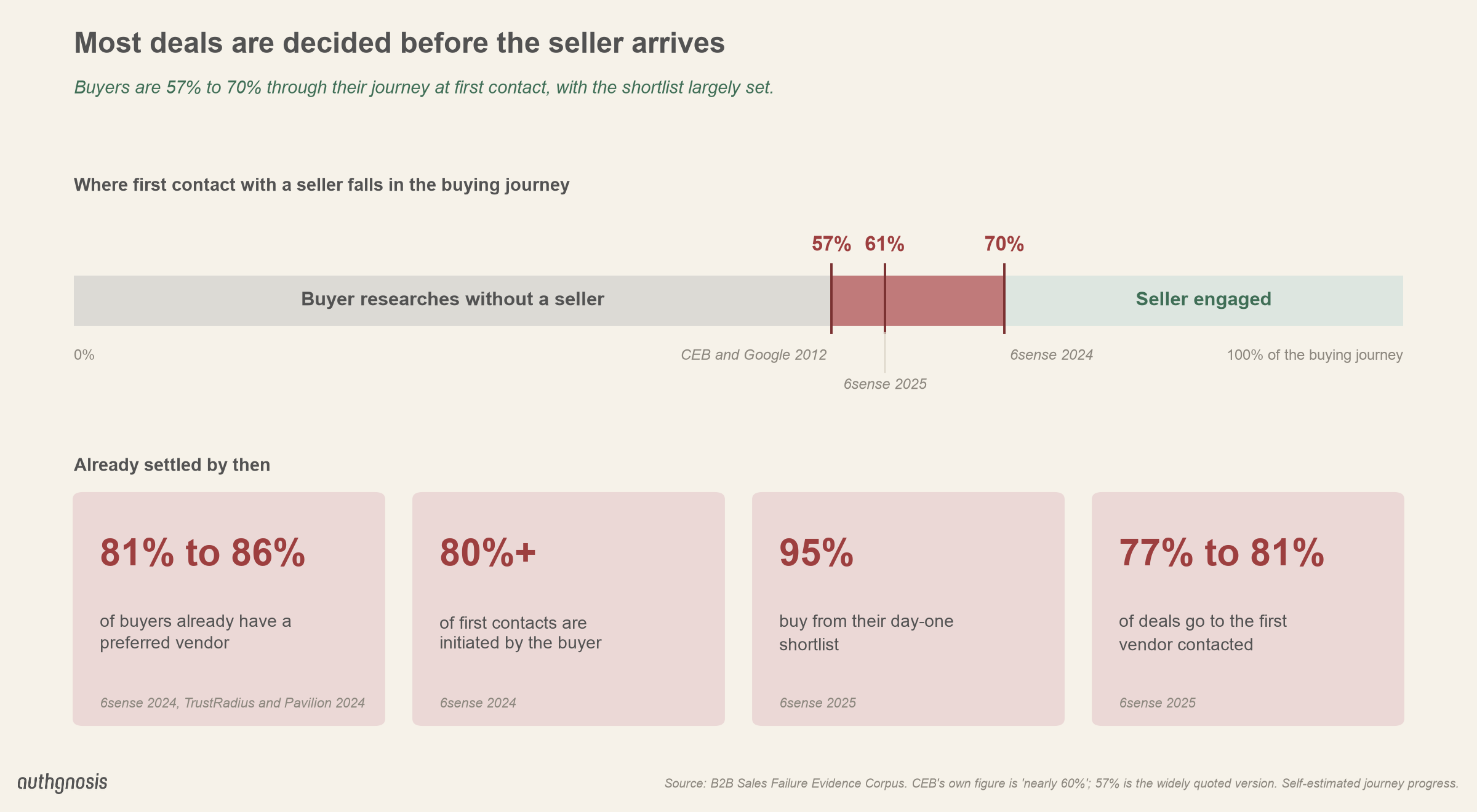
Much of Awareness failure happens before the rep is involved. The shortlist and first-vendor evidence says many deals are decided before first contact. For small and mid-size (SMB) vendors competing with larger rivals, the takeaway is that market coverage from marketing matters as much as rep skill here.
Here, failure takes two forms in the evidence: arriving too late and wasting the first touch.
Late arrival is the best measured. Buyers are 57% to 70% through the B2B buying process at first contact, and by then 81% to 86% already have a preferred vendor (CEB and Google 2012; 6sense 2024; 6sense 2025).
These failures originate in Marketing Signals, making both active outreach (email, events) and passive signals collection (website forms, user forums, free-trial product signals), and campaign management critical.
- Rep-free preference: 61% - 67% of buyers prefer a rep-free experience (Gartner 2025; Gartner 2026), which can suggest that Marketing retain the MQL and route the buyer to a self-serve free trial offer or targeted content to their interests to increase Signal gain before hand-off to Sales.

- A wasted first touch: 73% avoid suppliers who send irrelevant outreach (Gartner 2025), which makes the outreach design mission-critical. 69% saw inconsistencies between a supplier's website and what the rep told them (Gartner 2025), which makes close integration between Marketing and Sales and online/offline content critical.
- Lost meetings: only 76% of booked meetings are held as scheduled (RevenueHero 2024). This can often be a consequence of split responsibility for Lead response between SDR teams and Sales teams, together with poorly designed SDR KPI and compensation plans.
What sits within the seller’s control
The data tags the timing and preference findings as Customer and the website and capacity findings as Seller org. The first-touch findings are Rep. Governance owns coverage: ICP lists, campaigns, website message and SDR capacity. What the rep executes decides whether the one touch they get is worth it:
- Make the first touch relevant. This is the strongest rep-controlled lever at the stage. 73% of buyers drop suppliers for irrelevant outreach (Gartner 2025), and 72% chose the winner for its knowledge of their company (Demand Gen Report 2024, grade C). ICP fit-scoring, Account Brief generation, and proactive reframe email outreach are the mechanism; the rep's job is to use the Brief effectively.
- Earn the meeting on the call. Top-quartile reps convert conversations to meetings at 16.7% against 4.6% for average reps (Gong 2024). That gap is heavily influenced by a “call opener” (a Pain hypothesis presented to the prospect for concurrence) and its relevance to the prospect’s business, not volume.
- Use more than one channel. Adding phone calls as follow-ups to email outreach roughly doubles reply rates, 3.44% against 1.81% (Gong 2024). A reframe email followed by a call is the rep's to run. The same data shows the gap at each step of the call: top-quartile reps connect on 2.5x as many cold calls as average reps and convert 3.6x as many conversations to meetings (Gong 2024).

- Be the validator, not the brochure. 69% of buyers turn to reps to validate AI-generated insights (Gartner 2026). A buyer arrives having done some research, so the rep adds value by testing their conclusions (the Challenger reframe) rather than repeating the website or collateral content the buyer has likely already read.
- Stay consistent with the website. The website is marketing's (Gartner 2025), but the rep controls whether the call contradicts it. Knowing what the buyer has already read is part of the brief.
- Protect the booked meeting. With 24% of meetings not held (RevenueHero 2024), confirming and quickly re-booking cancellations or no-shows is the rep's discipline.
- Get in first where you can. You can't control when an inbound buyer arrives. On outbound, though, being the first to frame the problem is the only answer to the first-vendor advantage (6sense 2025). That makes campaign coverage the governance lever that sets up the rep's execution efficacy.
Where Awareness fits in the AISDALS/L lifecycle
Awareness is the second of the nine stages described in The Nine Stages of the AISDALS/L Enterprise Sales Lifecycle. How Marketing and Sales share the work of reaching buyers before and at first contact is covered in Selling Is a Team Sport: Cross-Functional Orchestration. The Sales Process-Customer Lifecycle CRM Visualization shows the process behind every stage.
How I can help
Through my Authgnosis consulting practice, I design and implement integrated sales, marketing, and customer success processes in your CRM system. I bring over 25 years of revenue leadership experience, data-evidenced research, best-in-class processes and methodologies, and my hands-on development and integration skills to plug pipeline leakage, reduce customer churn, and enable dependable revenue forecasts. If you would like to discuss your sales, marketing, and customer delivery challenges, reach out to me here.