
Sales Processes, Sales Methodologies, and Customer Lifecycles
A sales process and a customer lifecycle are two different views of a customer. The sales process is the most common view of a customer that most sellers have. A Lead is created, qualified as an Opportunity, and an Opportunity is managed by Sales to be closed as won or lost. It is a narrow, transactional view of the customer focused on one sale, and one customer at a time.
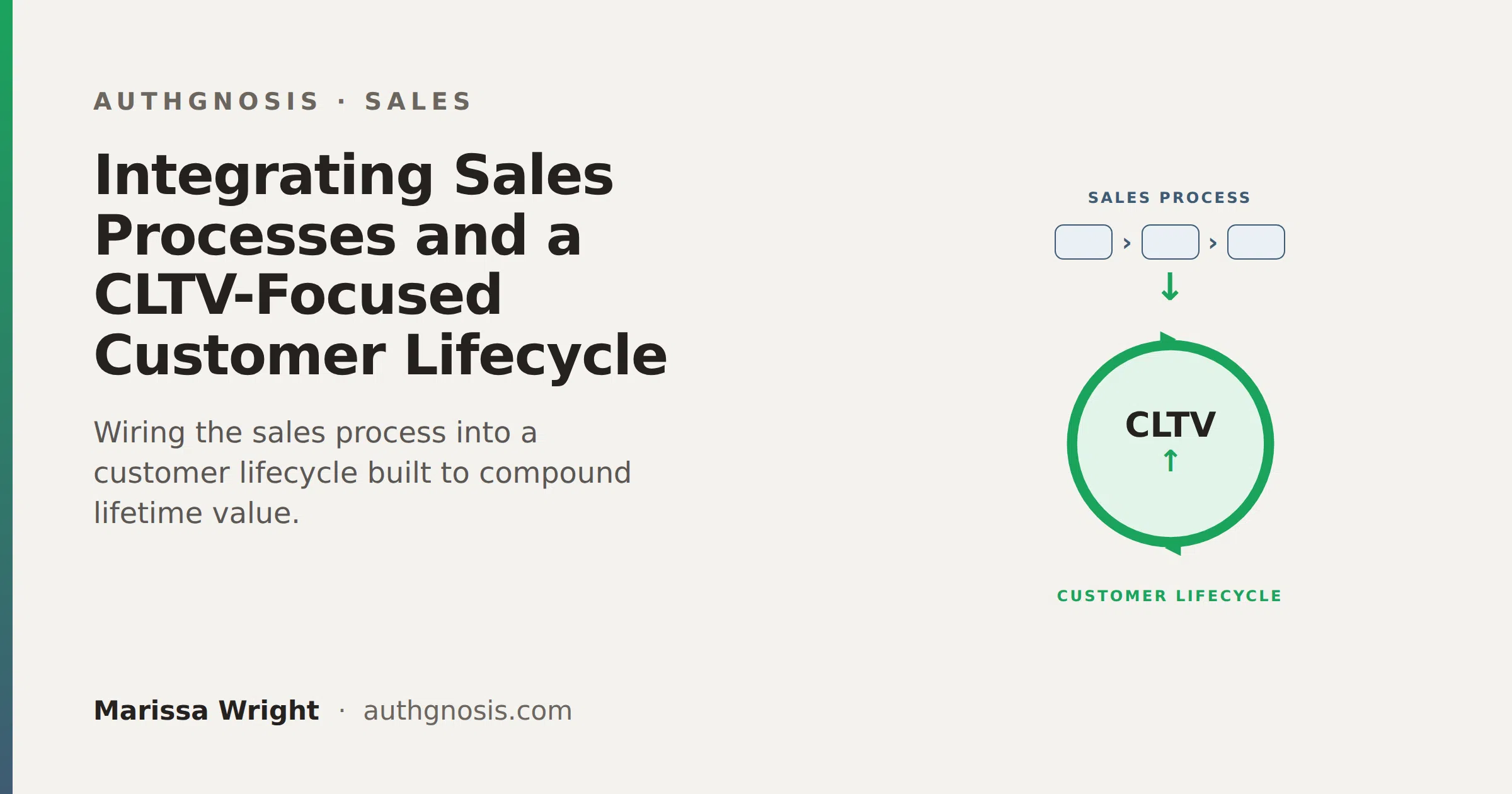
A customer lifecycle is a wider, long-term view of a customer. A customer lifecycle considers the customer lifetime value or "CLTV" across multiple sales. CLTV includes contract renewals or "retention", expansion of existing solutions within a customer, and the sale of new solutions to a customer.
Simply put, a sales process is the part of a customer lifecycle that focuses on contract value, and a customer lifecycle is the continuous flywheel of growth within a customer that focuses on customer lifetime value.
A sales process, by definition, is an incomplete view of the available revenue from a customer over the long-term. A customer lifecycle is the complete view.
Sales Process
A sales process generally starts when a Lead is generated, either by Marketing as a Marketing Qualified Lead (aka MQL), or generated by Sales (an unqualified Lead), and they go through a "qualification process" by a salesperson to become a Sales Qualified Lead (aka SQL).
Once a Lead is qualified as an SQL, a salesperson continues to manage the Lead through a discovery process to better understand the nature of a prospect's problems, and educate a prospect on their solutions to those problems. Once the problem is well understood and the customer expresses interest in the salesperson's solution, a Lead becomes a qualified Opportunity.
For companies using Customer Relationship Management (CRM) systems, Sales processes operate through Stages that represent a customer's decision process.
There is no real standard set for what these Stages are. Some organizations operate with the default settings in their CRM, and some customize these Stages according to the preferences of their sales leadership and according to their interpretation of how their customers buy.
Sales Process Stage Comparison (CRM platforms, out of the box)
| Platform | Default Stage / Label Name | Default Win Probability |
|---|---|---|
| Salesforce | 1. Prospecting 2. Qualification 3. Needs Analysis 4. Value Proposition 5. Id. Decision Makers 6. Perception Analysis 7. Proposal/Price Quote 8. Negotiation/Review 9. Closed Won 10. Closed Lost | 10% 20% 40% 60% 70% 80% 90% 95% 100% 0% |
| Microsoft Dynamics 365 Sales | 1. Qualify 2. Develop 3. Propose 4. Close | Driven by historical tracking or manual seller confidence scoring rather than hard-coded percentages. |
| HubSpot CRM | 1. Appointment Scheduled 2. Qualified to Buy 3. Presentation Scheduled 4. Decision Maker Bought-In 5. Contract Sent 6. Closed Won 7. Closed Lost | 20% 40% 60% 80% 90% 100% 0% |
| Zoho CRM | 1. Qualification 2. Needs Analysis 3. Value Proposition 4. Identify Decision Makers 5. Proposal/Price Quote 6. Negotiation/Review 7. Closed Won 8. Closed Lost | 10% 20% 40% 60% 75% 90% 100% 0% |
As you can see from Table 1 above, every CRM provides a different definition of what a sales process looks like. More importantly, you can see where they all end at Won, Lost, or Closed.
Sales Methodologies
Sales methodologies are the strategic frameworks, tactics, and behaviors that are applied in different stages of a sales process. They don't define the sales process; they define what is done within the process.
The most well-known sales methodologies, BANT, MEDDPICC, SPIN, Miller Heiman, Challenger, and Sandler, are described in Table 2 below:
| Sales Methodology | Primary Focus | Behavioral Philosophy / Lens | Best Suited For Defining... |
|---|---|---|---|
| BANT | Qualification | Simple, transactional sorting filter. | The exact milestone where a Lead becomes an Opportunity. |
| MEDDPICC | Enterprise Risk Management | Risk mitigation checklist for complex B2B buying panels. | The strict exit criteria required to move an Opportunity between late-stage gates. |
| SPIN / Solution | Consultative Discovery | Investigative questioning based on downstream business implications. | The early-to-mid Opportunity discovery and value proposition stages. |
| Miller Heiman (TAS) | Strategic Account Navigation | Multi-stakeholder alignment and red-flag identification. | Managing Opportunity stages involving large committees and procurement. |
| Challenger Sale | Insights-Driven Pitching | Teaching the buyer a new perspective and controlling the dialogue. | Shaping the early Opportunity demo and presentation stages. |
| Sandler Selling System | Mutual Commitment & Qualification | The Sandler Submarine (compartmentalized stages to prevent "unpaid consulting"). | Establishing clear entry criteria for early-stage discovery and disqualifying bad fits fast. |
As you can see from Table 2 above, sales methodologies end within the sales process at Won, Lost, or Closed. You can also see that none of the methodologies are complete: they all address what their authors perceive as weaknesses in salespeople's execution of the sales process.
In my experience, sales leaders tend to focus their sales team coaching on methodology, even though salesperson behaviors account for approximately 23% of the reasons for deal failure.
Customer Lifecycles
For more than a century, the marketing funnel has been a hand-me-down. AIDA: Attention, Interest, Desire, Action was sketched by E. St. Elmo Lewis in the 1890s to describe how an advertisement moves a stranger toward a purchase. Almost everything that followed is a variation on that theme: AIDAS bolted "Satisfaction" onto the end; Colley's DAGMAR reframed the path as Awareness–Comprehension–Conviction–Action so that advertising goals could be measured; Lavidge and Steiner's Hierarchy of Effects stretched it into six cognitive-affective-behavioral steps; and Kotler's modern 5A: Aware, Appeal, Ask, Act, Advocate finally acknowledged that connected customers talk to each other.
These are good models. They are also, largely, advertising models. They were built to explain how a message lands on an individual consumer, not how a buying committee of fifteen people spends two million dollars over nine months.
However, when I came across the AISDALS/L model: Awareness, Interest, Search, Desire, Action, Like, Share, and Love, it strongly resembled an modern enterprise SaaS customer lifecycle.
AISDALSLove was introduced by Bambang Sukma Wijaya in 2011 and published in 2012, as an extension of AIDA built for socially connected buyer behavior:
- It inserts a Search stage before purchase that represents how customers are 57–70% through their journey before engaging a rep, 81–86% already have a preferred vendor, and 95% buy from their day-one shortlist.
- It adds Like, Share, and Love after the sale is Closed, representing post-sale delivery, measured outcomes, customer peer influencing, and enables an expansion flywheel of business within existing customers.
My integration of sales process, sales methodologies, and customer lifecycle expansion maps Wijaya's marketing lifecycle onto a modern enterprise technology sales and delivery cycle. Cross-functional sales, engineering, partner, and success teams integrate against the AISDALS/L customer lifecycle, and promotes selling into existing customer "whitespace" and growing Customer Lifetime Value (CLTV) rather than one-and-done sales processes that focus on Annual Contract Value (ACV).
To that mapping I added a single stage up front: Signals, for enterprise demand sensing where there are online Marketing signals such as freemium downloads, product trials, etc. AISDALS/L is the first customer lifecycle I've found that fits the way enterprise technology solutions actually get bought, sold, delivered, and expanded.
This series explains why, walks through each stage and the sales process I've mapped to it, and shows how four sales methodologies and four cross-functional teams turn the model from a diagram into an operating system for revenue.
Where a Marketing AISDALS/L customer lifecycle aligns best for enterprise selling
Four structural gaps separate advertising funnels from enterprise selling reality:
- Most of the classics miss the Search stage enabled by web-accessible information. AIDA jumps from Interest straight to Desire, as if wanting the product were a feeling that simply arrives. In enterprise technology, the gap between "this is interesting" and "I want this" is the single most expensive part of the cycle: technical discovery, architecture review, proof of value, competitive bake-offs, security and procurement diligence.
- Buyers actively search and evaluate. The instinct to name this explicitly isn't new: the AISAS model (Attention, Interest, Search, Action, Share) recognized decades ago that connected buyers research and then talk, and AISDALS/L inherits that insight and extends it, making Search a first-class stage. It's exactly where many complex deals are won or quietly lost.
- Classic customer lifecycle models end at the Close of a transaction. AIDA ends at Action. AIDAS tacks on Satisfaction to AIDA. But in a subscription and consumption economy, and for companies that sell a broad range of related solutions to each customer, the sale is the beginning of the value relationship, not the end of it.
- Classic customer lifecycle models treat the customer as an island. This is where AISDALS/L aligns with something deeper than an ACV-focused opportunity funnel, particularly where new products are introduced or new markets are entered.
I noticed these structural gaps when modelling new market entry growth based on Everett Rogers' Diffusion of Innovations. The Rogers model is a critical market entry and expansion model that predicts the impact of buyer socialization and influence by specific types of buyer profiles on early-stage growth.
For a new market entrant or a company expanding their solution footprint, Innovators and Early Adopters are not just early revenue: they are a mission-critical marketing channel that depend on post-sale success and expansion that most sales processes do not account for.
At first glance, the growth curves in Figure 1 might be interpreted as overly-optimistic growth estimates. However, it is critical to understand that the model depends on:
- Effective targeting of different buyer profiles according to each stage of growth
- Well-defined success criteria being met post-sale
- Maximizing the solution footprint within each customer
- Sales of complementary or new products into the existing customer base
Also of note: it is specifically the Early Adopters, not the venturesome but high-risk Innovators, who become the trusted reference group that pulls the more pragmatic Early Majority across Geoffrey Moore's "chasm." Their willingness to share their experience across professional networks is what makes or breaks a company's ability to scale beyond 1-5 customers, which is precisely the requirement a new market entrant or new product introduction has to plan for. 56% of tech buyers sought a peer conversation before buying, while vendors estimated 34% (TrustRadius 2024). Sellers who don't set up references leave that peer influence to chance.
48% to 63% of new ARR comes from expansion as companies scale (Sapphire Ventures 2024). Customer Success-sourced opportunities have the highest win rate of any source (ICONIQ 2026). For sellers to fully realize their growth potential, they will need to implement tailored, integrated, cross-functional customer lifecycle process flows and focus on CLTV growth. They can't simply depend on the narrow, ACV deal-focused out-of-the-box sales process models in their chosen CRM systems.