
Business Growth Consulting Portfolio
Client deliverables drawn from 25 years of revenue and P&L ownership, spanning business growth consulting, GTM leadership, and commercial due diligence.

How Can I Grow My Business?
It would be great to be lucky being in the right place at the right time with the right product. I don't believe in luck: I believe in having an evidence-based strategic plan.


















At a Glance
Selected Client Outcomes
$40M+client capital raised
2xACV growth
90%+renewals, up from 75%
$22Mrevenue, up from $12M
Interactive Model
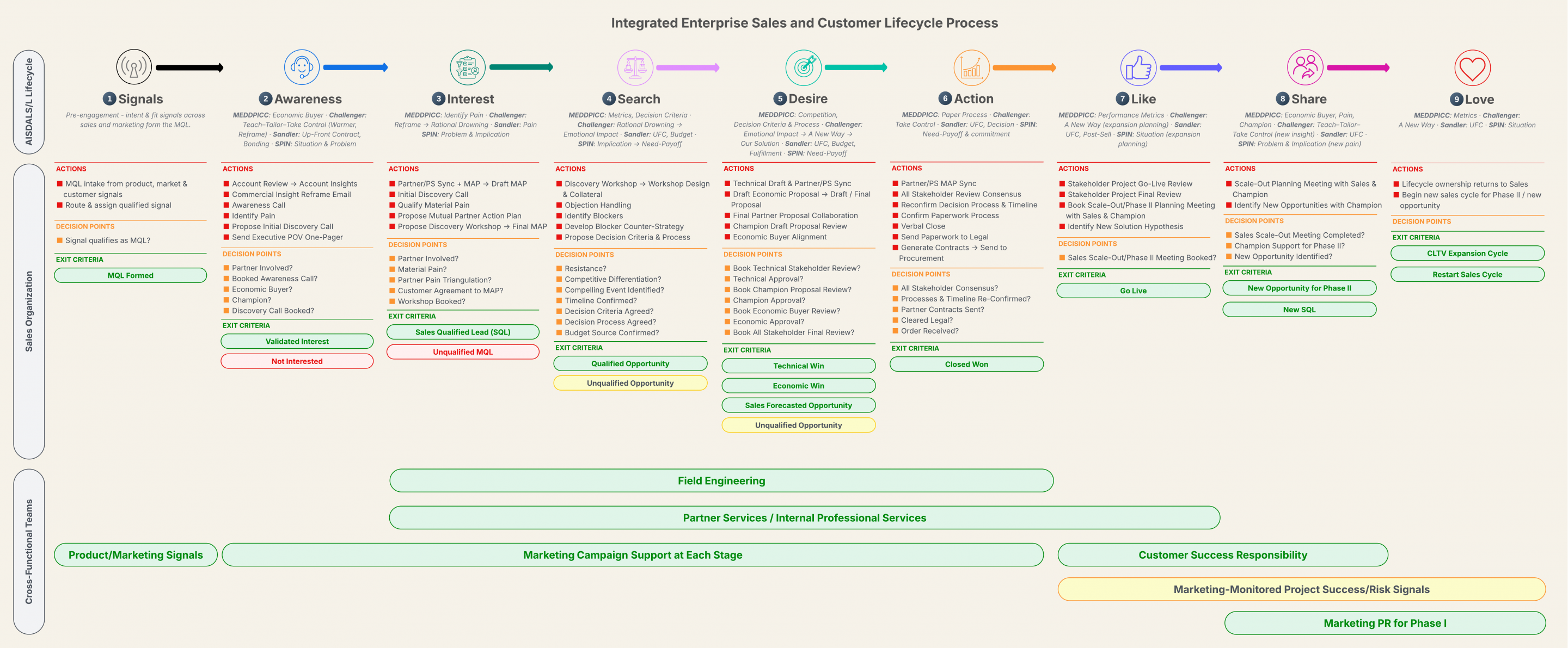
Interactive Sales Process Visualizer
This enterprise sales process is mapped to a continuous-flywheel customer lifecycle for CLTV growth. It uses automated Microsoft Power Automate workflows and Microsoft AI Builder analytics and automations to remove 46% of salesperson steps and 81% of the human time a deal costs, about 94.4 hours per deal.
Select the Salesperson, Automation, AI, Captured Data, and Critical Milestone chips to isolate functions
Select each Stage to see what occurs for each Layer
Hover over elements to show Tooltips that describe their purpose
Selected Engagements
Explore the work
Filter by capability, then open any card for the challenge, approach, and outcome.
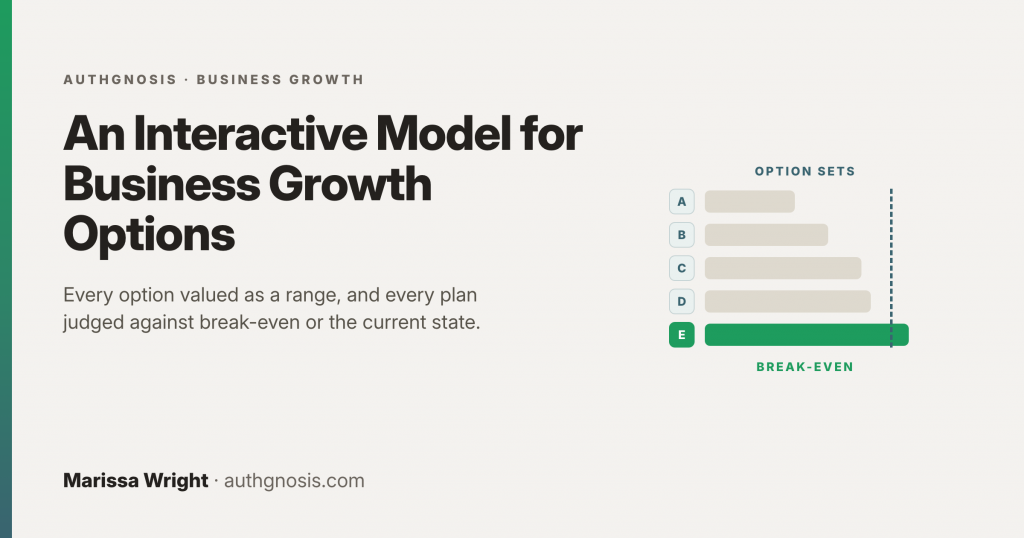
Interactive Growth Options Model for Business Growth Decisions
Fourteen growth options reduced to five, each valued as a range and judged against break-even or the current state.
Challenge
Management teams choosing among growth options rarely see each option’s cost, range of outcomes, and effect on the others in one place. Plans therefore tend to carry too many initiatives and to overstate their first-year return.
Approach
I built an options model that values each option at a cautious, middle, and strong setting and states the basis of every figure. It counts overlapping gains once, converts capacity limits into hiring cost, and adjusts each option for the market’s stage on the adoption curve. The published version uses a fictional software company with invented figures.
Outcome
Every combination of options is judged against the company’s break-even where it is seeking sustainable profitability, or against its current state where it is seeking a new growth curve. A management team can see which plans clear the benchmark, which clear it only when everything goes well, and how the ranking changes with the market’s stage.

Website Design and Build for a Smart City IoT Company
Site traffic, search click through, and content engagement rose more than 1,500% year over year.
Challenge
The client sold internationally, but its website was a basic stand up that did not carry the company. It had no narrative arc and no stated strategic position. It also lacked the material a serious buyer or investor looks for: product data sufficient for customer due diligence review, investor information, company leadership information, and clear value proposition messaging.
Approach
I designed the site, developed it alongside the client’s team, maintained it, and created all of its content. It runs on WordPress, built with Divi.
Outcome
Site traffic, search click through, and content engagement were up more than 1,500% year over year as of February 2026.
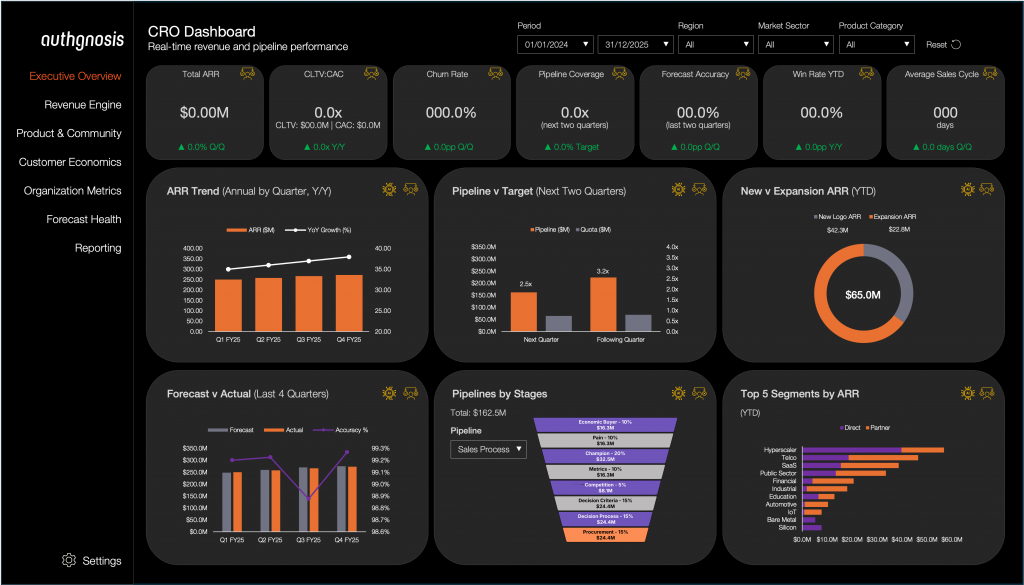
Revenue Performance Dashboard Prototype for a Chief Revenue Officer
A prototype answering which measures a Chief Revenue Officer's dashboard should actually surface.
Challenge
This prototype was designed to answer a single question: what KPIs should a Chief Revenue Officer’s dashboard surface? It is built for a large enterprise CRO, and concentrates on pipeline health, forecast quality, and customer lifetime value (CLTV) growth, which is the measure most often missed.
Approach
The design covers top level revenue KPIs, product and community based marketing signals, customer success metrics, organizational KPIs, forecast health tracking, and data analytics driven by artificial intelligence.
Outcome
Balanced scorecards generate from settings that define company goals and objectives, so the board adapts as targets change rather than being rebuilt.
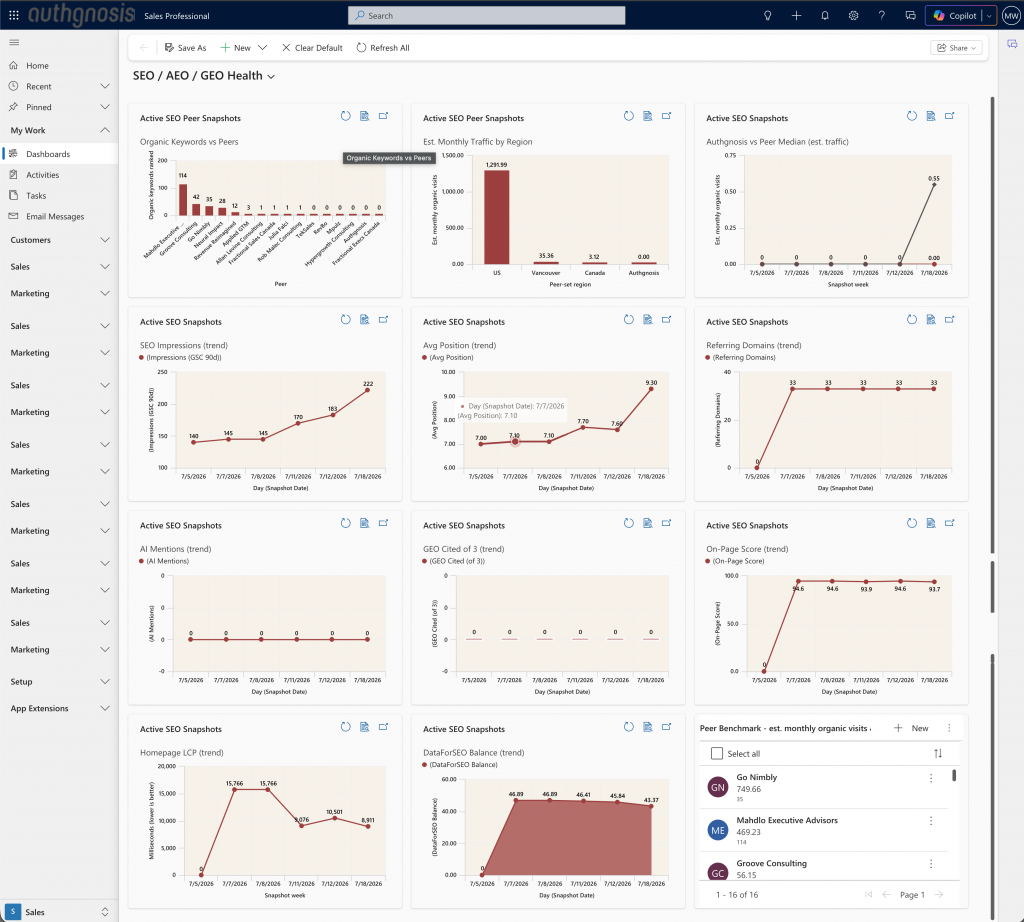
SEO, AEO and GEO Health Dashboard in Microsoft Dynamics 365
Ranking, authority, technical health, and AI citation presence in one live Dynamics 365 board.
Challenge
Discovery is shifting from links to AI answers. The signals that matter, being traditional rankings, answer engine visibility, and generative engine citations, were not measurable in one place.
Approach
A weekly automated agent built with Claude Code pulls Google Search Console, DataForSEO, and PageSpeed data, writes a snapshot to a custom Dynamics 365 table, and surfaces it as trend charts and peer benchmarks. It tracks organic keyword rankings and estimated traffic against a competitor set, Search Console impressions and average position, referring domains, on page score, homepage Core Web Vitals, and AI mentions.
Outcome
Ranking, authority, technical health, and AI citation presence land in a single view: the early signal that demand generation and revenue operations teams need as discovery moves toward AI answers.
Competitive Landscape Analysis for Public Sector Bids
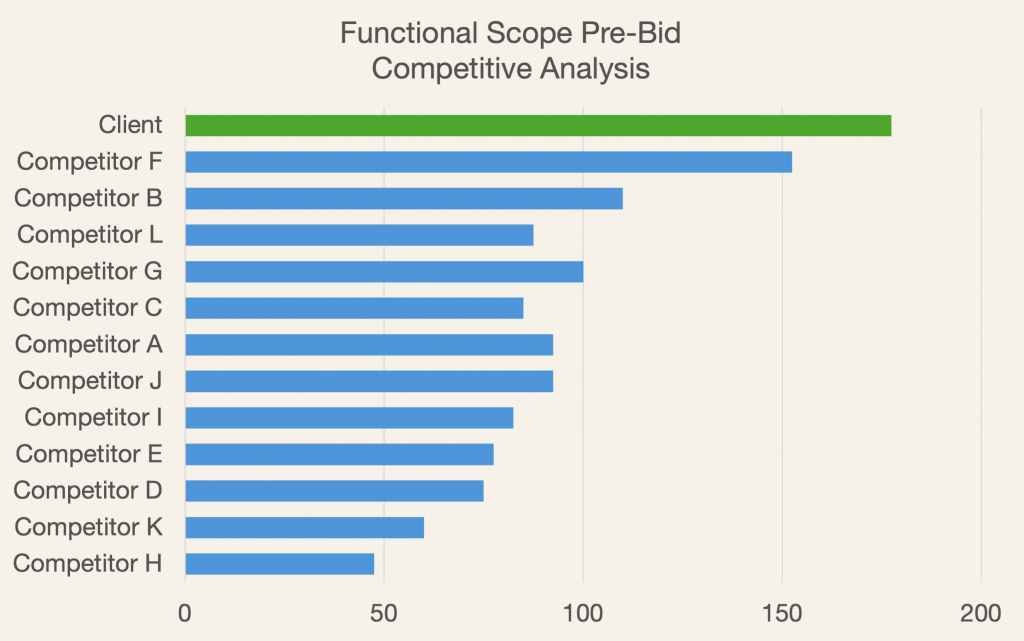
Over 40 functional attributes across 12 competitors, weighted to predict win probability on any bid.
Challenge
Bid decisions were being made without a reliable read on where the product stood against twelve competitors, or on how pricing and functionality would interact with a given scoring methodology.
Approach
I monitored product functional scope changes across 12 market competitors on a continuing basis, and used research and freedom of information requests to track their pricing strategies. The model applies a weighting, so that for any competitive bid, over 40 functional attributes across 12 competitors could be assessed against that bid’s specific requirements.
Outcome
The model produced a probability of success, and showed how pricing and functionality interacted with each bid’s scoring methodology. That was sufficient to decide whether to pursue a public tender, what the pricing strategy should be, and how to respond to changes in the competitive landscape.
Public Tender Bid Scoring Analysis
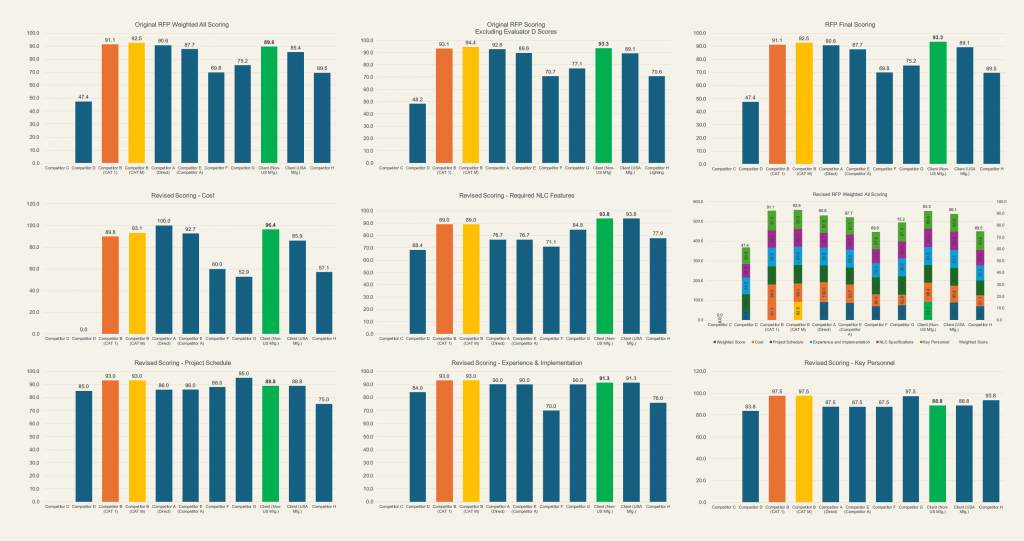
Analysis established that the highest scoring bid had been passed over, and the city settled.
Challenge
After writing and submitting a request for proposal (RFP) response on behalf of a client, the bid was neither short listed nor awarded. The competitive model had predicted a first or second position out of ten vendors, so the result warranted examination.
Approach
I used a competitive analysis model I had created earlier to predict the bid score within plus or minus 5%. I then submitted a freedom of information request to obtain the city’s bid scoring data and competitor responses, and ran the analysis again against the actual numbers.
Outcome
The analysis showed that we had submitted the top scoring bid. After discussions, the city offered a significant monetary settlement and an admission that it had failed to properly award the contract.
Smart Lighting and Streetlight Cost Benefit Model
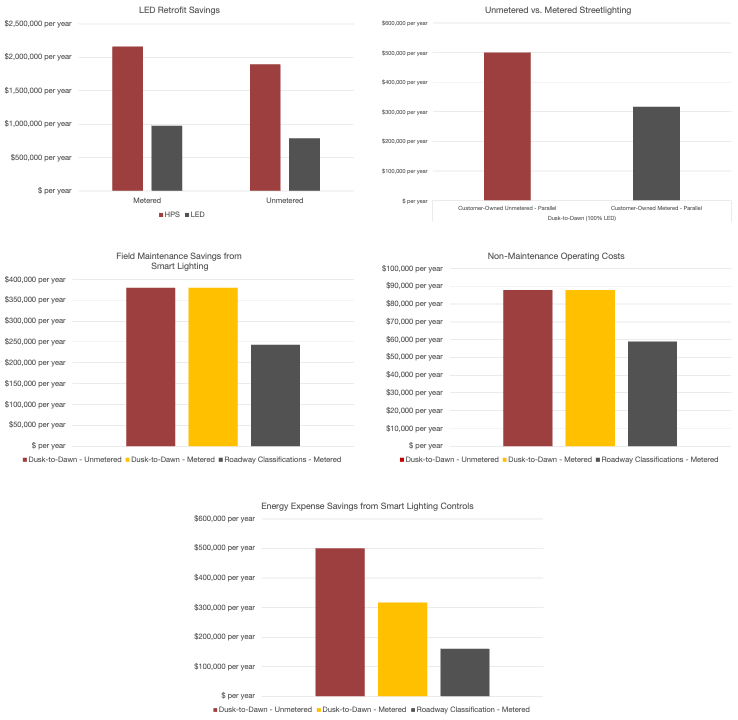
A municipal business case model covering operating cost, emissions, asset lifecycle, and financing route.
Challenge
Municipalities evaluating LED retrofits and smart lighting controls needed a defensible view of current state costs and emissions, and of what actually changes after a project, including how dimming affects asset lifecycles.
Approach
I developed a detailed cost benefit model assessing current state municipal streetlighting operating costs and greenhouse gas (GHG) footprint, costs and footprint before and after both LED retrofit and smart lighting controls projects, and the effect of dimming on streetlight asset lifecycles. It draws on municipal open data streetlight assets, ANSI RP-8 roadway classification and dimming standards, and the specific utility rate plan for each city.
Outcome
The model adapts to self financed budget appropriations, bond issues, or energy services contract financing, so the same analysis supports whichever funding route a city takes.
Solutions Guide Design
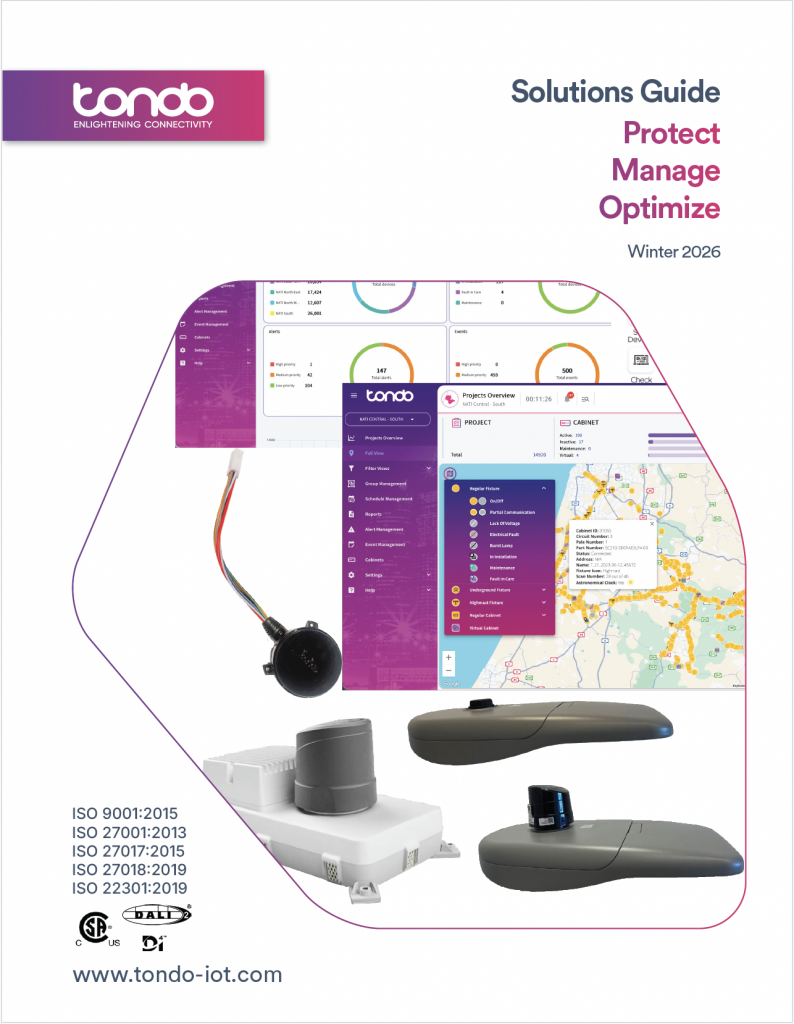
Product cut sheets pulled into a solution narrative, with a competitive comparison at the close.
Challenge
The client had product cut sheets, but they were not collected in a solution context. The Solutions Guide pulls the product data together into a narrative flow, opening with a solution lens preface and closing with a competitive comparison.
Approach
I designed and created the guide and all of the content within it in Adobe InDesign, using Adobe Illustrator, Pixelmator Pro, SketchUp 3D, and LucidChart. It features a hyperlinking table of contents to sections, a reusable categorized media library, and structured formatting built for scale.
Outcome
The categorized media library enables team based maintenance and readability, and the structured formatting allows new products to be added without rebuilding the document.
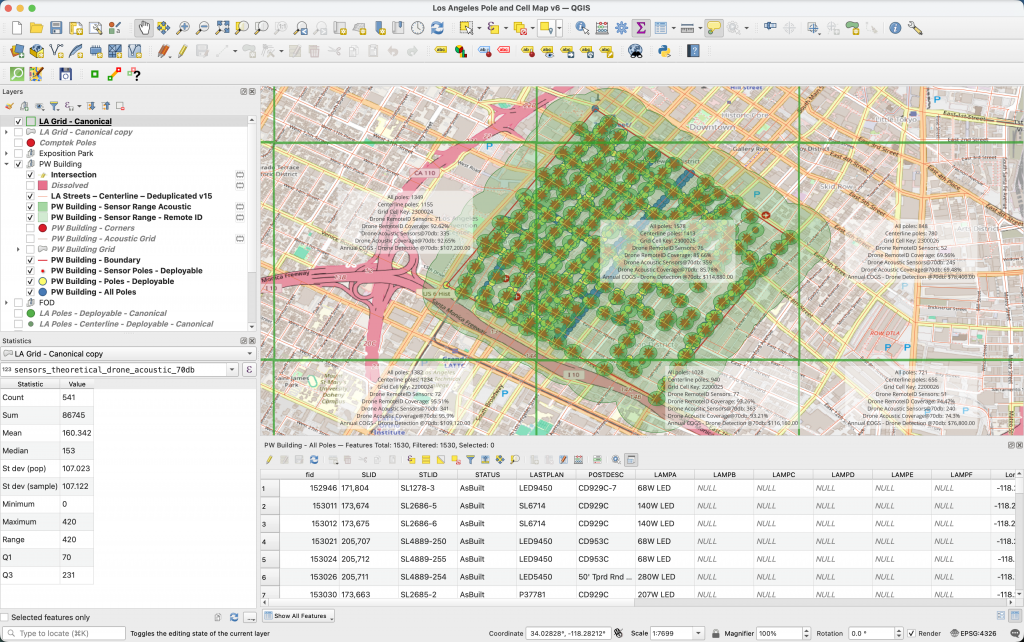
Sensor Placement Optimization with GIS Modelling
Validated project costs, and produced accurate quotes for deployments of any size.
Challenge
Quoting sensor deployments accurately requires knowing where the sensors should go, and that depends on each customer’s actual asset inventory and locations rather than on an estimate.
Approach
I developed a geographic information system (GIS) model to optimize the placement of sensors, using customer asset inventory and location data for accuracy.
Outcome
The model validated project costs and enabled rapid generation of accurate price quotes for projects of any size. It adapts to any customer environment, working from open data or from a structured internal asset inventory.
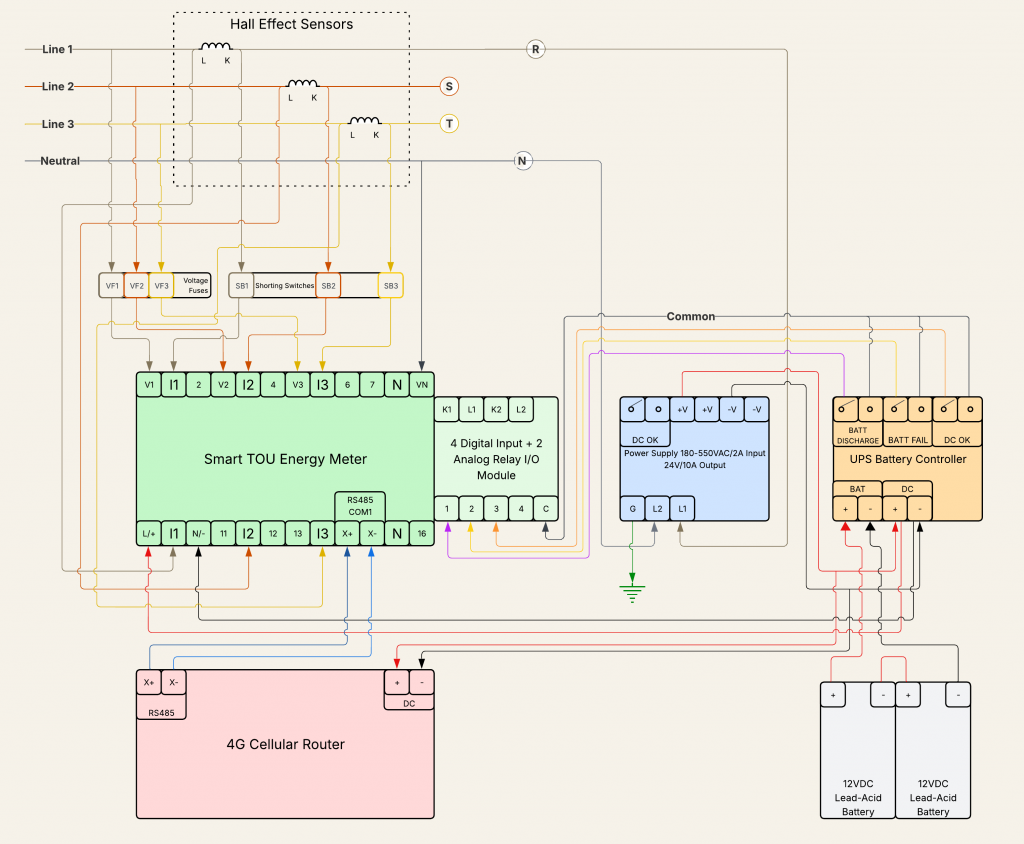
Technical Wiring Diagram for Installation Documentation
Installation documentation built from vendor sources, so the tender response could proceed.
Challenge
Preparing request for proposal (RFP) responses on behalf of a client required User and Installation Guides that did not exist. The solution was assembled from several off the shelf components that were field wired and installed. The client’s existing diagram was not detailed enough for the purpose, and the development team was unavailable.
Approach
I created the diagram in LucidChart, working from the client’s existing diagram and from the installation guides of each component vendor in order to confirm accuracy.
Outcome
The diagram served the installation and user guide, and, as an insert, the technical specifications cut sheet.

3D Product Visualization for Marketing Collateral
Renderings showing what a deployed solution looks like across a range of use case scenarios.
Challenge
The renderings were created for insertion into marketing collateral, to illustrate a variety of use case scenarios for the client’s solutions. They are aimed at visual learners, so that the problem the client’s solutions solve can be understood without reading a specification.
Approach
I developed the 3D model using Trimble SketchUp 3D, and produced a series of illustrations from it.
Outcome
The images helped customers visualize the aesthetic impact of a deployed product.
Let's Discuss!
If something here looks like your problem, a first conversation is free and carries no obligation.