
In the article series, The Six Drivers That Drive Business Growth, I describe these six drivers and offer high-level examples for each, and offer a free copy of my Growth Strategy Checklist (get it here). In this article, I dive deeply into a real world case of how I applied a Comprehensive Framework for Strategic Analysis1 to create a strategic growth plan for Maximizer Software in 2013.
The situation: a growing market, a declining share of new customers
Maximizer competed in a CRM market growing at roughly 12% per year, against a target base of more than three million businesses that had not yet adopted a solution. Despite that, the company had been unable to sustain revenue growth or profitability over the three years ending November 2012.
Revenue from new customers was declining faster than total revenue, which indicated the company was losing its ability to win new logos rather than simply facing a soft market.
The diagnosis: a low defensible position in a crowded horizontal market
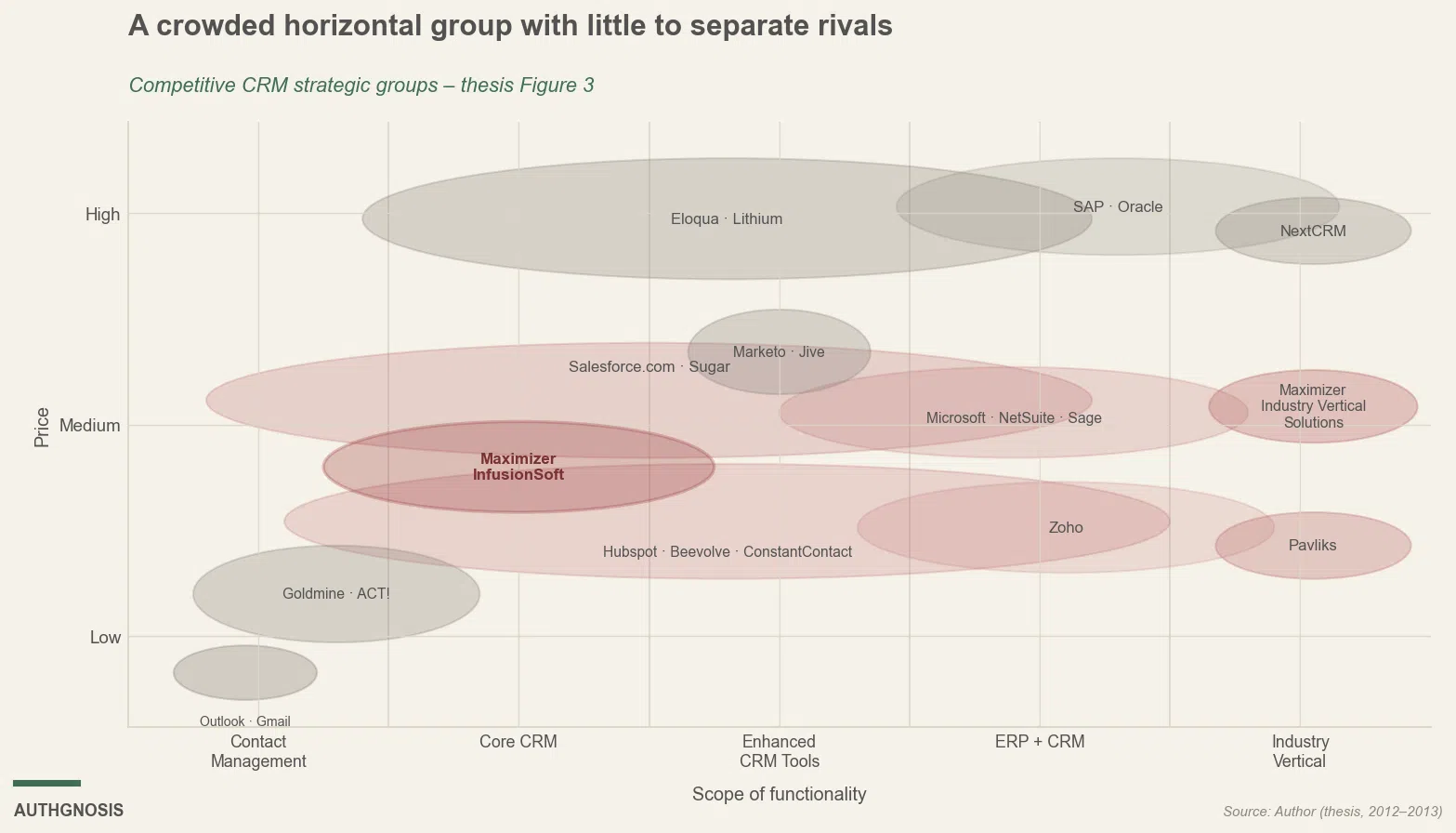
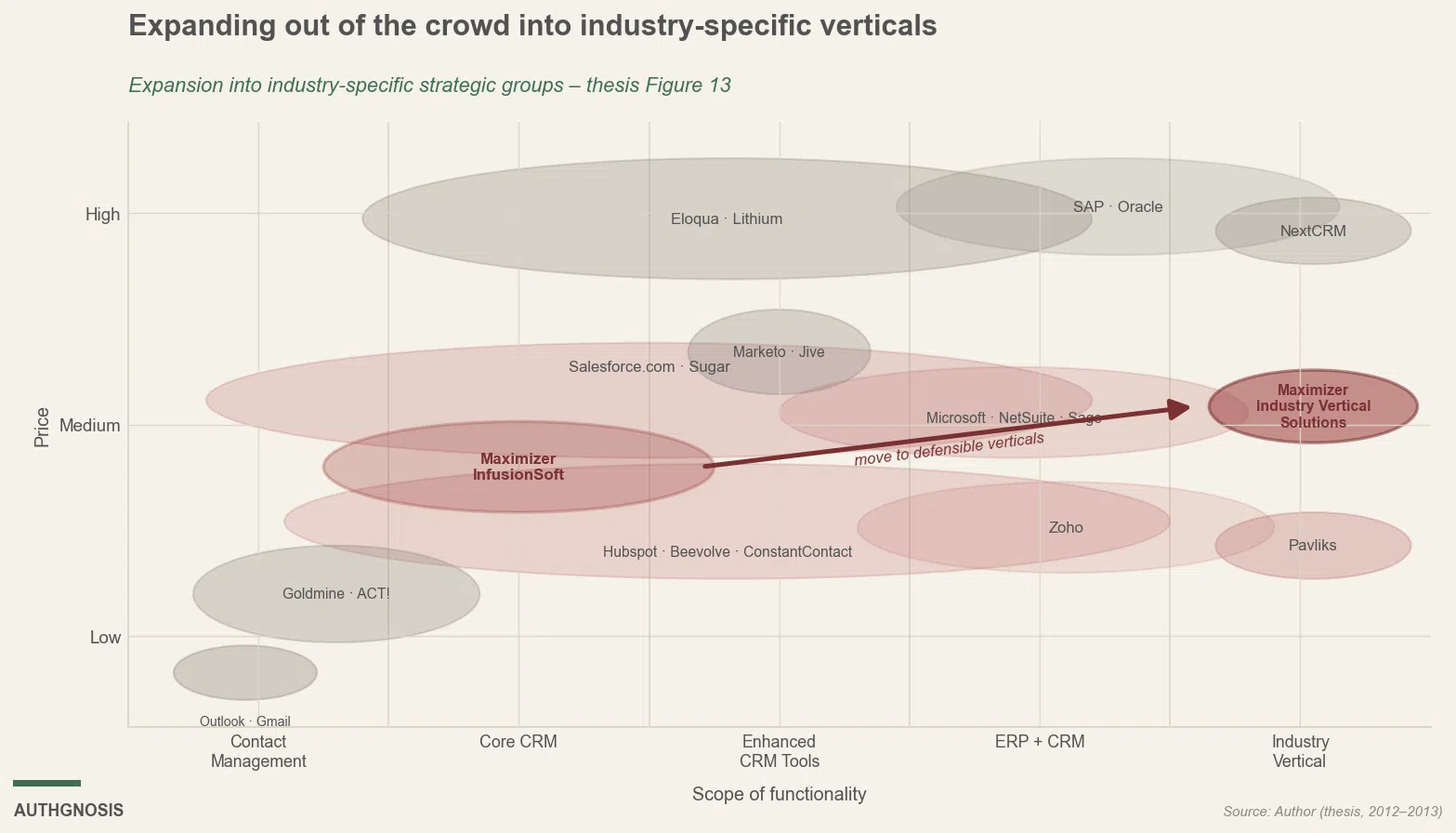
The external analysis explained why. Mapping the market into strategic groups showed Maximizer positioned in a dense horizontal segment alongside many similar vendors, with little to separate it from most rivals on either price or scope of functionality.
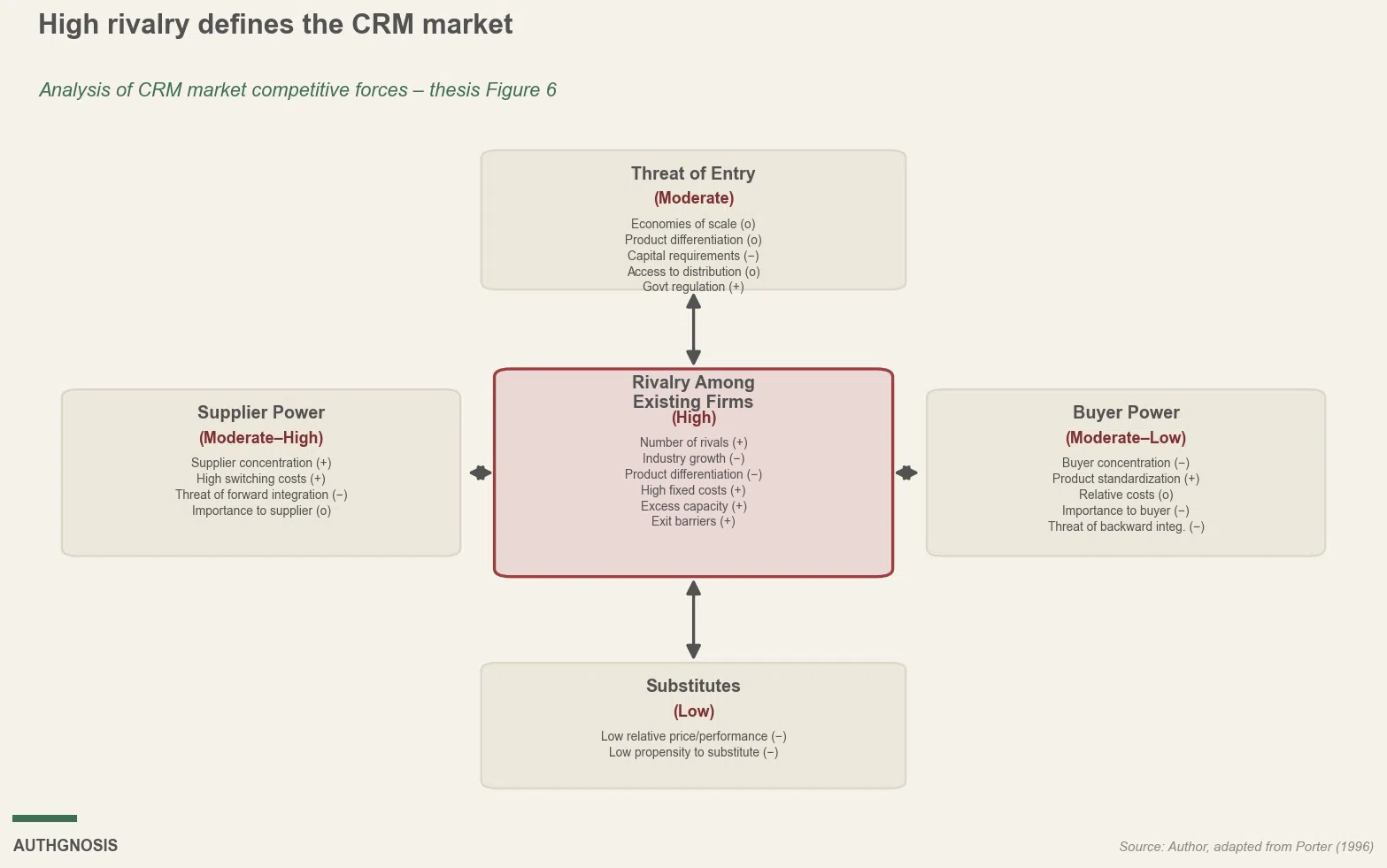
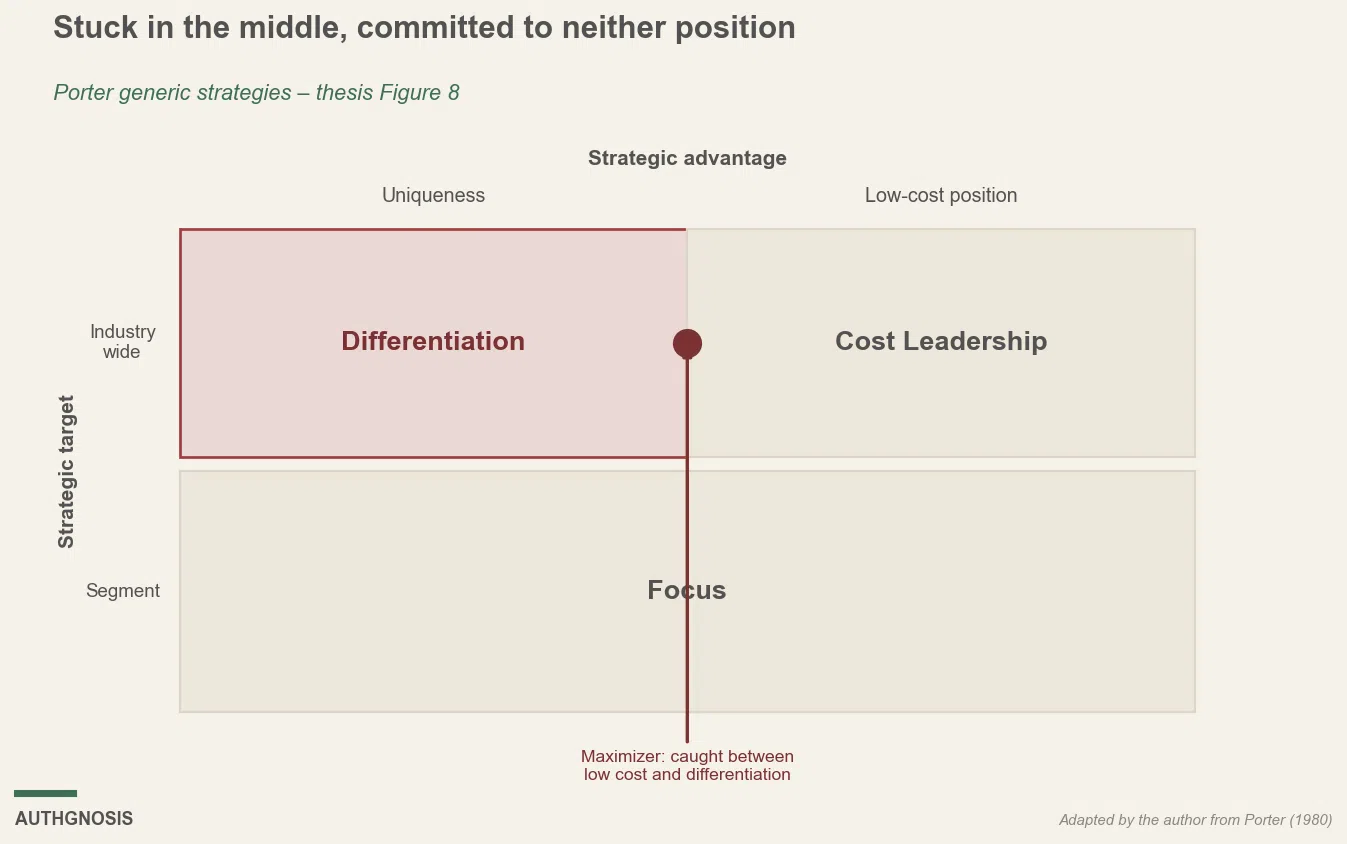
The competitive-forces analysis pointed to high rivalry, and the generic-strategy view showed the company caught between low-cost and differentiation rather than committed to either.
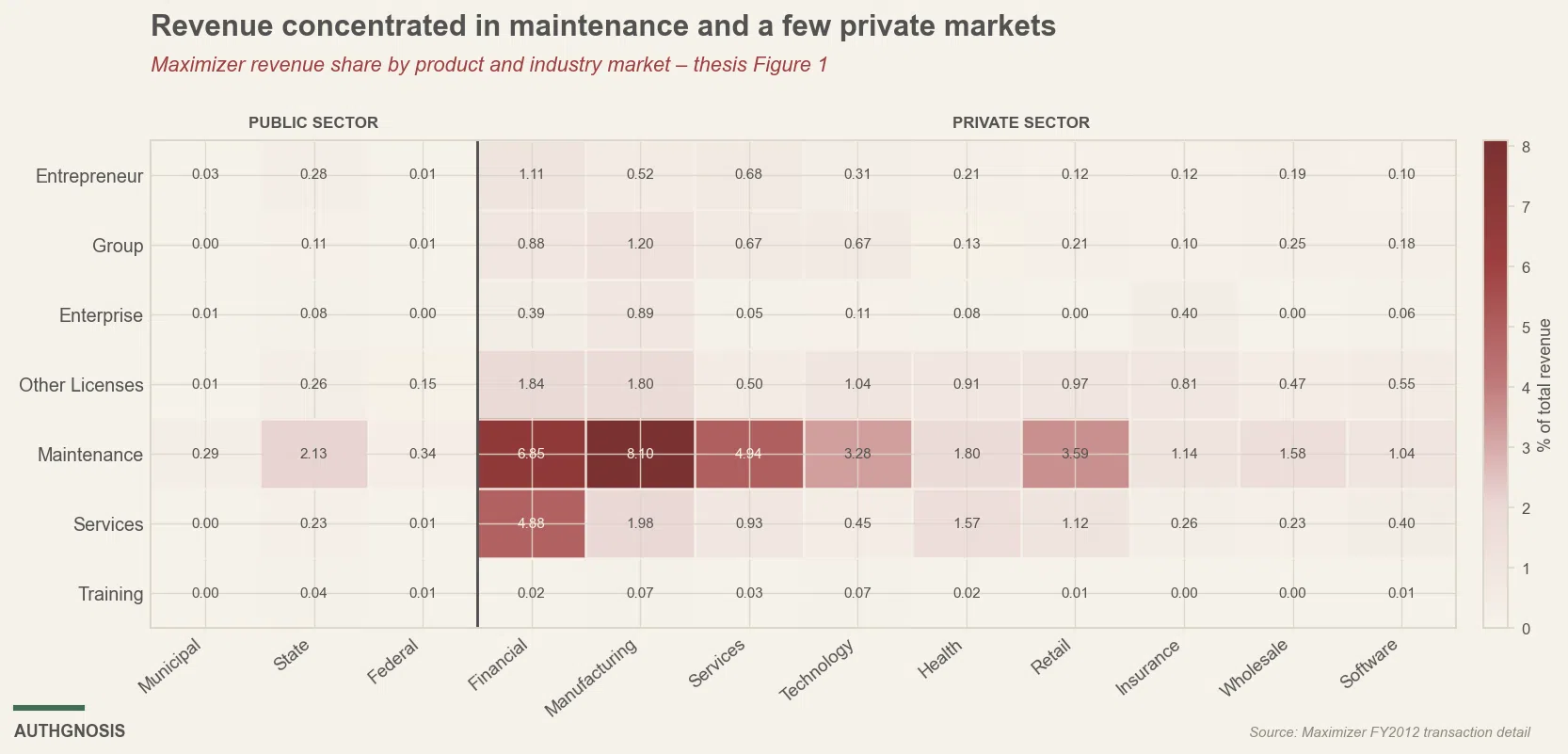
The internal analysis found capable resources that were not being converted into advantage: with one telling exception. The firm already held a genuinely defensible position in a single segment, Financial Advisors, where it had won and retained customers against the same broad-market rivals, and had a deep understanding of that market segment.
However, the company was still selling the same generic CRM software to that segment, and leaving it up to their customers to tailor the product to fit their needs, or hire Maximizer or partner professional services to do the customization work. This prevented the company from being able to capture the tailor-to-fit value within a recurring revenue stream.
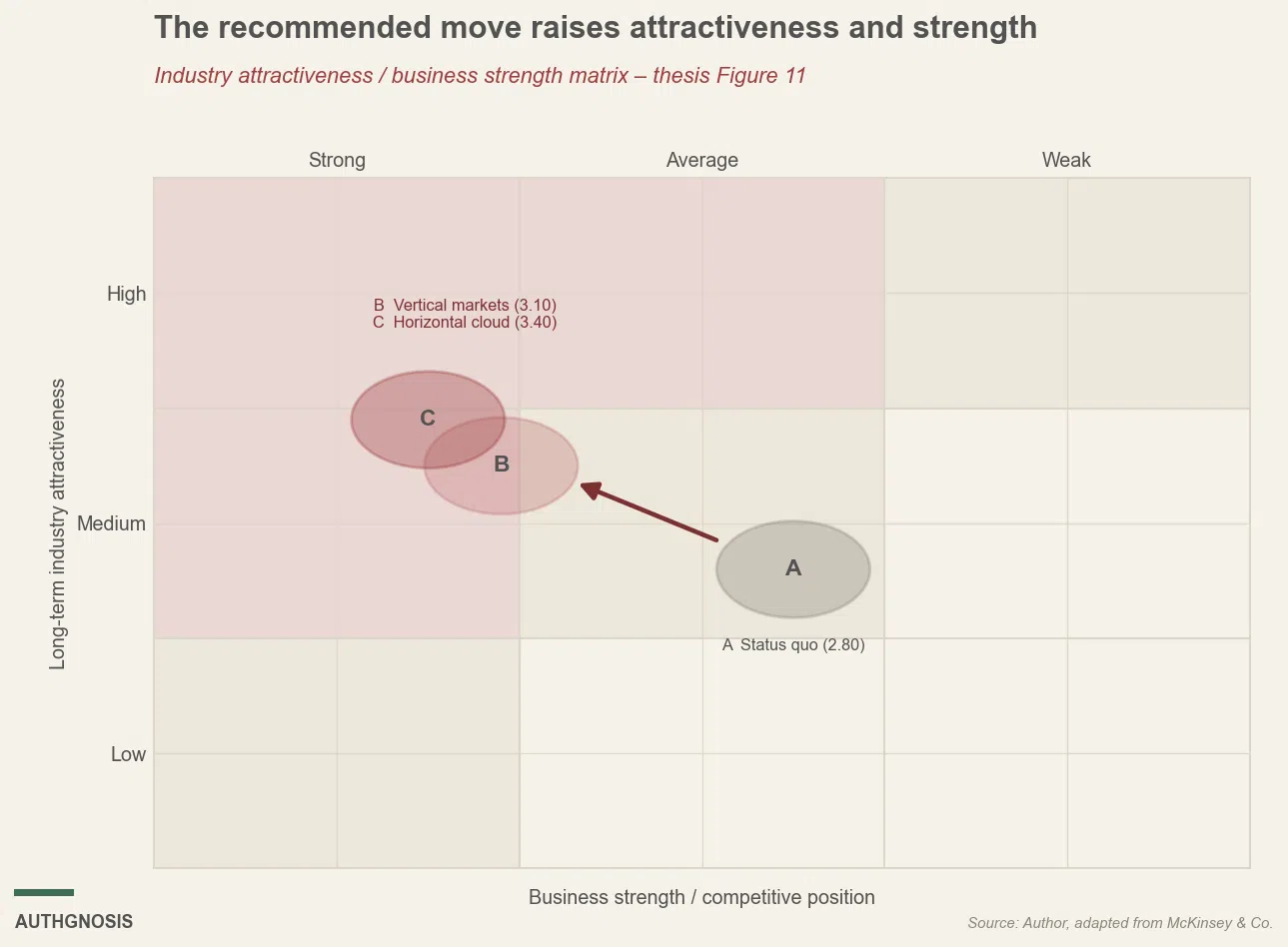
A Fulcrum Assessment showed the firm held only a low, narrow defensible position: enough to prove a model in one niche, not enough to sustain the whole business, and the status quo predicted continued erosion.
The recommendation: move from a horizontal market to defensible verticals
The financial-advisors foothold pointed to the answer. The company had a capability it was underusing: it could inexpensively produce industry-specific variants of its horizontal product – the same move that had made it defensible with financial advisors.
The recommendation was to repeat that move deliberately across a series of smaller, less-competitive vertical markets, with differentiated solutions that raised the customer’s willingness to pay. In framework terms, this moved the firm out of a crowded strategic group and into ones where it could earn returns above its cost of capital.
Two strategies were evaluated with discounted cash flow analysis. The internally funded case combined lower operating expense with vertical expansion and projected revenue growth from $7.5M in FY2012 to $15M in FY2017, with a net present value of between $3.5M and $4.6M over five years. A second case added $2M to $2.7M of shareholder investment to accelerate the same path.
How verticalization built a moat
Why would the vertical position hold where the horizontal one had not? A review of Maximizer’s customer base gave the answer. Its long-term strength with financial advisors traced back to its origins as a contact-management system: that customer base had acted for years as a feedback loop into product design, tailoring the product to the sector’s needs and, in the process, building a depth of domain knowledge its broad-market rivals did not have.
Extending that pattern to new verticals meant committing to a customer-intimate value discipline in Treacy and Wiersema’s terms – a deep understanding of a specific customer, tailor-to-fit solutions, and close support – rather than competing on lowest cost or broadest feature set. That is a different operating model, not just a different market.
That discipline is what made the position defensible on both flanks, even against large competitors with massive resources.
- Enterprise competitors such as Salesforce and Microsoft could match the domain depth only at a price point the niche would not bear.
- Low-end horizontal players such as Zoho competed on a scalable, one-size model that tailor-to-fit deliberately gives up.
- The vertical niche sat in the gap between them: too specialized and service-heavy for the enterprise cost structure, too bespoke for the low-cost scale model. The moat was the operating model itself.
The result
Executed, the verticalized product validated the model. The Financial Services-specific version sold at roughly 2x the average contract value (ACV) of the generic product, and the sales cycle shortened by about half – the pricing power and reduced friction that a tailor-to-fit, customer-intimate position is meant to produce.
Larger players are priced out of the niche and fail to provide the tailor-to-fit service that a smaller player like Maximizer provided. Price-competitors at the low-end are seeking massive scale to become the next unicorn. In between those two spaces is the landscape for small and mid-size firms to carve out a healthy business with lower competitive intensity and higher profit margins.
How it maps to the six drivers
- Products: the vertical variants were the differentiation lever, built from an existing capability.
- Markets: the core move was market selection, exiting a crowded horizontal segment for defensible verticals.
- Pricing Models: differentiated vertical solutions raised willingness to pay and supported margin.
- Business Processes: lower operating expense and reuse of the product platform funded the shift.
- Financing: the base case was internally funded, with an optional shareholder-accelerated variant.
- Partnerships were the least central driver in this case, which is itself a finding: not every driver carries equal weight in a given situation.
What the case demonstrates
The framework’s value here was identifying the one narrow defensible position correctly and building out from it: moving from one differentiated footing to replicate an set of defensible market niches, supported by evidence at each stage and tested against a financial model before it was recommended.
Work with Authgnosis
Work with Authgnosis. If you would like this analysis applied to your business, that is my Strategic Growth Plan engagement. Reach out to me for a free consultation.
Figure rights and sources
The figures in this article are the author’s own work, produced for her MBA thesis (2012–2013) applying the framework of Boardman, Shapiro & Vining (2004) to a CRM company, and re-rendered here in Authgnosis styling. They are dated 2012–2013 and are presented as a historical worked example.
- Figure 1 – Author’s analysis; Maximizer FY2012 transaction detail.
- Figure 2 – Author.
- Figure 3 – Author, adapted from Porter (1996).
- Figure 4 – Adapted by the author from Porter (1980).
- Figure 5 – Author, adapted from McKinsey & Co. (industry attractiveness / business-strength matrix).
- Figure 6 – Author.
1 Framework: Anthony E. Boardman, Daniel M. Shapiro & Aidan R. Vining, “A Framework for Comprehensive Strategic Analysis,” Journal of Strategic Management Education 1(2), 2004.
2 Value disciplines: Michael Treacy & Fred Wiersema, “Customer Intimacy and Other Value Disciplines,” Harvard Business Review 71 (Jan–Feb 1993), 84–93.