
Even for product companies, the talent dynamics below apply directly to your engineering and product org.
My MBA Strategy professor, Dr. Andrew Von Nordenflycht, proposes three defining traits of a Technology Service Firm: high knowledge intensity, low capital intensity, and a professionalized workforce, and each one bends a growth driver:
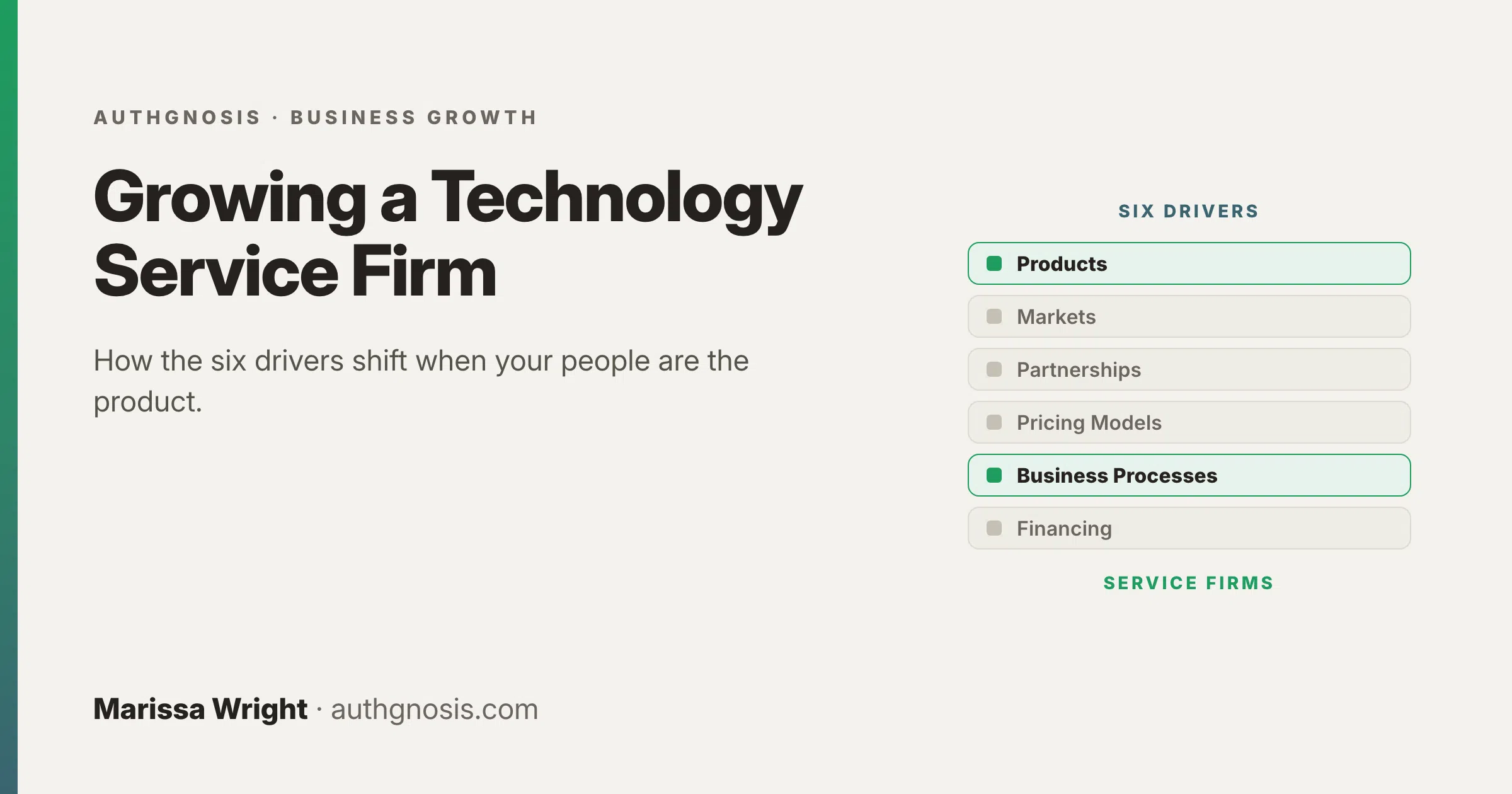
- The people are your product. In a service firm the “product” is inseparable from the people delivering it, and quality is hard for clients to judge up front. Growth means productizing expertise: methodologies, reusable IP, packaged offerings, so value doesn’t live only in a few heads.
- Business Processes become knowledge management. There’s no factory floor. The value chain is how you capture, transfer, and reuse knowledge across people and engagements: the services version of Toyota’s system, and the most underrated growth dimension in this model.
- Financing behaves inversely. Because these firms are low capital intensity, they can often grow from cash flow (the Mailchimp/Spanx pattern is the norm), but they struggle to raise outside equity, because the core assets can walk out the door every night. Talent, not capital, is the accelerant.
- The defining inhibitor is “cat herding.” Von Nordenflycht’s framing: professionals hold scarce, transferable skills and hold real bargaining power against their own firm, and they can’t be managed by directive control.
For a service business, and for the engineering core of any startup, talent retention isn’t an HR footnote; it’s the growth strategy. Your product, your process, and your moat can all resign.
Founder Guidance
For a services-heavy business, the highest-leverage drivers are:
- Business Processes (knowledge management)
- Products (productized expertise), and the human-capital layer, not aggressive market expansion.
Scaling headcount faster than you can codify and transfer knowledge to new headcount dilutes the quality that builds your reputation.
Dr. Von Nordenflycht’s taxonomy splits these firms into Classic PSFs, Professional Campuses, Neo-PSFs, and Technology Developers: a useful lens for segmenting service-business clients by how knowledge- and professional-intensive they really are.
Related drivers: Partnerships and Business processes.
Working with Authgnosis
Authgnosis is my AI-native business growth consulting practice.
I’ve turned the Six Drivers framework into a Growth Diagnostic Checklist: a section-by-section guide covering all six drivers plus the talent layer and a “Fulcrum” assessment.
It’s the prerequisite information I need to map a company’s current state, desired future state, and co-create a growth strategy that identifies the one or two moves that will move your growth needle fastest.
Get the Authgnosis Growth Diagnostic Checklist
The full section-by-section diagnostic, free. If you would like this analysis applied to your business, that is my Strategic Growth Plan engagement.
Sources: Boardman, Shapiro & Vining (2004), JSME 1(2); Von Nordenflycht, A. (2010). What is a professional service firm? Toward a theory and taxonomy of knowledge-intensive firms. Academy of Management Review, 35(1), 155-174.; Canadian funding per SR&ED (Budget 2025) and NRC-IRAP (2025–26).