
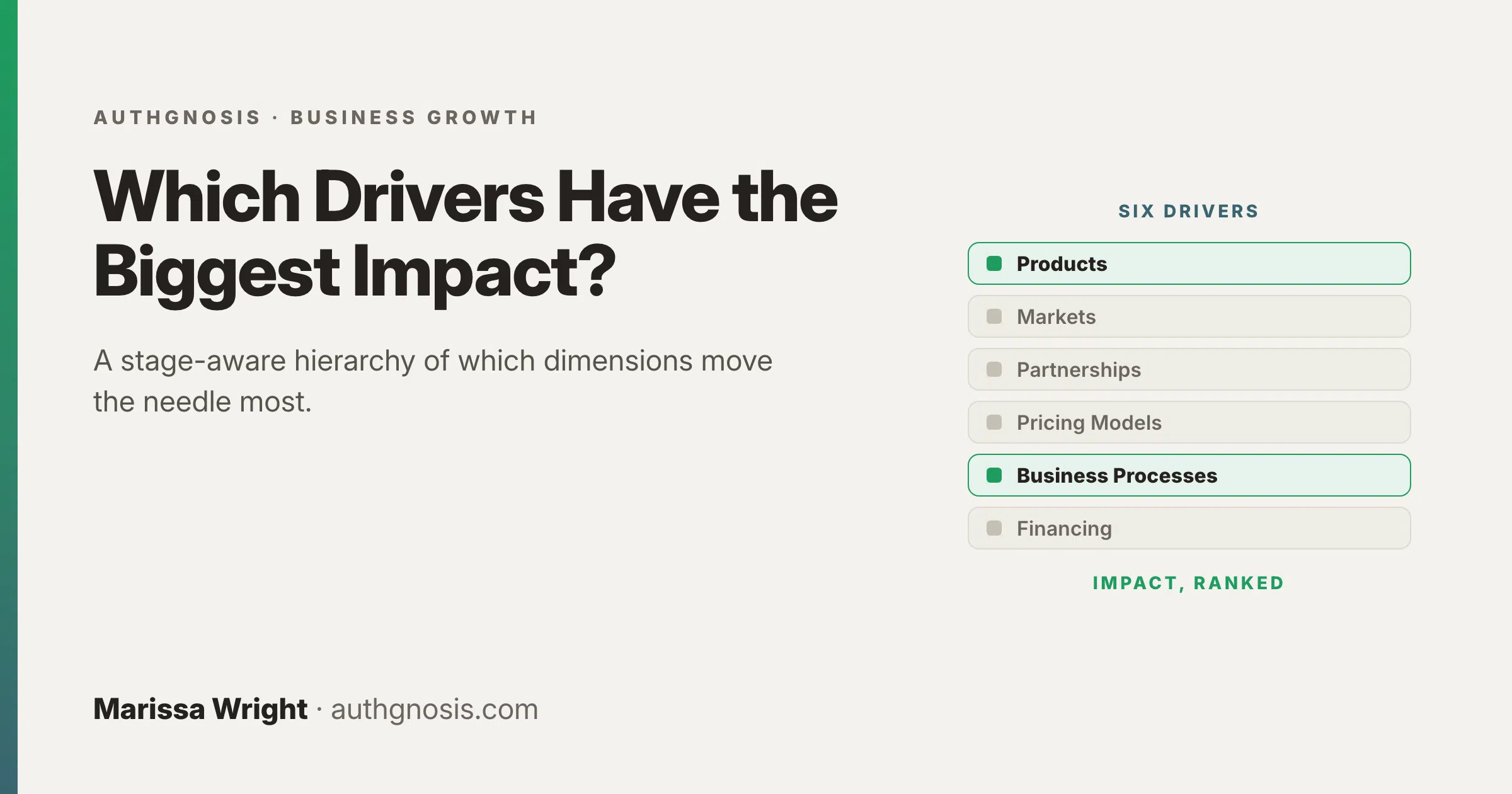
| Rank | Driver | Why | Durability |
|---|---|---|---|
| Highest | Products (product-market fit) | Nothing else matters without it; it’s the source of pricing power and retention | Sustainable but must be renewed |
| High | Business Processes | Hardest to copy; compounds; now cheap to improve with AI: the moat rivals underrate (Stripe, Toyota) | Very sustainable |
| High | Pricing Models | Fast, high-margin, and for startups often the growth motion itself (NRR) | Moderate–high |
| Medium | Markets | Multiplies existing advantage, but only if unit/customer acquisition economics already work | Sustainable if disciplined |
| Variable (high early) | Partnerships | For an unknown early-stage firm, borrowed relationships and reputation can outweigh everything; but a bad dependency can be fatal | Depends entirely on fit |
| Enabler | Financing | Least direct impact: it funds the others; non-dilutive sources make it far cheaper than founders assume | Amplifier, not a source |
Guidance for Founders
- Financing has the least standalone impact but the greatest multiplier effect. Canadian companies have a significant advantage with government tax incentives and grant programs.
- Partnerships are the wildcard that can matter most at the earliest stage: relationships and reputation are exactly what an early-stage company lacks.
- WeWork shows the downside of over-fueling
- Mailchimp shows near-zero outside capital can still produce a $12B outcome when product and process are sound and a solid strategy is well-executed.
Authgnosis Services: I can provide my clients with a complete strategic analysis to identify inhibitors to growth and provide a weighted set of strategic options that identify their best options for investing their limited resources.
Related drivers: Products and Partnerships.
Working with Authgnosis
Authgnosis is my AI-native business growth consulting practice.
I’ve turned the Six Drivers framework into a Growth Diagnostic Checklist: a section-by-section guide covering all six drivers plus the talent layer and a “Fulcrum” assessment.
It’s the prerequisite information I need to map a company’s current state, desired future state, and co-create a growth strategy that identifies the one or two moves that will move your growth needle fastest.
Get the Authgnosis Growth Diagnostic Checklist
The full section-by-section diagnostic, free. If you would like this analysis applied to your business, that is my Strategic Growth Plan engagement.
Sources: Boardman, Shapiro & Vining (2004), JSME 1(2); Andrew von Nordenflycht (2010); Canadian funding per SR&ED (Budget 2025) and NRC-IRAP (2025–26).