
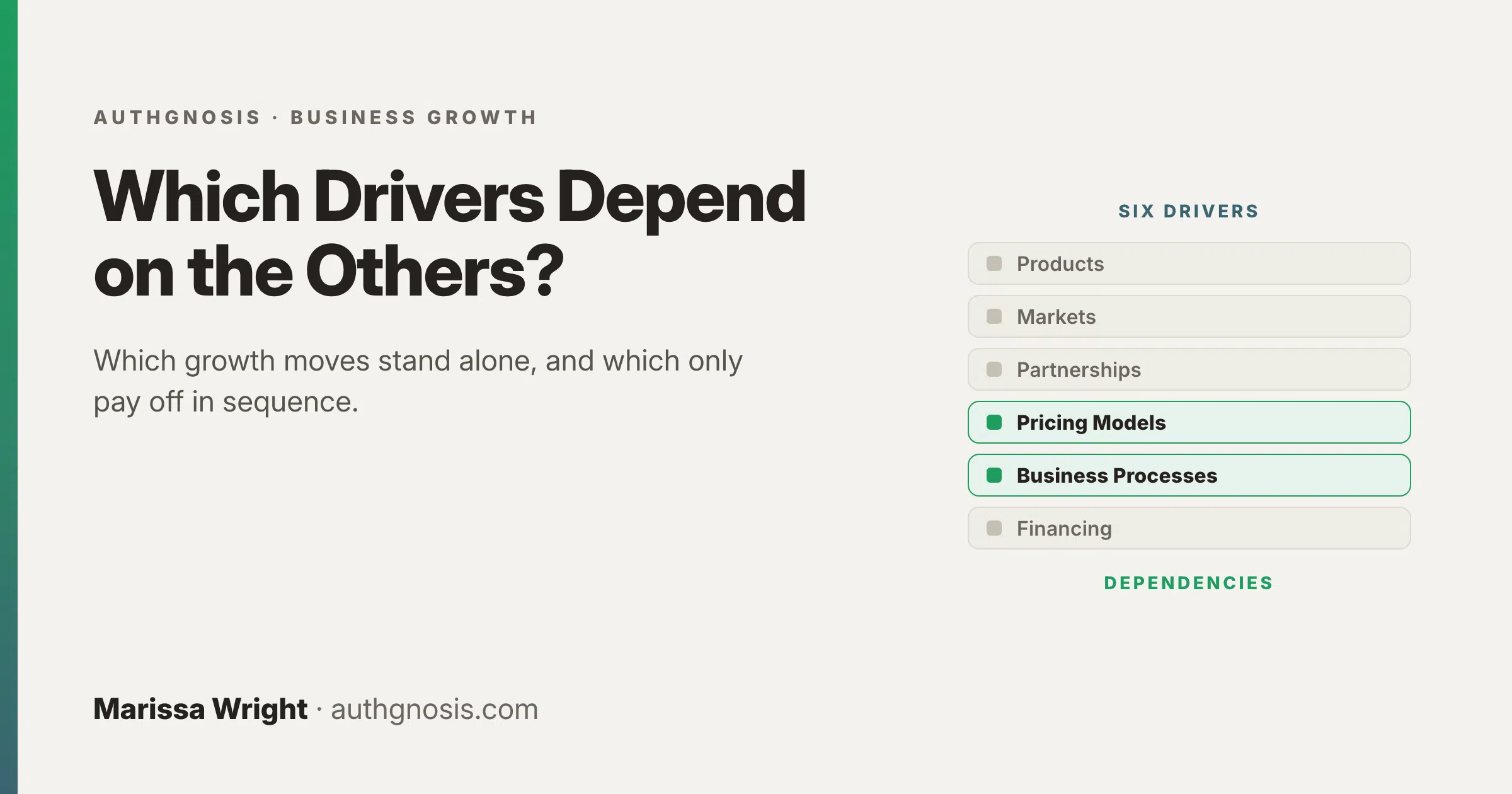
| Driver | Dependency | Notes |
|---|---|---|
| Pricing Models | Most independent | You can re-price or add a tier next quarter, but the ceiling is set by product value and cost structure. |
| Business Processes | Largely independent | Codifying and automating how work gets done can start today, cheaply, with AI tooling. |
| Financing | Independent to raise, purpose-dependent | Capital, including non-dilutive grants, is only as good as the driver you deploy it into. |
| Products | Dependent | Needs process capability to build; AI has lowered the capital it takes, but not the need for real differentiation. |
| Markets | Highly dependent | Expansion multiplies product + process + unit economics; weakness in any one gets magnified (Homejoy). |
| Partnerships | Dependent, with a catch | Channel partners need proven demand before they’ll engage; but community/association partnerships can be pursued early precisely to build the reputation the others require. |
Guidance for Founders
- Pricing and process are the most independent first moves.
- Channel and market expansion should extend an advantage you already have.
- Reputation-building partnerships are the exception you can start early: their whole job is to create the credibility the other dimensions depend on.
Related drivers: Products, Pricing models, Business processes, and Financing.
Working with Authgnosis
Authgnosis is my AI-native business growth consulting practice.
I’ve turned the Six Drivers framework into a Growth Diagnostic Checklist: a section-by-section guide covering all six drivers plus the talent layer and a “Fulcrum” assessment.
It’s the prerequisite information I need to map a company’s current state, desired future state, and co-create a growth strategy that identifies the one or two moves that will move your growth needle fastest.
Get the Authgnosis Growth Diagnostic Checklist
The full section-by-section diagnostic, free. If you would like this analysis applied to your business, that is my Strategic Growth Plan engagement.
Sources: Boardman, Shapiro & Vining (2004), JSME 1(2); Andrew von Nordenflycht (2010); Canadian funding per SR&ED (Budget 2025) and NRC-IRAP (2025–26).