
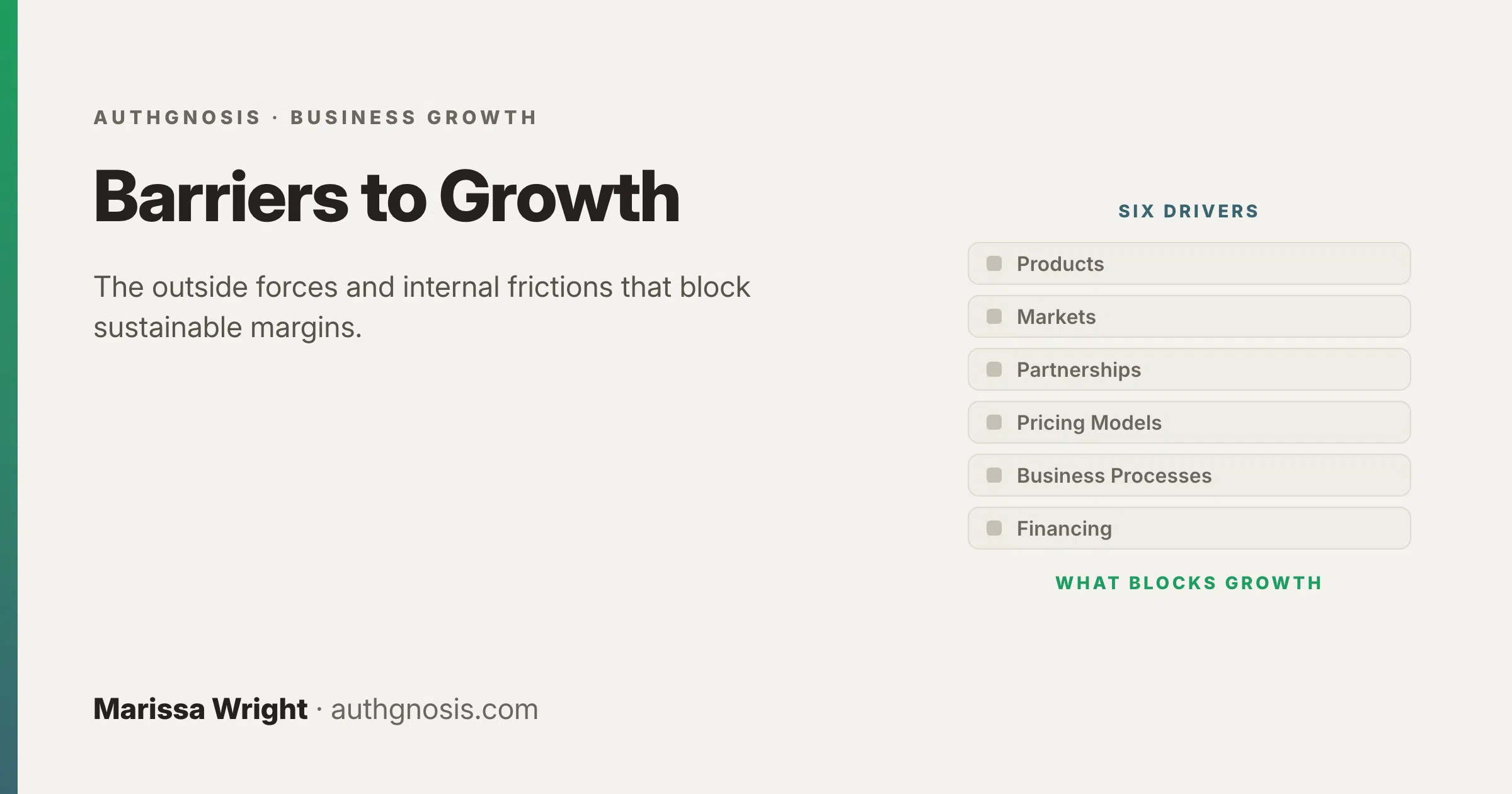
What blocks business growth
Outside forces (mostly beyond your control):
- A crowded market: too many competitors chasing the same customers, which pushes prices down and drives up what it costs to win each one.
- Customers who hold the power: when a handful of big buyers, or highly price-sensitive ones, can dictate terms and cap what you can charge.
- Suppliers or platforms that hold the power: when the vendors or platforms you depend on take the margin, or can change the rules on you overnight.
- Barriers to entry: if your edge is easy to replicate, fast-followers pile in and erode it. Recent advances in AI/LLM software development tooling have nearly eliminated the cost-resource barrier for fast-follower copycats of software-only solutions.
- A different way to solve the same problem: customers meeting the same need with an alternative (chat instead of email, video calls instead of travel).
- Shifts you can’t control: interest rates, the funding climate, AI/LLMs, and data regulation, or a platform quietly changing its policy.
Internal frictions (within your control, and often the real problem for startups):
- Weak product-market fit: the number one startup killer; growth spend poured into a leaky bucket. AI/LLM coding tools have spawned a massive “vibe-coder” community who are creating products and seeking investor financing before they do any product-market fit due-diligence.
- Broken unit/customer economics: it costs more to win a customer than they’re worth, margins are negative, or payback takes longer than your runway (Homejoy, MoviePass).
- Scaling too early: hiring, expanding, or spending ahead of a repeatable, proven motion.
- Talent concentration: critical knowledge trapped in a few people who can walk out the door.
- Too little fuel, or too much: under-capitalization stalls you; over-capitalization hides a broken model until it’s expensive (WeWork).
- Refusing to diagnose honestly: Boardman, Shapiro & Vining call the honest-assessment step the “fulcrum,” and note it’s exactly where teams are most likely to fall off. Many startups never name their real constraint.
Related drivers: Products and Business processes.
Working with Authgnosis
Authgnosis is my AI-native business growth consulting practice.
I’ve turned the Six Drivers framework into a Growth Diagnostic Checklist: a section-by-section guide covering all six drivers plus the talent layer and a “Fulcrum” assessment.
It’s the prerequisite information I need to map a company’s current state, desired future state, and co-create a growth strategy that identifies the one or two moves that will move your growth needle fastest.
Get the Authgnosis Growth Diagnostic Checklist
The full section-by-section diagnostic, free. If you would like this analysis applied to your business, that is my Strategic Growth Plan engagement.
Sources: Boardman, Shapiro & Vining (2004), JSME 1(2); Andrew von Nordenflycht (2010); Canadian funding per SR&ED (Budget 2025) and NRC-IRAP (2025–26).