
This guide is written for companies under ~200 people, where every dimension of growth competes for the same scarce runway, headcount, and founder attention.
Two things have quietly changed the math: AI has slashed the cost of two dimensions that used to be expensive, and for Canadian companies, non-dilutive government funding can cover more of the cost and Canadian tax credits offer a key competitive advantage.
How the six business growth drivers build competitive position
When preparing to write my MBA thesis in 2013, my thesis advisor Dr. Aidan Vining provided me with a framework that he co-authored with Dr. Anthony Boardman and Dr. Daniel Shapiro, the dean of SFU’s Beedie School of Business, “A Framework for Comprehensive Strategic Analysis”.
For my MBA thesis I applied this framework in its entirety to Maximizer Software, a CRM company where I was VP of Sales, running the full analysis from industry forces to a discounted cash flow-backed recommendation.
The application of the Framework found the root problem: Maximizer had little defensible position in a crowded horizontal market. I recommended moving into differentiated vertical niches, a path projected to roughly double revenue over five years.
The published 2004 version extends the framework in two further directions: a Relational Management Analysis of the internal characteristics that determine whether a strategy can actually be executed, and an Augmented Forces model of industry competitiveness that adds government and complementors to Porter’s five forces.
Their framework defines the purpose of strategy around a single idea: a company exists to generate returns above its cost of capital.
In founder language, that’s sustainable margins and unit/customer economics: not growth for its own sake, but growth where each new dollar of revenue is worth more than it costs to win and keep.
That definition matters because it stops “How do I grow?” from becoming a backlog of tactics. Business growth comes from a specific set of dimensions, each of which pushes on one thing: competitive position.
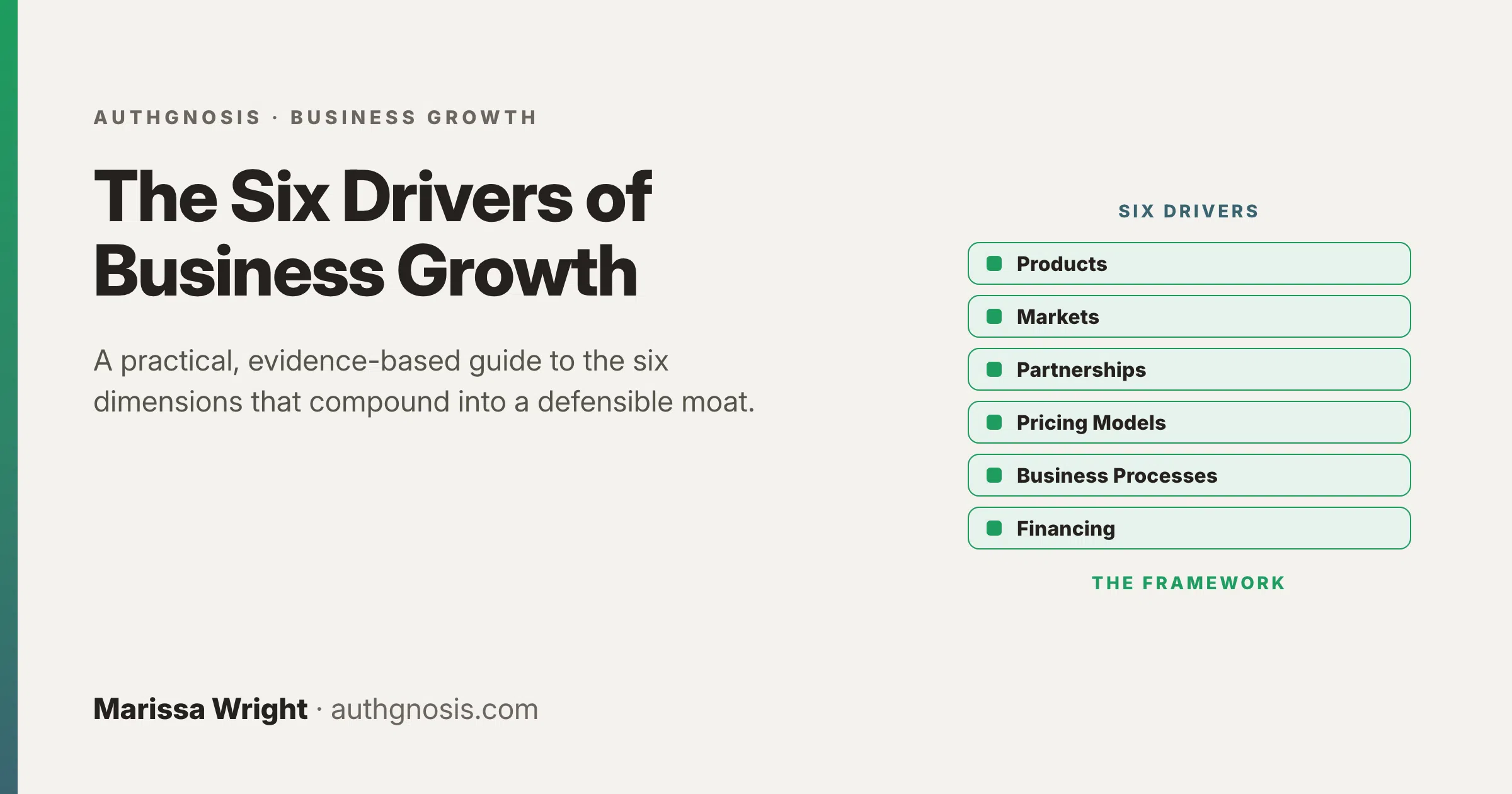
Here, I organize those dimensions into six drivers shown in Figure 2 below:
Invest in any one dimension, and you can drive growth. Invest in the right combination and in the right order, and you can build a defensible moat.
Invest the wrong order or invest hard on a dimension your company isn’t ready for, and you get an expensive lesson in failure, as several companies below discovered. Most of the failures here weren’t bad ideas; they were good dimensions invested in out of sequence.
The six drivers, one by one
Each driver has its own deep dive covering what it is, when to pull it, and a real success and failure story:
- Products – the differentiation dimension
- Markets – where you choose to compete
- Partnerships – reach and credibility you do not own yet
- Business and pricing models – how you package and charge
- Business processes – how work actually gets done
- Financing – how growth gets funded
Then the practical questions: which drivers have the biggest impact, which are most overlooked, and how to sequence them into a strategy.
Working with Authgnosis
Authgnosis is my AI-native business growth consulting practice.
I’ve turned the Six Drivers framework into a Growth Diagnostic Checklist: a section-by-section guide covering all six drivers plus the talent layer and a “Fulcrum” assessment.
It’s the prerequisite information I need to map a company’s current state, desired future state, and co-create a growth strategy that identifies the one or two moves that will move your growth needle fastest.
Get the Authgnosis Growth Diagnostic Checklist
The full section-by-section diagnostic, free. If you would like this analysis applied to your business, that is my Strategic Growth Plan engagement.
Citations
Framework foundation: Anthony E. Boardman, Daniel M. Shapiro & Aidan R. Vining, “A Framework for Comprehensive Strategic Analysis,” Journal of Strategic Management Education 1(2), 2004.
Professional-service-firm lens: Andrew von Nordenflycht, “What Is a Professional Service Firm? Toward a Theory and Taxonomy of Knowledge-Intensive Firms,” Academy of Management Review 35(1), 2010.
Canadian funding figures: SR&ED enhanced expenditure limit per Budget 2025; NRC-IRAP 2025–26 contributions. Real-world examples drawn from public reporting.