
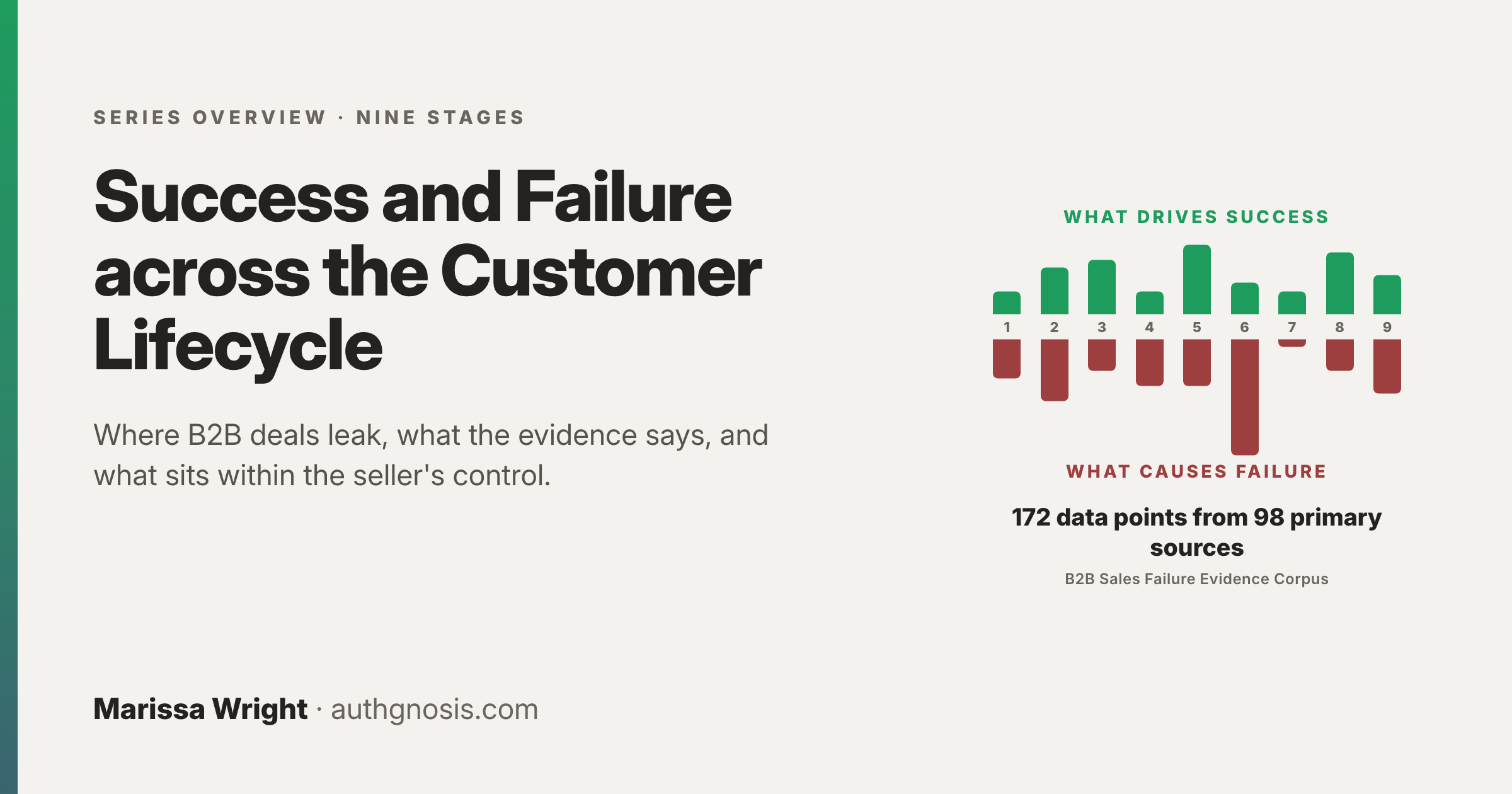
Most failures are within the seller's control, and they're prevented by governance, systems and rep execution working together, not by rep effort alone.
The research behind this series (172 data points from 98 primary sources) points to the same conclusion at every stage of the customer lifecycle.
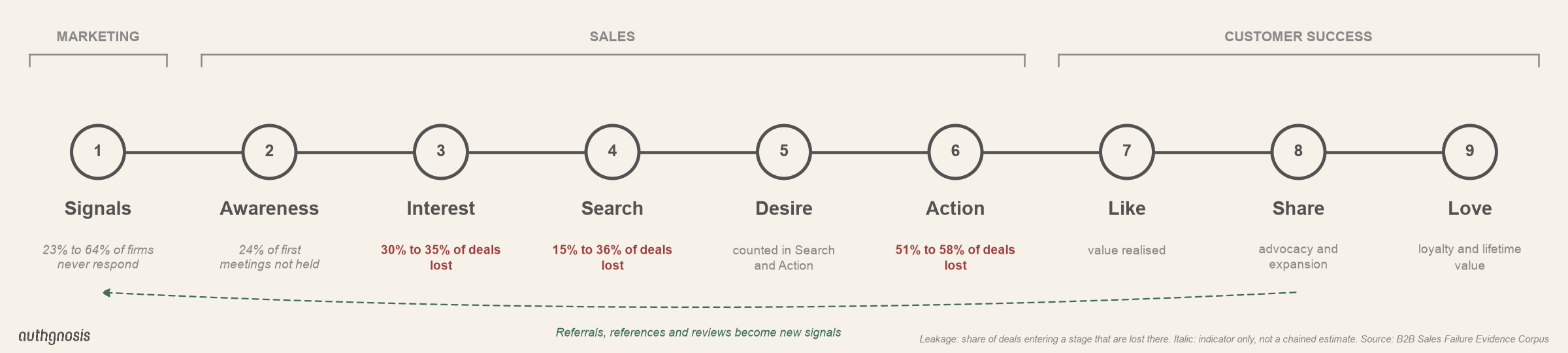
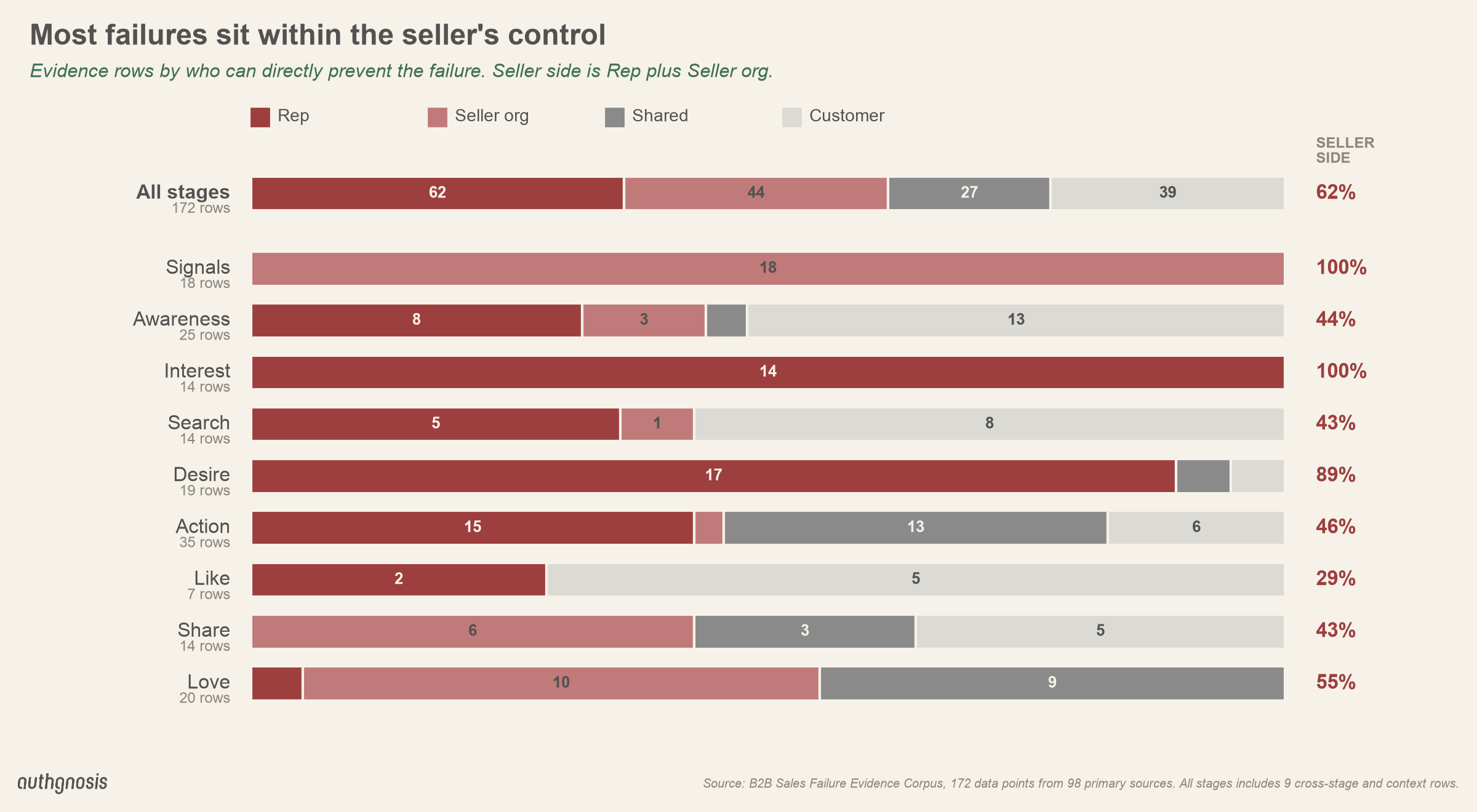
Across the evidence, 62% of the rows place the failure on the seller's side, ranging from 29% at Like to 100% at Signals and Interest.
1. Rep behaviour is 23% of the evidence
Figure 2 places 62 rows with the rep, but most of those are not selling skills. Sorted by the lever that addresses each failure, 39 of the 172 rows (23%) are rep behaviour: how a rep questions, presents value, handles objections and closes. Another 23 rows sit with the rep but are process steps, such as completing MEDDPICC by the solution stage, engaging the economic buyer early, raising price on the first call and agreeing next steps. Process and control is the largest lever, at 73 rows (42%), followed by buyer dynamics at 44 (26%) and market and outcome at 16 (9%).
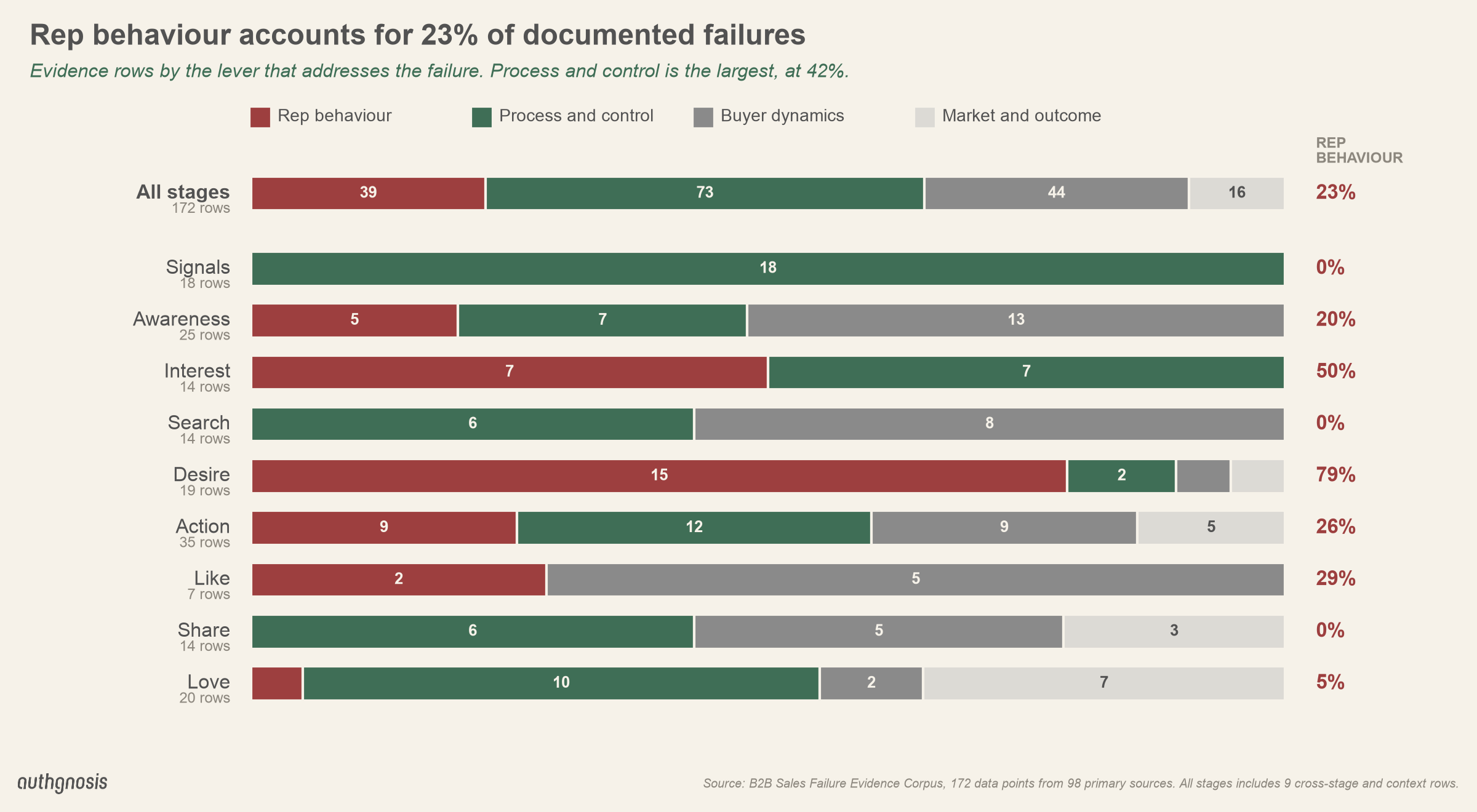
In my experience, sales leaders direct most of their coaching attention to rep behaviour, through methodologies such as MEDDPICC, Challenger, SPIN and Sandler. The evidence suggests that attention is weighted toward the smallest controllable lever.
MEDDPICC shows the difference. The evidence for it measures completion: deals with MEDDPICC complete by the solution stage were 324% more likely to win (Ebsta x Pavilion 2024). That is a process result, which a governed sales process can require at a stage gate rather than leave to coaching.
Note: row counts show where evidence exists, not the size of each effect, and 21 of the 39 rep-behaviour rows come from one study, Rackham's SPIN Selling research.
The largest estimated pipeline leakage is at Action, at 51% to 58%, and at Interest, at 30% to 35%; Signals and Awareness are measured by indicators rather than chained estimates.
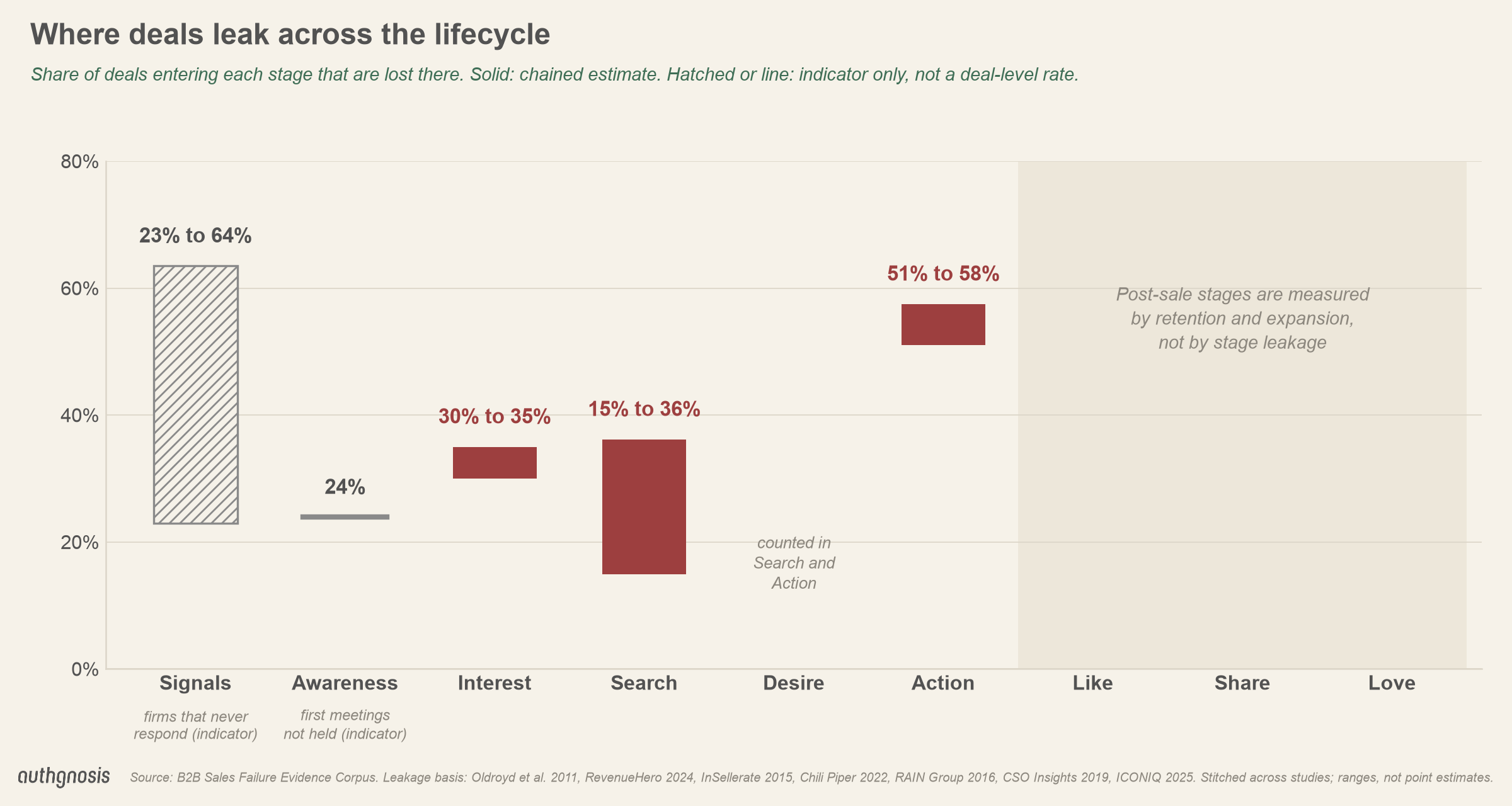
2. Most deals are decided before the seller arrives.
Buyers are 57–70% through their journey before engaging a rep, 81–86% already have a preferred vendor, and 95% buy from their day-one shortlist.

Action Item: Fund market coverage as a standing program and measure it. Define the ICP accounts in your serviceable addressable market (SAM), run continuous campaigns to them, and track the share that produce an identifiable signal. Pair that with a response standard of first contact within the hour.
3. Discovery quality decides the pipeline.
An estimated 30–35% of deals fail at Interest. Winning conversations turn implied needs into explicit ones, raise price early and find a compelling event. Most losing deals lack one: 76% of weaker deals have no critical event.

Action Item: Make the qualification standard a hard gate, not a guideline. A deal doesn't advance until the pain is explicit and costed, a compelling event and a budget range have been discussed, and a mutual next step is booked.
4. Deals die from internal disagreement, not competition.
Purchase likelihood falls from 81% with one stakeholder to 31% with six or more, and 74% of buying teams show unhealthy conflict. This is the best-evidenced finding in the research. Sellers can't control the size of a buying group, but they can structure its decision.

Action Item: Require a stakeholder map and a mutual action plan, agreed by the buyer, on every deal above a set size, and add a deal quality KPI for how many buying roles are engaged, not just on activity volume.
5. The biggest competitor is "no decision."
Half of forecast deals never close, and 40–60% of losses end in no decision, mostly from buyer indecision rather than satisfaction with the status quo. Urgency tactics make it worse. What works is a clear recommendation, reduced risk and confidence in the decision.

Action Item: Change how deals are closed and how losses are recorded. Retire urgency-based closing tactics, standardise risk-reducing options (phased scope, pilots with go/no-go criteria), and capture loss reasons that distinguish no decision from a competitive loss.
6. Growth after the sale is where most firms have no process.
56% of organizations regret their largest technology purchase. A 1% gain in retention is worth about 5% of firm value, and firms with 130%+ net retention grow more than twice as fast as those at 100–110%. Yet most SMB firms have no designed process for value realization, expansion, referrals or renewals.

Action Item: Assign clear ownership of retention and expansion, measure net and gross revenue retention every quarter, and tie part of sales and customer success compensation to them. Agree on success criteria before and at the sale, and review customer-realized value 60–90 days after go-live.
What this means for leaders
Every stage has two layers:
- Governance and systems-embedded data-driven processes in your CRM set the standard: routing and response times, qualification gates, a mutual action plan, forecasting rules, success criteria, and incentives tied to retention.
- Rep execution supplies the quality: relevant outreach, explicit needs, multi-threading, benefits over features, and concurrence rather than pressure. Its levers split between process (13%) and rep behaviour (23%), and the process share can be managed by a well-designed CRM-based sales process.
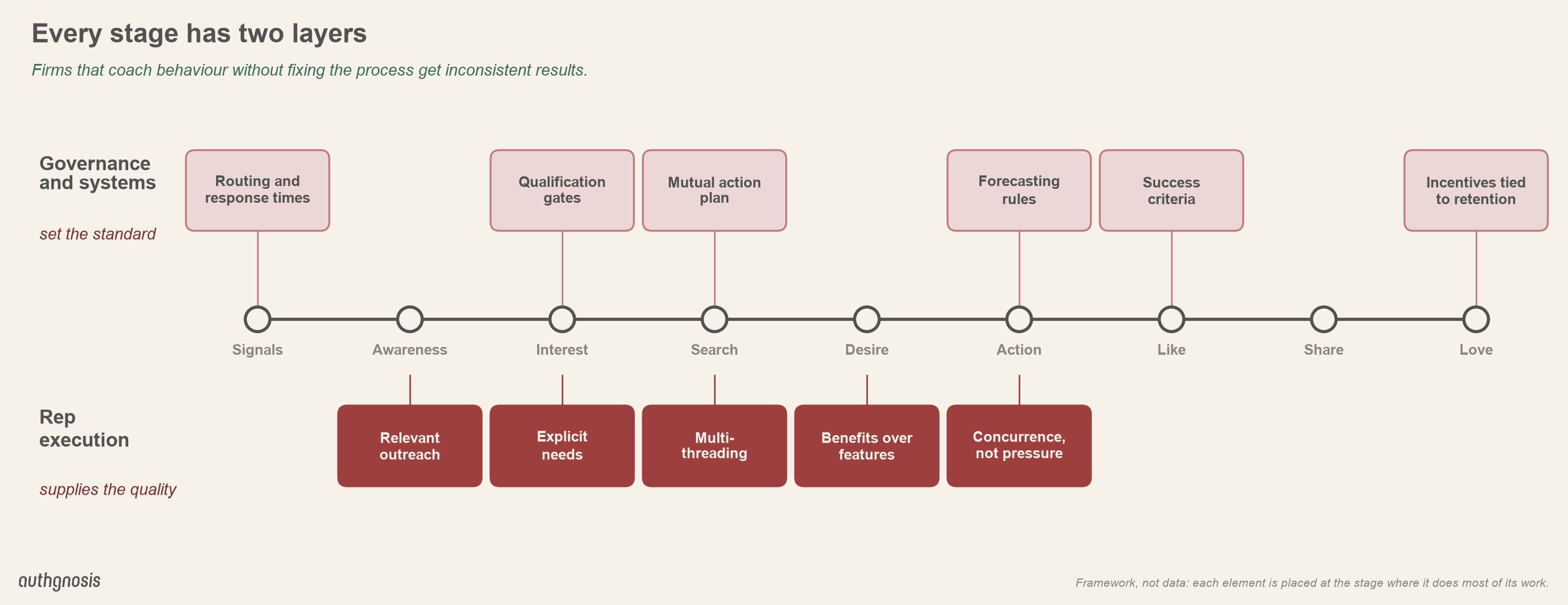
Firms that coach behaviour without fixing the process get inconsistent results. Firms that build the process give every rep a standard to meet and give management the data to see where deals are lost.
Where this series fits
This series tests the AISDALS/L customer lifecycle against the evidence. The lifecycle is introduced in Integrating Sales Processes and a CLTV-Focused Customer Lifecycle, its nine stages are described in The Nine Stages of the AISDALS/L Enterprise Sales Lifecycle, and the Sales Process-Customer Lifecycle CRM Visualization shows the process behind every stage.
How I can help
Through my Authgnosis consulting practice, I design and implement integrated sales, marketing, and customer success processes in your CRM system. I bring over 25 years of revenue leadership experience, data-evidenced research, best-in-class processes and methodologies, and my hands-on development and integration skills to plug pipeline leakage, reduce customer churn, and enable dependable revenue forecasts. If you would like to discuss your sales, marketing, and customer delivery challenges, reach out to me here.