
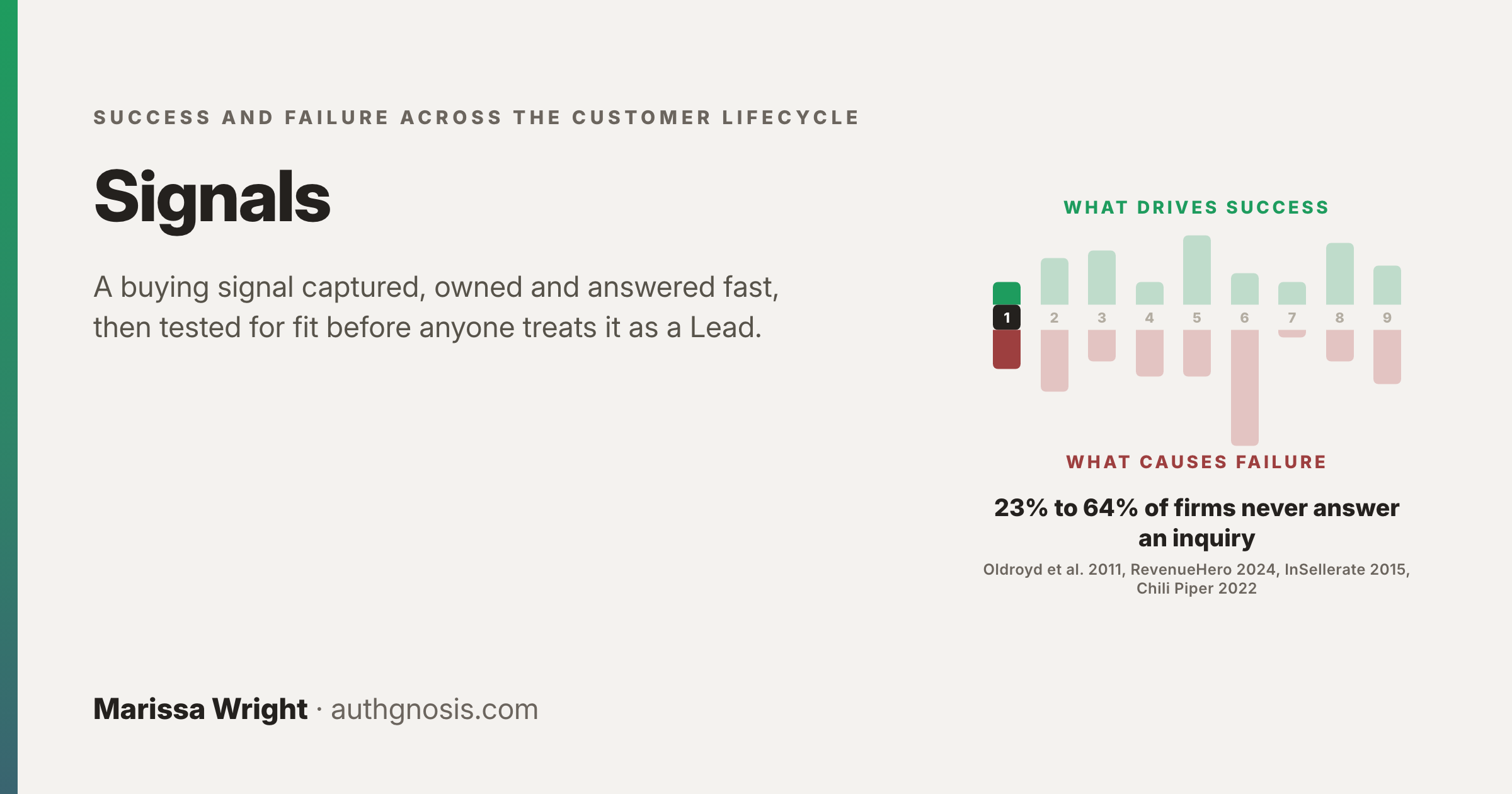
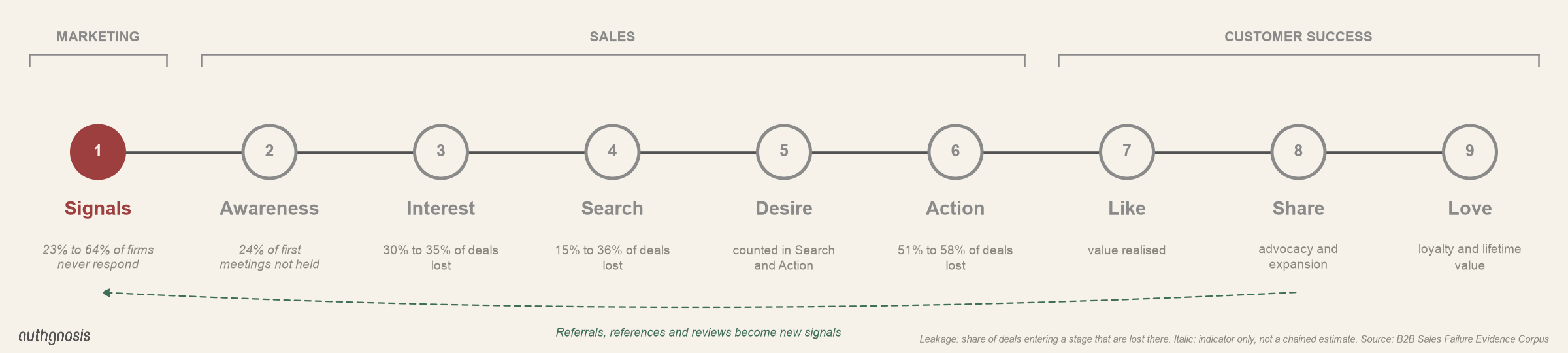
This post is part of Success and Failure across the Customer Lifecycle, which tests each stage of the AISDALS/L customer lifecycle against 172 data points from 98 primary sources. The lifecycle itself is set out in the series that begins with Integrating Sales Processes and a CLTV-Focused Customer Lifecycle.
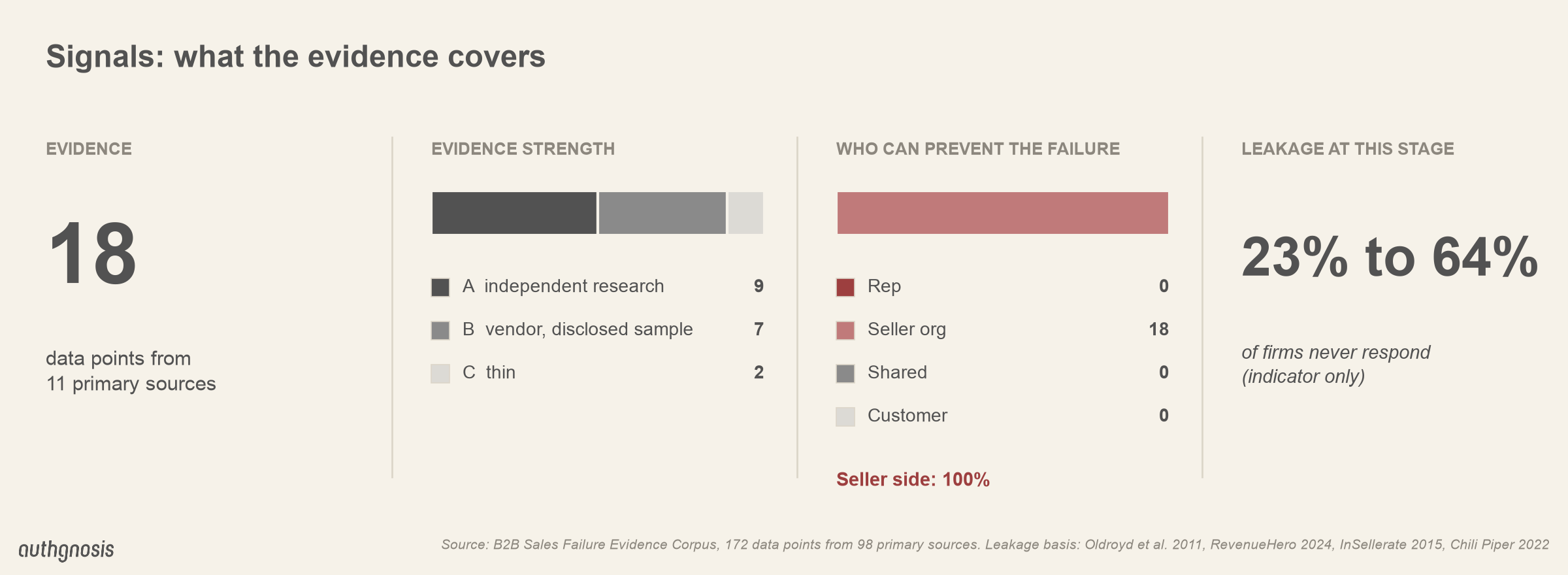
What the evidence covers
The data set evidence refers almost entirely to inbound web leads. The one product-adjacent row is about trials, and it sits at the Search stage (Forrester 2026).
Leakage at this stage is not measurable in the traditional sense of pipeline leakage. More accurately, signals leakage would be measured as “serviceable addressable market coverage” - the percentage of the seller’s ICPs in its serviceable addressable market (SAM) that Marketing is able to reach and generate leads from.
Success at Signals
Success means a buying signal is captured, owned and answered fast, then tested for fit and intent before anyone treats it as a Lead.
The exit is validated Interest: a real person at an ICP-fit account has confirmed a reason to engage. Anything short of that goes to nurture, not to sales.
Failure at Signals
Failure here takes four forms in the evidence:
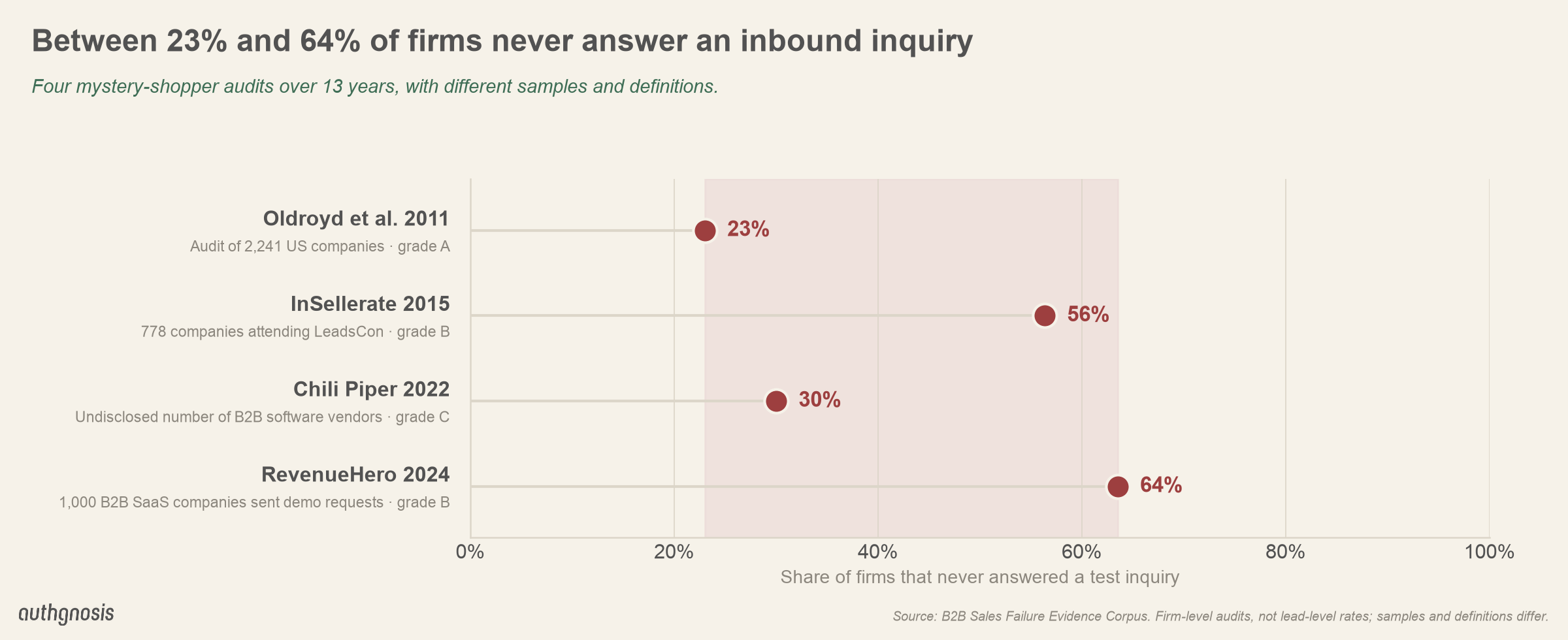
The first two, silence and slowness, are the best measured. Four audits over 13 years found between 23% and 64% of firms never answer a test inquiry, and the samples and definitions differ enough that the range matters more than any single figure.
The other two forms are:
- Premature handoff: 73% of leads aren't effectively scored as sales-ready at conversion (MarketingSherpa 2012), and 59% of marketers have no nurturing programme to catch the rest (MarketingSherpa 2012).
- Disconnected functions: marketing and sales collaborate on only 3 of 15 commercial activities (Gartner 2024).
What sits within the seller's control
The data set shows almost every Signals failure as governance + systems failure: the organisation sets the routing, service levels and definitions (governance), implements them as automated in their CRM (systems), and only then can the rep execute against them to:
- Respond within the hour, ideally within minutes. This is the strongest lever at the stage. Contact within an hour makes a lead about 7x likelier to qualify (Oldroyd et al. 2011). The odds of qualifying fall more than sixfold within the first hour (Oldroyd and InsideSales.com 2007). Most firms fall well short on speed to lead: only 37% of the firms audited answered within an hour, and 23% never answered at all.
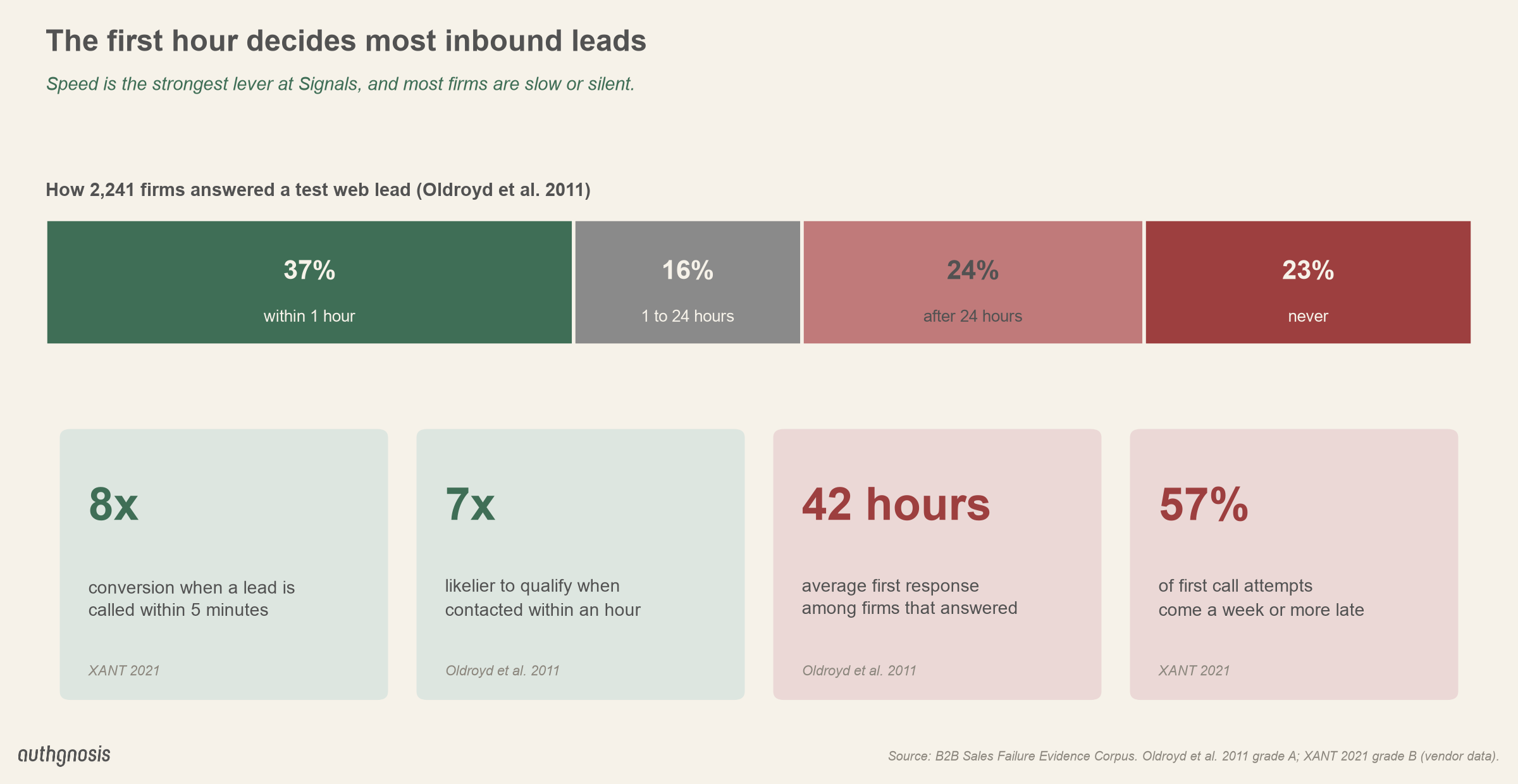
- Persist past the first attempt. Most lost inbound leads die from no follow-up rather than a "no" (Oldroyd et al. 2011). A defined multi-attempt, multi-channel cadence is the rep's to run; adding follow-up calls to email roughly doubles email response rates (Gong 2024).
- Qualify before handing off. Confirm an identifiable person and organization matches, and prepare the rep to confirm fit, pain and intent with a generated Prospect Brief and ICP fit score, rather than passing on a form fill. Reps' follow-up improves with the quality of pre-qualification, not the volume of leads (Sabnis et al. 2013), and most leads aren't ready at conversion (MarketingSherpa 2012). Alternatively, a dedicated lead qualification team can avoid contention between lead qualification and lead/opportunity management.
- Route the not-ready to nurture, not to closed. With 73% not ready, how the rep dispositions a lead decides whether it comes back later. Leads that are dispositioned as not ready need a nurturing campaign to land in.
- Feed insight back to marketing. Firms that share buyer-journey insight across functions (sales <-> marketing) are 2.3x likelier to see higher conversion (Gartner 2024). A rep's disposition notes and reasons are that feedback loop. Reducing the CRM friction for reps to capture these notes and reasons can improve compliance and quality; having an augmented AI mechanism to interpret those notes and reasons, route them to the correct nurturing campaign, and surface systemic failures to Marketing for correction is ideal.
Where Signals fits in the AISDALS/L lifecycle
Signals is the first of the nine stages described in The Nine Stages of the AISDALS/L Enterprise Sales Lifecycle. The exit criteria that govern each stage, including the exit from Signals to validated Interest, are covered in Exit Criteria, Forecast Quality, and a CLTV Growth Flywheel. The Sales Process-Customer Lifecycle CRM Visualization shows the process behind every stage.
How I can help
Through my Authgnosis consulting practice, I design and implement integrated sales, marketing, and customer success processes in your CRM system. I bring over 25 years of revenue leadership experience, data-evidenced research, best-in-class processes and methodologies, and my hands-on development and integration skills to plug pipeline leakage, reduce customer churn, and enable dependable revenue forecasts. If you would like to discuss your sales, marketing, and customer delivery challenges, reach out to me here.