
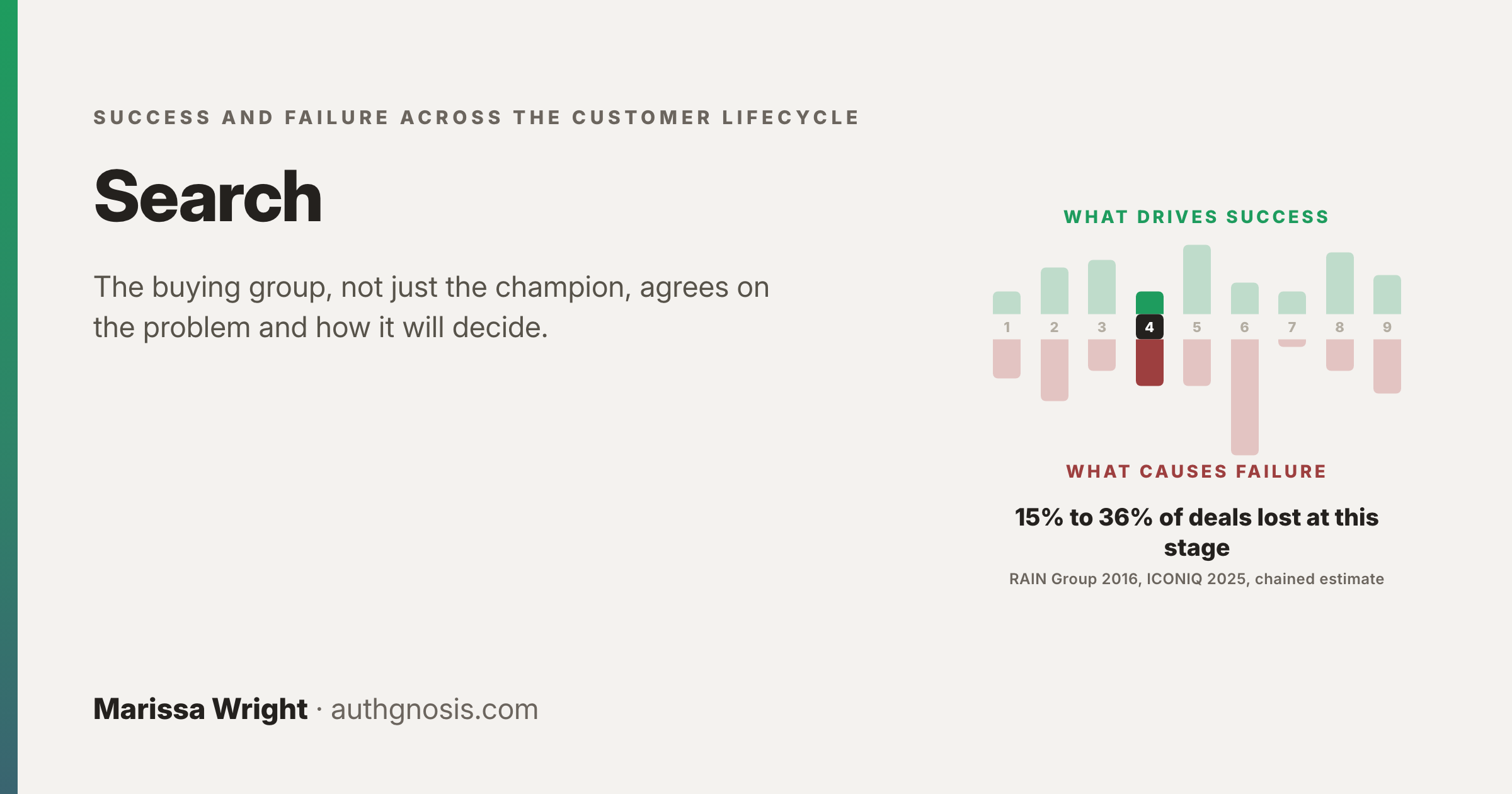
This post is part of Success and Failure across the Customer Lifecycle, which tests each stage of the AISDALS/L customer lifecycle against 172 data points from 98 primary sources. The lifecycle itself is set out in the series that begins with Integrating Sales Processes and a CLTV-Focused Customer Lifecycle.
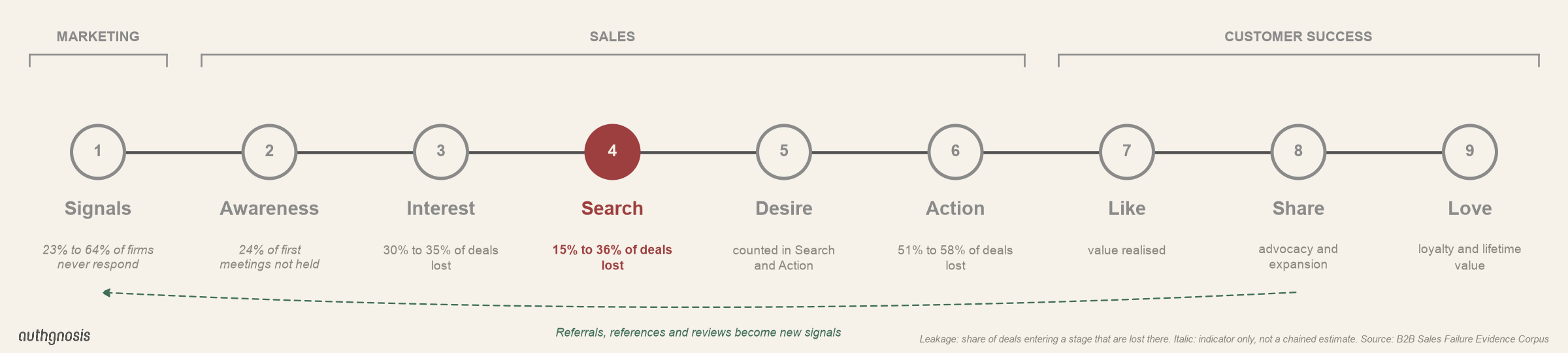
What the evidence covers
This is the best-evidenced stage in the data set. CEB, Gartner and Forrester are all grade A data sources, and they all agree: internal customer consensus failure is the main way deals die at Search.
15% - 36% of deals fail through this stage.
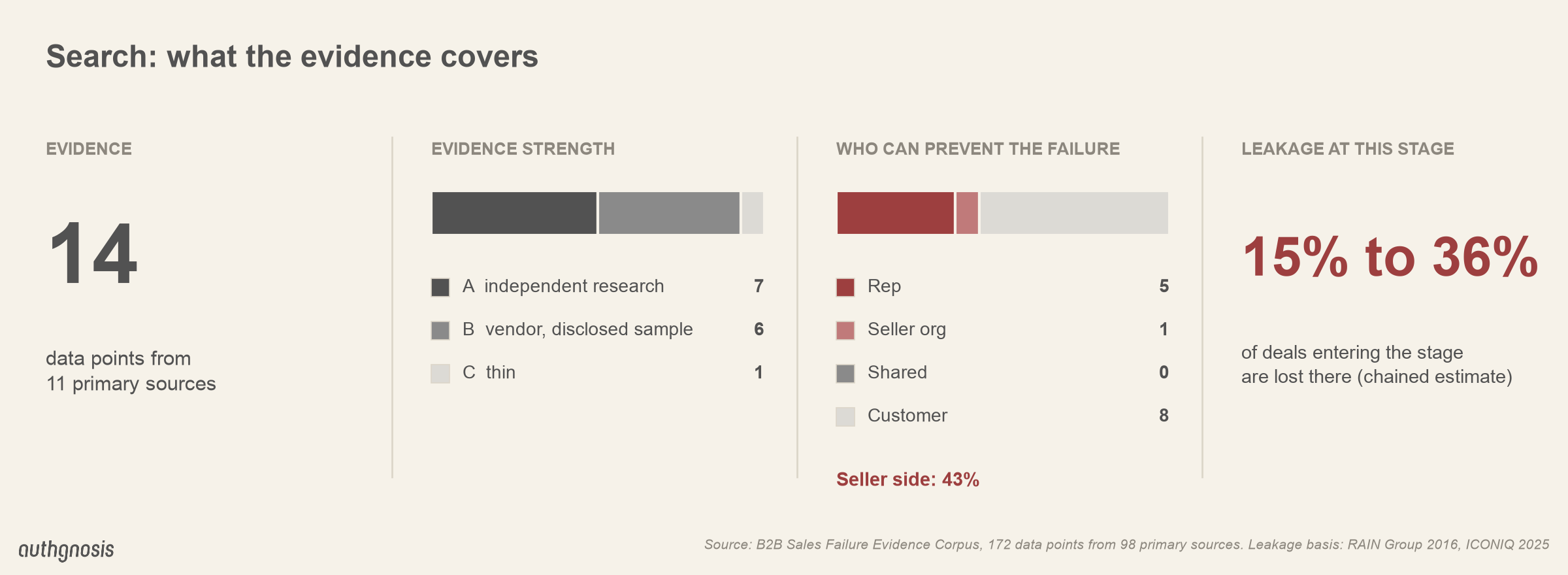
Success at Search
Success means the buying group, not just the champion, agrees on the problem, how it will decide, and that you're in the running:
- The Discovery Workshop is held and the stakeholders who surface there are mapped;
- The pain is costed against a materiality threshold (“Is this problem costly enough to make it a priority over other projects we have on our plate?”) and the customer agrees;
- The customer agrees to the updated MAP;
- Competitive differentiation, a compelling event, and the implementation timeline are recorded;
- Decision criteria and the decision process are agreed, including procurement's role;
- A budget source (business unit, line item) is identified.
Failure at Search
Failure at the Search stage is mostly about internal customer consensus, and nearly all of the evidence is grade A:
As the buying group grows, purchase likelihood falls from 81% with one stakeholder to 31% with six or more (CEB 2015), and 91% of purchases stall at some point (Forrester 2024).
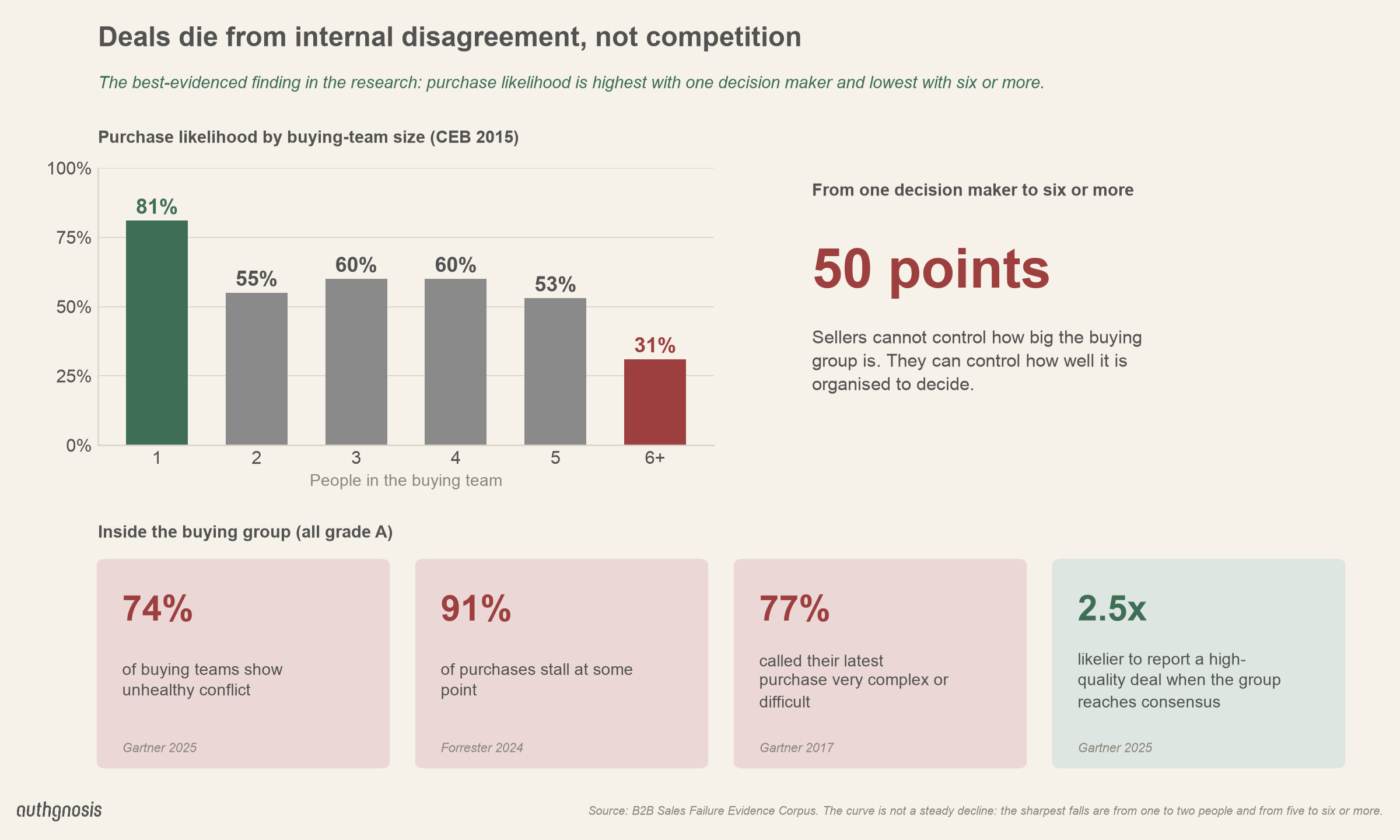
This does not mean it is seller complexity or difficulty - it may be internally sourced.
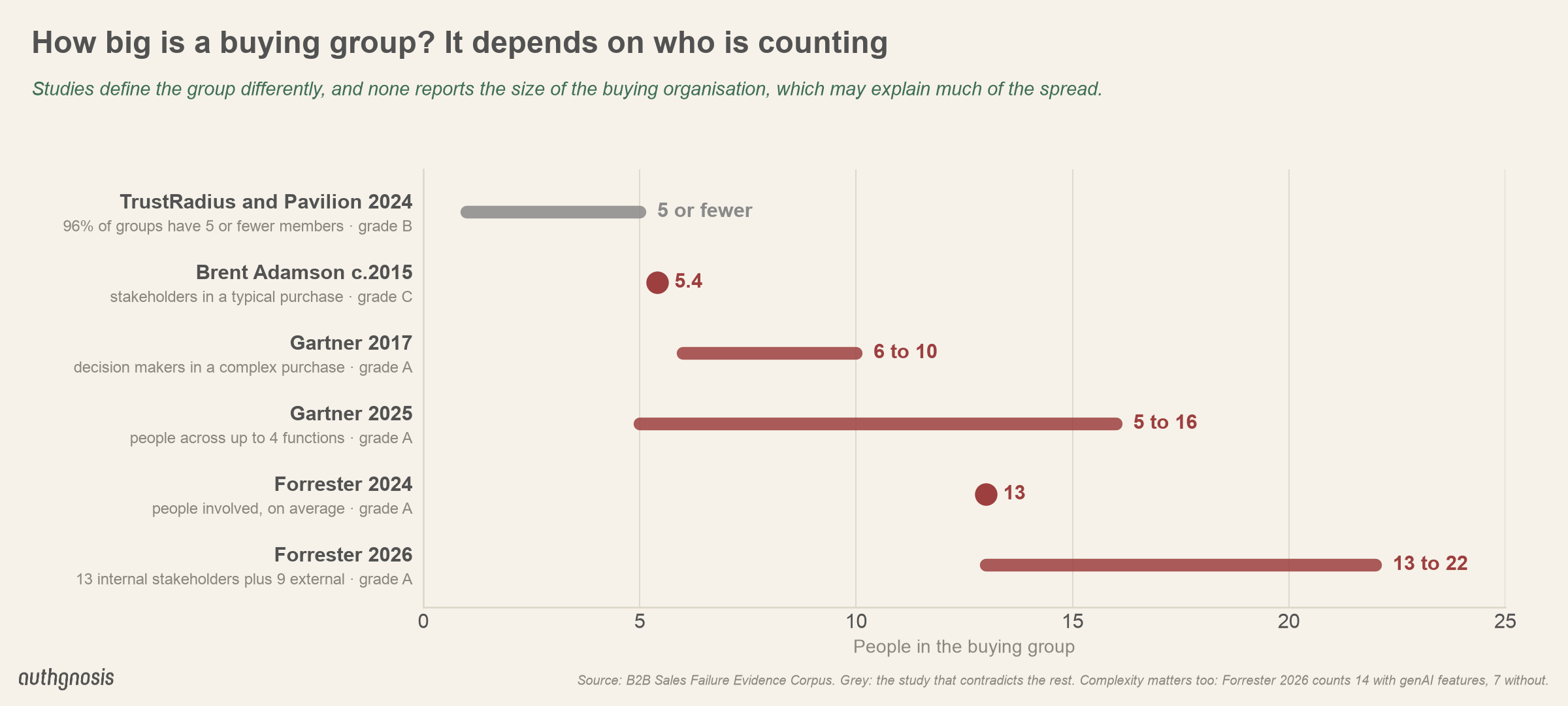
Estimates of group size vary widely because studies define the group differently and none reports the size of the buying organisation; purchase complexity also matters, with genAI purchases involving about twice as many people (Forrester 2026).
- Procurement arrives late to the process: procurement is the decision-maker in 53% of purchases (Forrester 2026). Procurement-as-decision-maker will be heavily weighted for public sector procurement processes, versus private sector processes.
What sits within the seller's control
The group's size and its internal conflict belong to the buyer, which is why two of these cells are scored Outside seller control. The rep controls how well the group is organised to reach a decision:
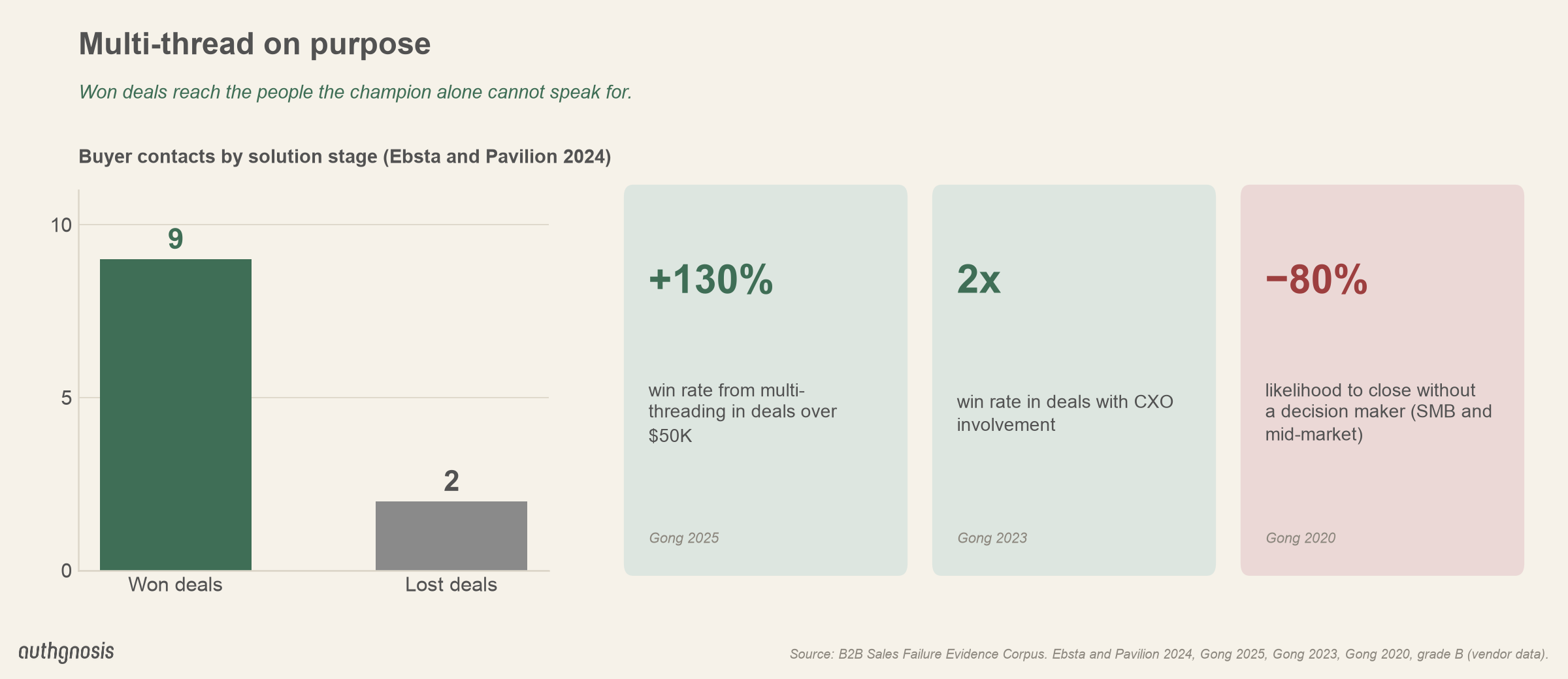
- Multi-thread on purpose (Gong 2025; Ebsta and Pavilion 2024). Use the workshop to meet the people the champion alone can't speak for, such as finance, operations and IT, and add them to a Key Stakeholder map for concurrence-building. Multi-threading develops direct relationships across affected stakeholders (finance, IT, cybersecurity, operations, procurement, etc.) and lifts win rates 130% in deals over $50K (Gong 2025). Won deals have nine buyer contacts by the solution stage against two for lost deals (Ebsta and Pavilion 2024).
- Build consensus for the group. Groups that reach consensus are 2.5 times likelier to report a high-quality deal (Gartner 2025). Give the champion materials written for each role: the costed pain for Finance, the MAP for all stakeholders, implementation for IT, cybersecurity compliance for CSO, contract templates for Legal, part numbers and pricing for Procurement. A customer "No" at this stage is an early, cheap loss rather than a late and expensive one.
- Agree the decision process explicitly, procurement included (Forrester 2026). The rep asks who signs, who reviews contracts, and how long procurement takes.
- Test access to the decision maker early (Gong 2020; Gong 2023). Confirmation of the Economic Buyer often emerges when stakeholders align. The rep can still ask during the Discovery Workshop who owns the pain, the budget and what they'll need to see to agree, without forcing an Economic Buyer meeting before a proposal is ready for their review. No decision maker involved: deals are 80% less likely to close in SMB and mid-market, with a 233% decrease in enterprise deals (Gong 2020).
- Use the Discovery Workshop to qualify a trial/pilot phase. More than 60% of buyers buy some form of trial (Forrester 2026). A paid Discovery Workshop is exactly that for a services firm: a small, low-risk commitment that tests working together. It's also where the rep sees the group's dynamics first-hand. However, structure the trial/pilot as a phase within a full deployment with a go/no-go milestone on clear KPIs to de-risk the customer decision. This will avoid future decision delays for trial/pilot-to-full-rollout
- Name the competition and your difference (grade C). The rep asks who else is being considered and records why you're different in terms the whole group would accept.
- Watch for stalls. A 91% stall rate (Forrester 2024) means stalling is the norm, so the rep tracks MAP dates and follows up when they slip. Slippage is trackable in a CRM process flow.
Where Search fits in the AISDALS/L lifecycle
Search is the fourth of the nine stages described in The Nine Stages of the AISDALS/L Enterprise Sales Lifecycle. Coordinating the people on both sides of a buying group is covered in Selling Is a Team Sport: Cross-Functional Orchestration, and the qualification methods that map the group, including MEDDPICC, in Four Sales Methodologies, One Integrated System. The Sales Process-Customer Lifecycle CRM Visualization shows the process behind every stage.
How I can help
Through my Authgnosis consulting practice, I design and implement integrated sales, marketing, and customer success processes in your CRM system. I bring over 25 years of revenue leadership experience, data-evidenced research, best-in-class processes and methodologies, and my hands-on development and integration skills to plug pipeline leakage, reduce customer churn, and enable dependable revenue forecasts. If you would like to discuss your sales, marketing, and customer delivery challenges, reach out to me here.