
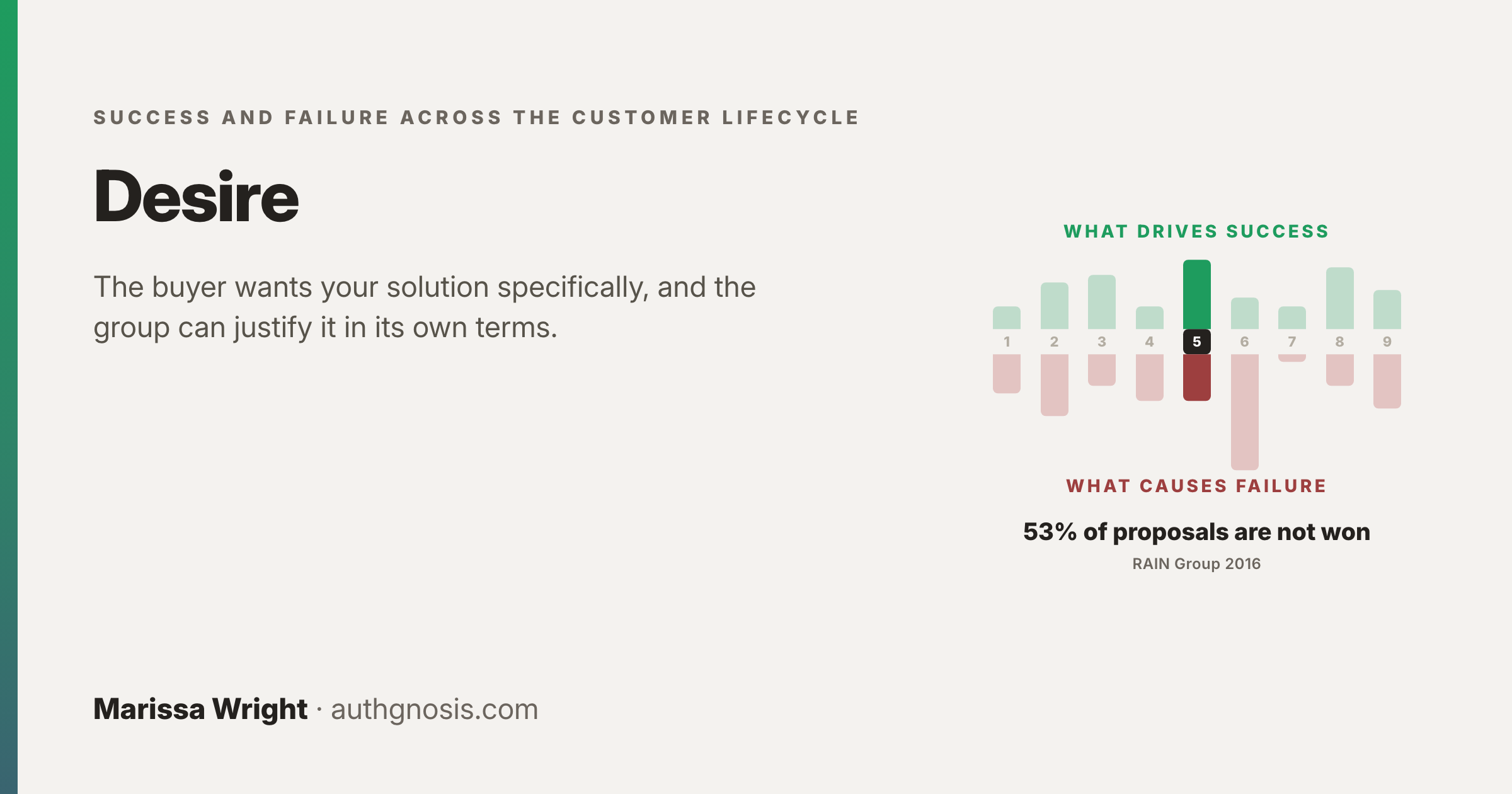
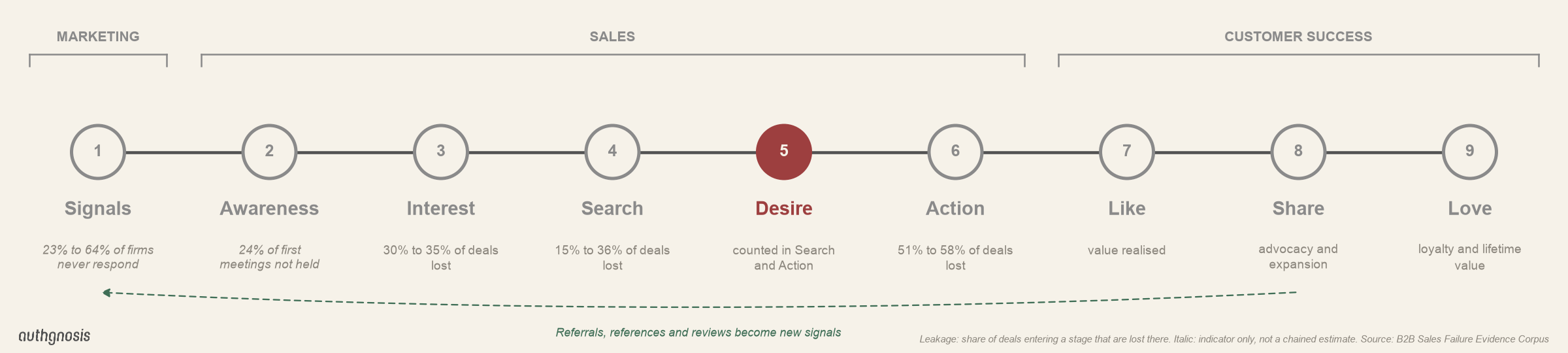
This post is part of Success and Failure across the Customer Lifecycle, which tests each stage of the AISDALS/L customer lifecycle against 172 data points from 98 primary sources. The lifecycle itself is set out in the series that begins with Integrating Sales Processes and a CLTV-Focused Customer Lifecycle.
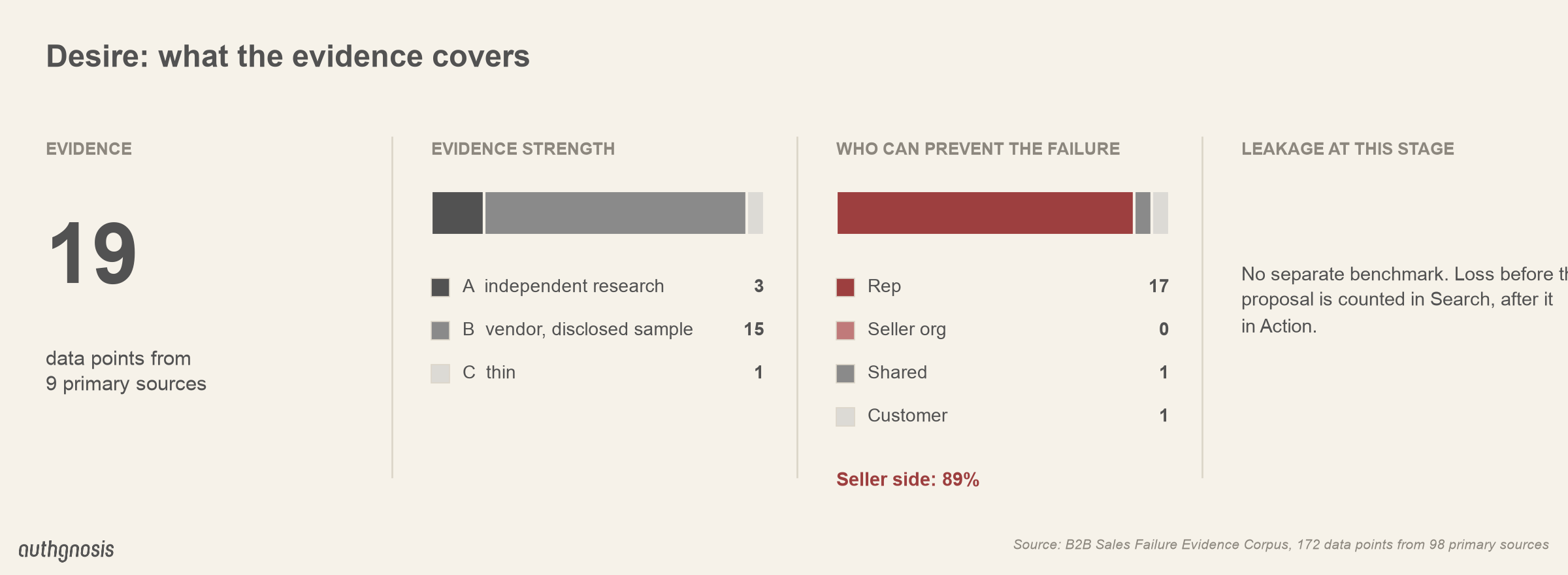
What the evidence covers
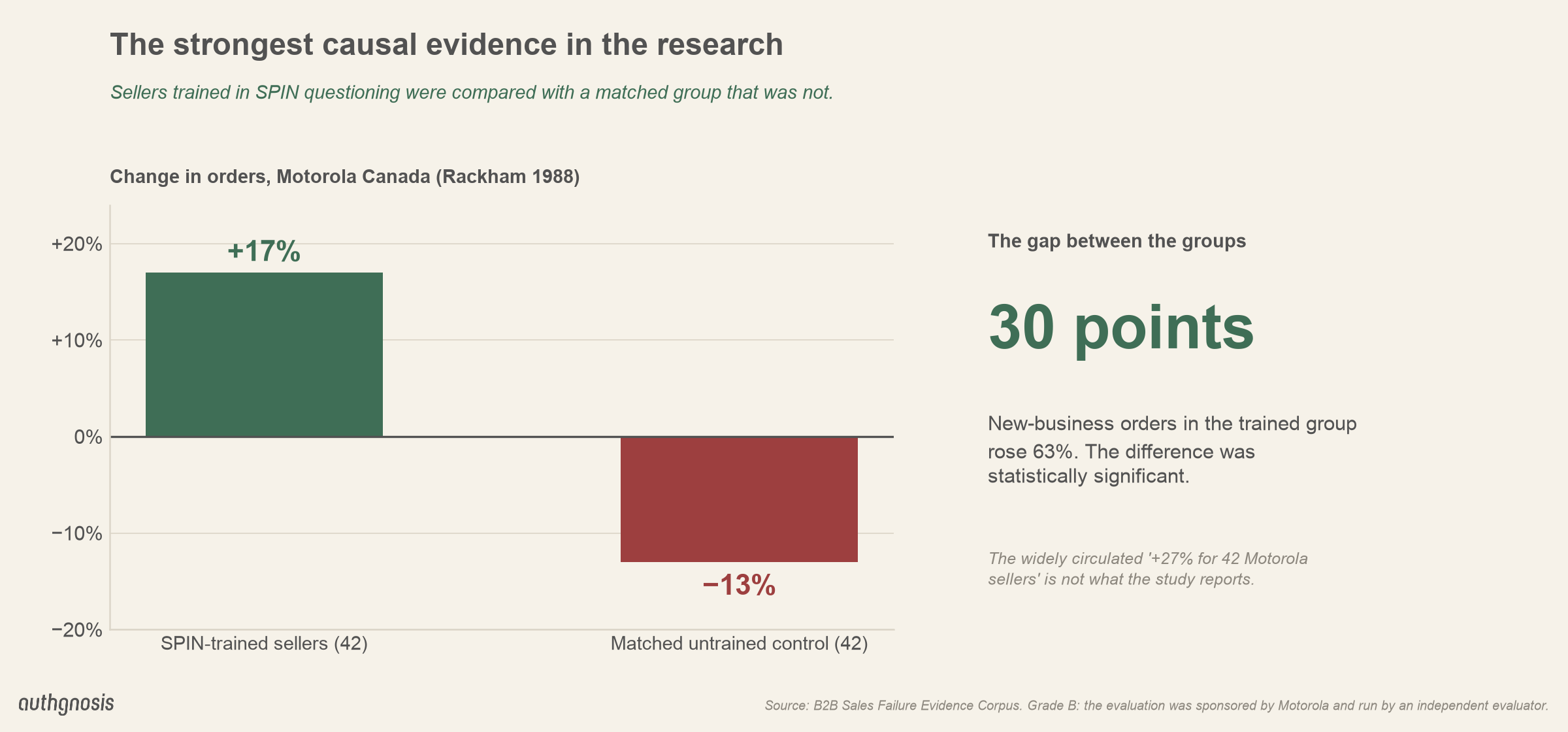
Desire has grade A evidence for the approach, and grade B for call behaviour. CEB and Gartner support teaching and sense-making; Gong and Rackham supply the talk-pattern findings. Rackham's Motorola study is the strongest causal evidence in the data set: the SPIN-trained group raised orders 17% while a matched untrained control fell 13% (Rackham 1988).
Desire has no number of its own because the research data splits leakage at the proposal: the early part of leakage is counted in Search and the later part in Action. Most of what's specific to Desire (value proof, pricing, ROI timing) sits after the proposal.
Success at Desire
This means the buyer wants your solution specifically, and the group can justify it in its own terms:
- The technical design plan is reviewed and accepted by the technical buyer
- Financial discovery sets the success criteria and the price basis: “What is this going to cost, and what is the clearly defined success criteria that will justify the spend?”
- The draft proposal is priced against the Pain Cost;
- the Champion reviews and approves the proposal. At this point, the Champion moves from tentative to confirmed;
- The MAP is kept current for all engaged stakeholders, so every step has an agreed next one. Any disagreements are resolved with every MAP update.
Failure at Desire
Failure in the evidence looks like this:
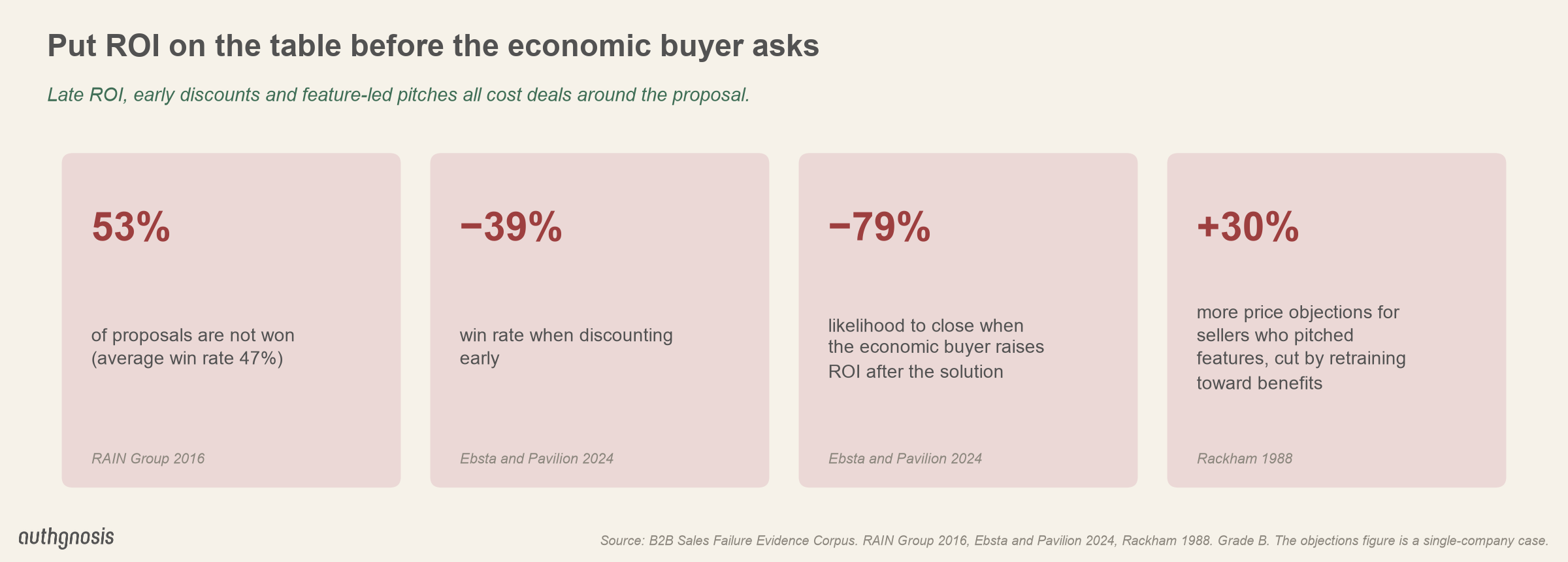
Most of the measured loss gathers around the proposal and its price: 53% of proposals are not won (RAIN Group 2016), and close likelihood drops 79% when the economic buyer raises ROI after the solution is presented (Ebsta and Pavilion 2024).
- Price dominates the conversation: time spent on pricing is up 62% since 2020 (Gong 2024, grade C).
What sits within the seller's control
Most Desire rows are rep-controlled, and this is where the rep's conduct on calls matters most:
- Teach, don't pitch. Challengers were 54% of high performers in complex sales (CEB 2011, grade A). AI augmented Reframe and Executive POV skills based on a Discovery Call make this repeatable and governable, rather than dependent on an individual rep.
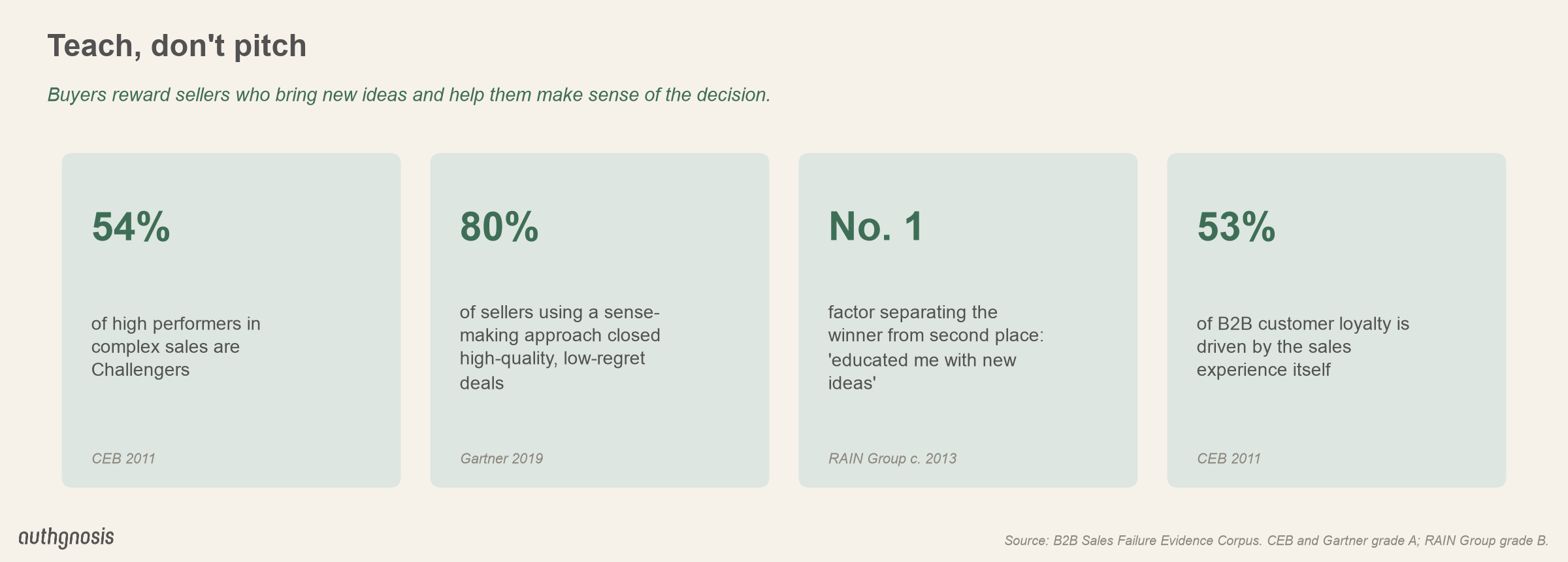
- Help the buyer make sense of the decision. 80% of sellers using a sense-making approach closed high-quality, low-regret deals (Gartner 2019, grade A). This means helping the group weigh the information it already has, not adding more. The Key Stakeholder Workshop and the MAP update in it are where the rep does it.
- Talk benefits, not features. Benefits made up 9.2% of seller behaviour in calls ending in orders against 2.6% in no-sales (Rackham 1988). A benefit here, in Rackham's sense, is what meets a need the buyer has stated explicitly. That depends on the explicit needs the rep established at the Interest stage. Rackham found features slightly higher in unsuccessful calls (Rackham 1988). Feature talk has a measured cost of its own: win rate falls from 26% with no feature talk to 5% at 500 seconds of it (Gong 2021).

- Keep demos short on monologue and long on next steps. No winning demo had a monologue (uninterrupted pitching) longer than 76 seconds, and won demos spent 12.7% more time on next steps (Gong 2017). With agreed next steps (the MAP), close rates are 20%, against 5% without (Gong 2021).
- Put ROI on the table before the economic buyer asks (Ebsta and Pavilion 2024). Pain Cost and Materiality are quantified early, and price is reconciled to Pain Cost before any economic-buyer review.
- Hold price; negotiate scope. Early discounting costs 39% of win rate (Ebsta and Pavilion 2024). Warn when price exceeds Pain Cost but avoid a hard block; not all Pain is hard-costable, and some of that Pain may be kept unsurfaced as embarrassing or confidential. When you do discount, the rep can trade scope or terms rather than cutting rates or unit cost.
- Address the cause of objections, not just the objection. Features cause price concerns and advantages cause objections (Rackham 1988). The objections assessment handles objections after they're raised; the rep prevents them by staying on benefits tied to explicit needs.
Where Desire fits in the AISDALS/L lifecycle
Desire is the fifth of the nine stages described in The Nine Stages of the AISDALS/L Enterprise Sales Lifecycle. The Challenger and SPIN methods behind teaching and benefit-led selling are combined into one process in Four Sales Methodologies, One Integrated System. The Sales Process-Customer Lifecycle CRM Visualization shows the process behind every stage.
How I can help
Through my Authgnosis consulting practice, I design and implement integrated sales, marketing, and customer success processes in your CRM system. I bring over 25 years of revenue leadership experience, data-evidenced research, best-in-class processes and methodologies, and my hands-on development and integration skills to plug pipeline leakage, reduce customer churn, and enable dependable revenue forecasts. If you would like to discuss your sales, marketing, and customer delivery challenges, reach out to me here.