
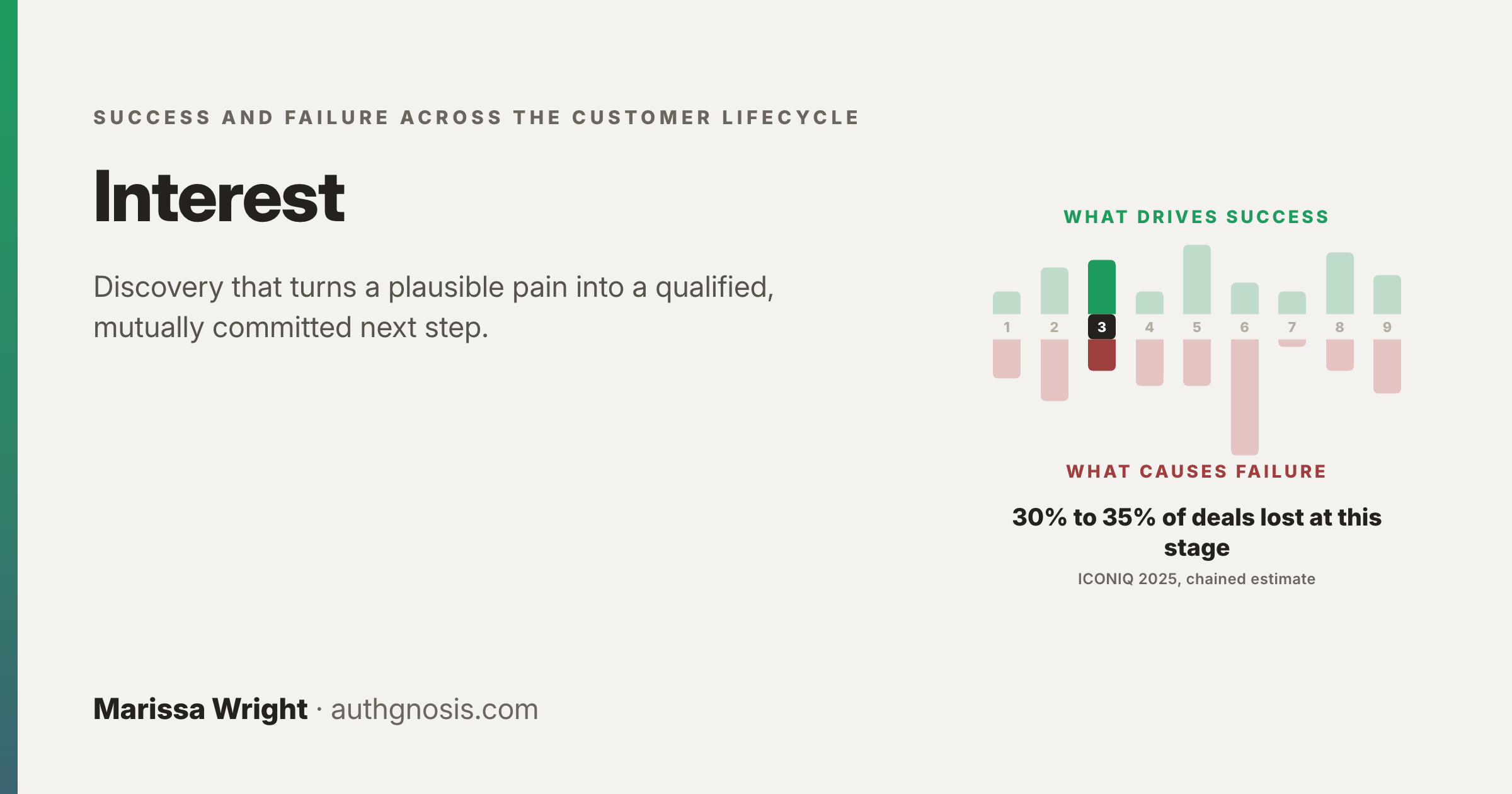
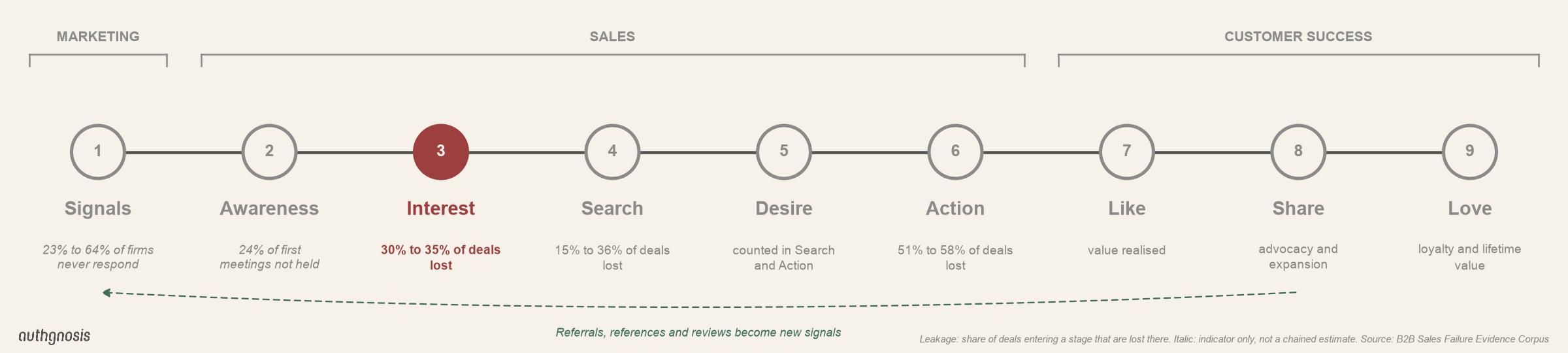
This post is part of Success and Failure across the Customer Lifecycle, which tests each stage of the AISDALS/L customer lifecycle against 172 data points from 98 primary sources. The lifecycle itself is set out in the series that begins with Integrating Sales Processes and a CLTV-Focused Customer Lifecycle.
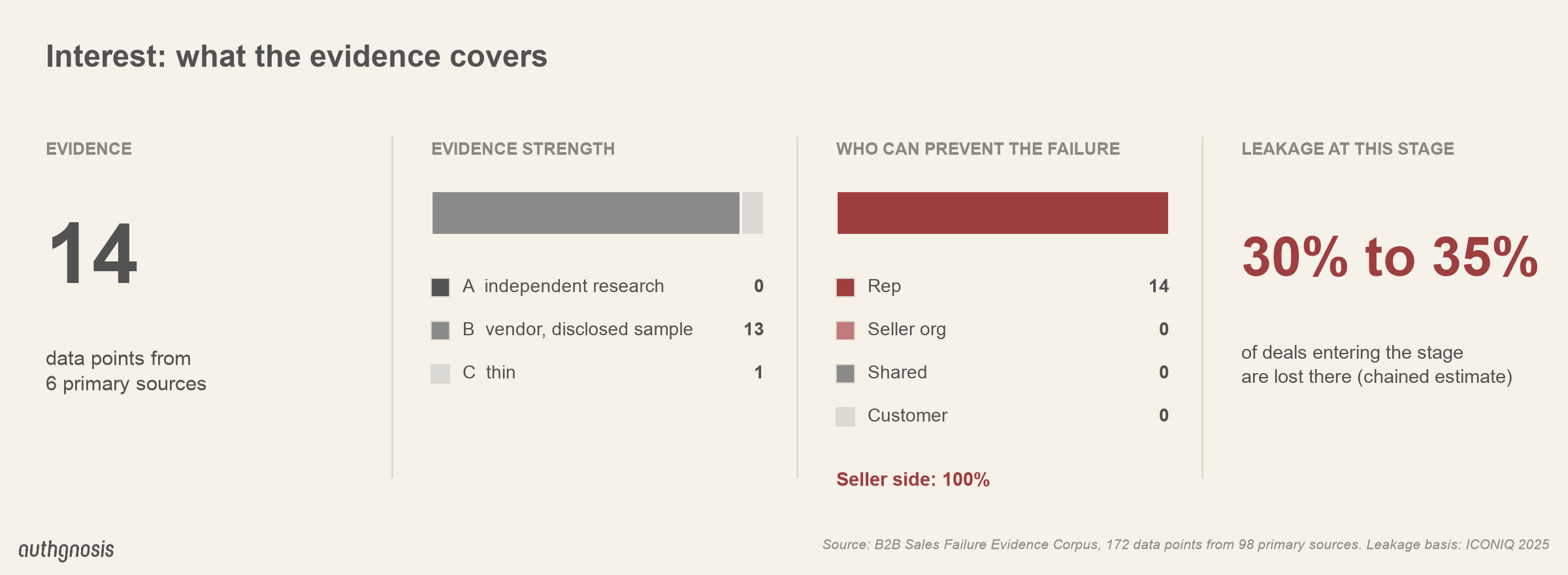
What the evidence covers
Interest has no grade A evidence. All 14 rows are grade B vendor-generated data or Rackham (also grade B), plus one grade C. The findings are consistent with each other, but they're correlational, not causative.
The MEDDPICC result especially may reflect deal quality rather than cause it. Interest claims are shaped as "top performers do X," not "doing X causes wins."
30% - 35% of deals fail through this stage.
Success at Interest
Success here means the discovery conversation turns a plausible pain into a qualified, mutually committed next step:
- The pain is made explicit and material, with all four SPIN parts captured;
- Working hypotheses exist for the champion, the economic buyer and the compelling event;
- An Executive POV and first Mutual Agreement Plan (MAP) have gone out;
- The buyer has agreed to a Discovery Workshop that focuses on prospect-specified pain points, cost of pain, a compelling event and the information required to confirm the problem-solution alignment.
The chained estimate puts leakage here at 30 – 35%, the second-largest after Action.
Failure at Interest
In the evidence, Interest Failure looks like this:
Needs left implied is the failure behind the strongest lever at this stage. In large sales, successful calls uncovered 2.7 Explicit Needs against 1.3 in unsuccessful ones, while Implied Needs barely differed, 4.2 against 3.9 (Rackham 1988).

- The rep talks too much: reps talk 57% of the time in won deals against 62% in lost ones, and winning calls ask fewer questions (Gong 2025). Situation questions don't predict success (Rackham 1988).
What sits within the seller’s control
Nearly every Interest lever is rep-controlled. Governance supplies the process guidance, gates, and tools; the quality of discovery is how it is executed:
- Turn implied needs into explicit ones. This is the strongest lever at the stage. An explicit need is the buyer stating the problem, its cost and wanting it solved (Rackham 1988). In the Motorola study, successful calls had 53% more Implication and 60% more Need-payoff questions (Rackham 1988). The CRM process provides guidance and captures the result; the rep's questioning produces it.
- Listen more, ask fewer and better questions. Less talk and fewer fact-finding questions go with winning calls (Gong 2025; Rackham 1988). The brief already answers the situation questions, so the rep can spend the call on implication and consequence.
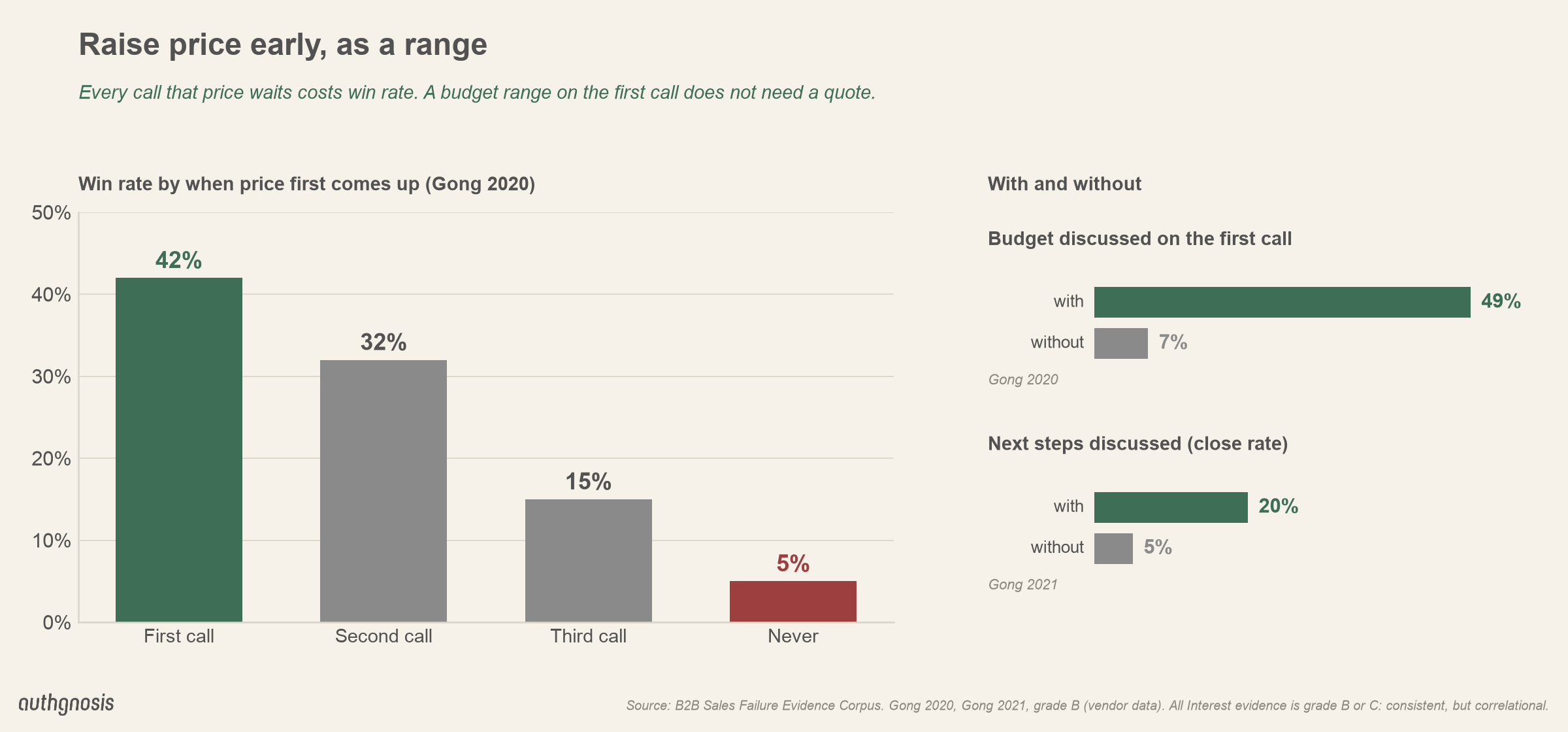
- Raise price/cost early, as a range rather than a scoped price. Win rates were 42% when price came up on the first call and 5% when it never did (Gong 2020). A budget range during the Discovery Call doesn't need a quote. Win rates fall with each call that passes before price comes up: 32% when it first comes up on the second call and 15% on the third (Gong 2020).
- Find the compelling event. 76% of weaker deals lack one (Ebsta and Pavilion 2025). …such as a new fiscal year, new product roll-out, or critical dependencies. The rep asks what happens if nothing changes, and by when. CRM records it, and the Discovery Call is where it surfaces.
- Qualify completely, but at pace. Deals with MEDDPICC complete before the solution is proposed were 324% likelier to win (Ebsta and Pavilion 2024). Being complete matters, but so does speed. The Ebsta and Pavilion benchmarks measure four parts of qualification at this stage: completeness, pace, the economic buyer and the compelling event.
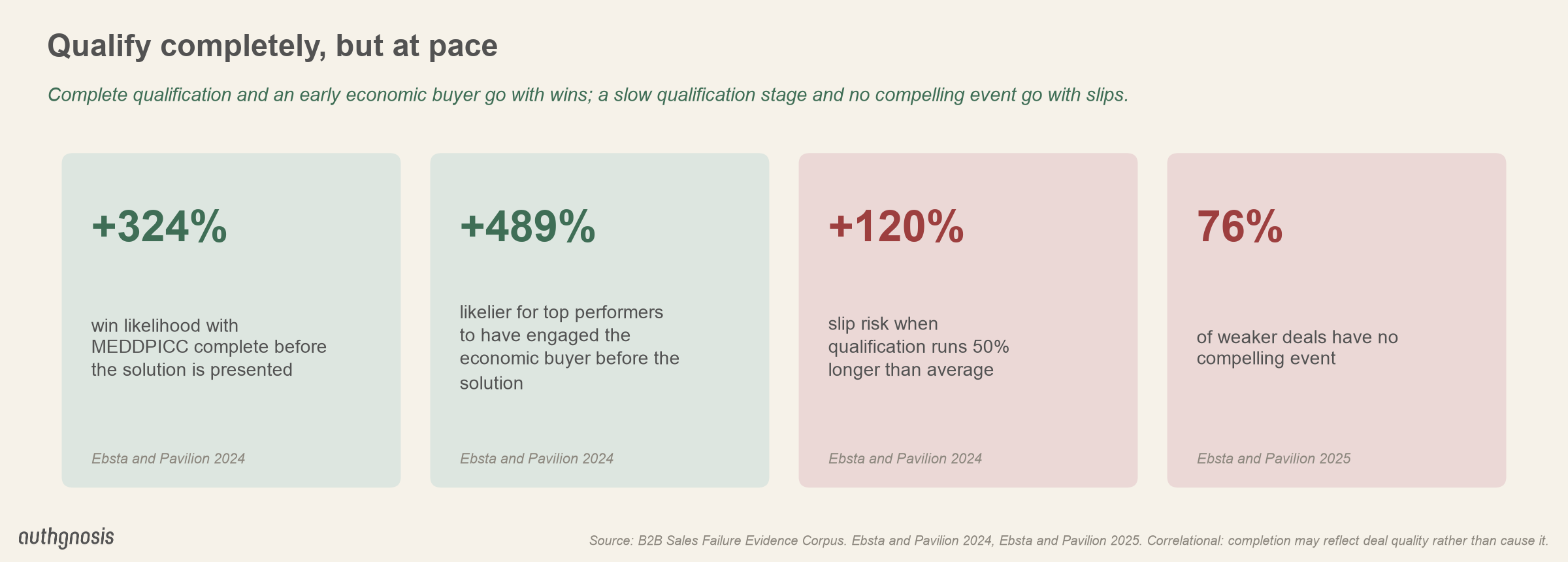
- Test the economic-buyer hypothesis early. Top performers are 489% likelier to have engaged the economic buyer before the solution proposal stage (Ebsta and Pavilion 2024). That means testing who holds the budget but not having to confirm it until further downstream when the customer has internal budget discussions that may change the source of funds.
- Surface the competition early. Discussing competitors early goes with a 49% higher close rate (Gong 2017, grade C). The rep asks who else is being considered, or what alternatives are being considered before the Discovery Workshop, not after the proposal is drafted and sent.
- Leave with a mutual next step. Close rates are 20% with agreed next steps against 5% without (Gong 2021). A booked Discovery Workshop and the first MAP are evidence-based commitment, and they're what makes a Lead convertible to an Opportunity.
Where Interest fits in the AISDALS/L lifecycle
Interest is the third of the nine stages described in The Nine Stages of the AISDALS/L Enterprise Sales Lifecycle. The methods behind discovery and qualification, including SPIN and MEDDPICC, are combined into one process in Four Sales Methodologies, One Integrated System. The Sales Process-Customer Lifecycle CRM Visualization shows the process behind every stage.
How I can help
Through my Authgnosis consulting practice, I design and implement integrated sales, marketing, and customer success processes in your CRM system. I bring over 25 years of revenue leadership experience, data-evidenced research, best-in-class processes and methodologies, and my hands-on development and integration skills to plug pipeline leakage, reduce customer churn, and enable dependable revenue forecasts. If you would like to discuss your sales, marketing, and customer delivery challenges, reach out to me here.