
This post is part of Success and Failure across the Customer Lifecycle, which tests each stage of the AISDALS/L customer lifecycle against 172 data points from 98 primary sources. The lifecycle itself is set out in the series that begins with Integrating Sales Processes and a CLTV-Focused Customer Lifecycle.
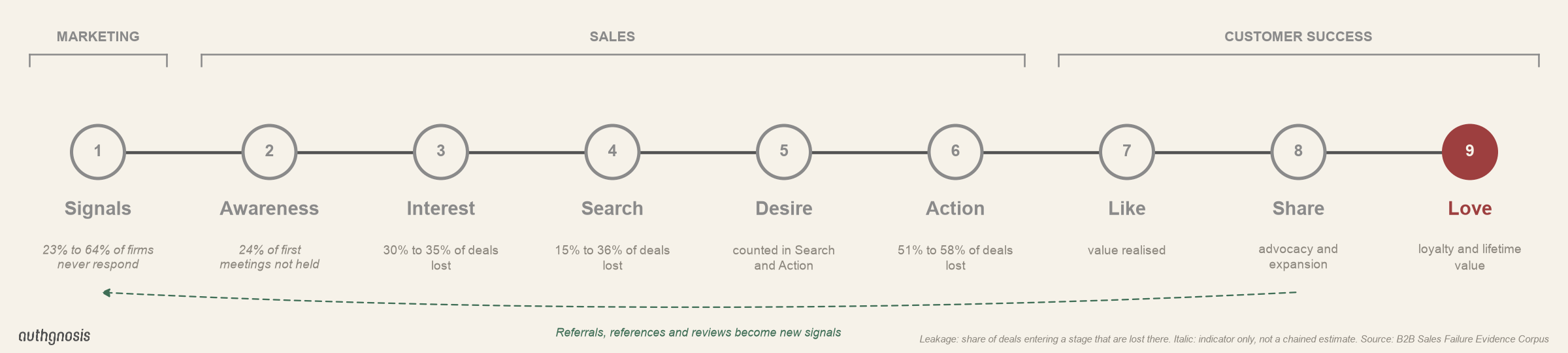
The customer stays with you over time, renews, deepens the relationship, and does so profitably. It's where customer lifetime value (CLTV) accumulates. In your CRM, Love sits with Share in a Customer Success workflow (not Sales-owned):
- A two-stage success measure, operational at go-live and soaked value at 60 - 90 days which become the record that renewal and retention are justified for the customer;
- Phase or whitespace expansion Leads which keep the customer inside a continuous-loop sales process;

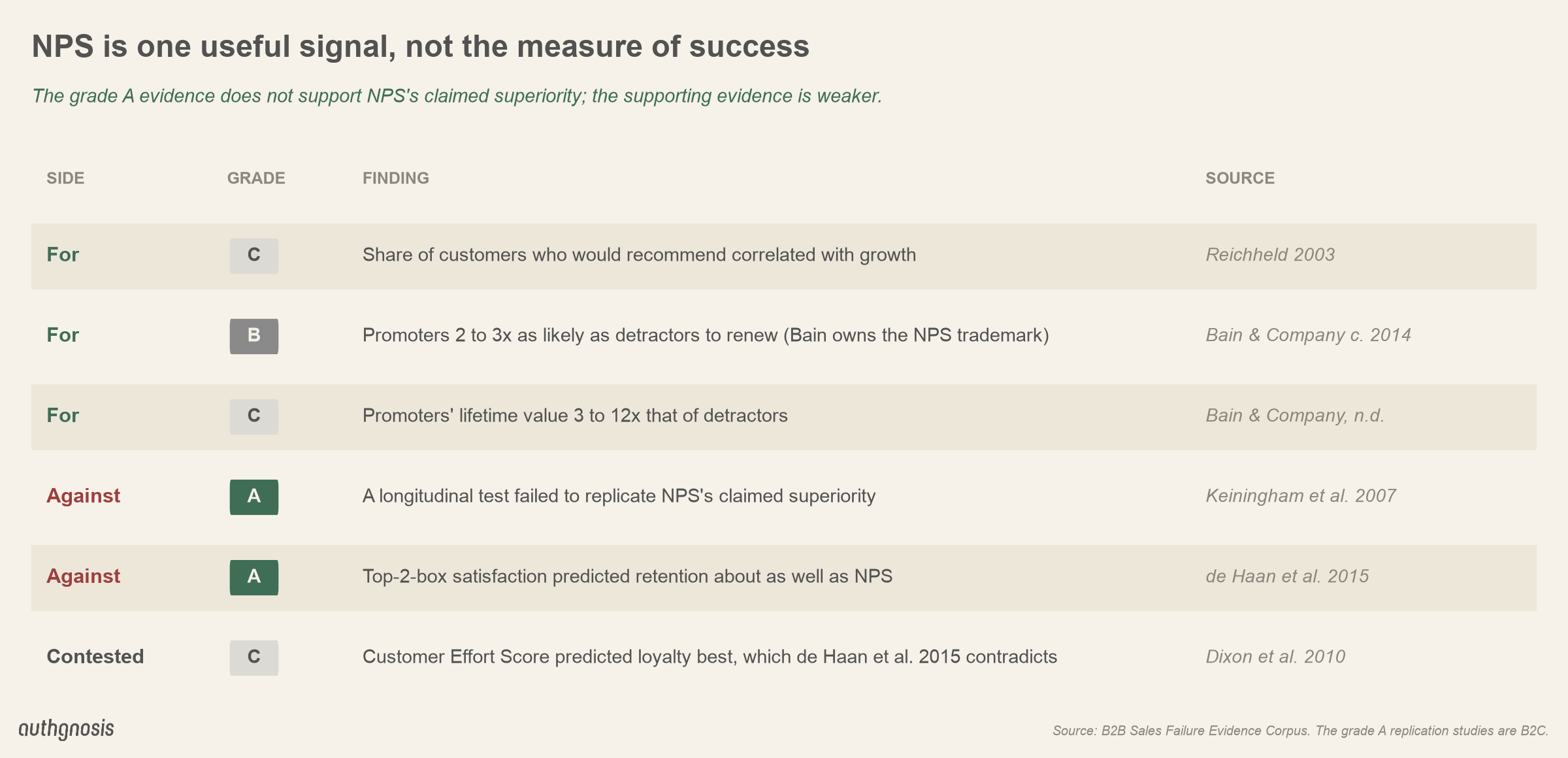
NPS evidence is contested here in the research, and the data shows both sides. Reichheld linked promoter share to growth (Reichheld 2003, grade C). Later grade A research failed to replicate NPS's claimed superiority (Keiningham et al. 2007) and found top-2-box satisfaction predicted retention about as well (de Haan et al. 2015). A Customer Effort finding (Dixon et al. 2010, grade C) pointed the other way from de Haan et al. 2015.
NPS is one useful signal but cannot be relied on for a measurement of Success at the end of the customer lifecycle.
Success at Love
Success here means:
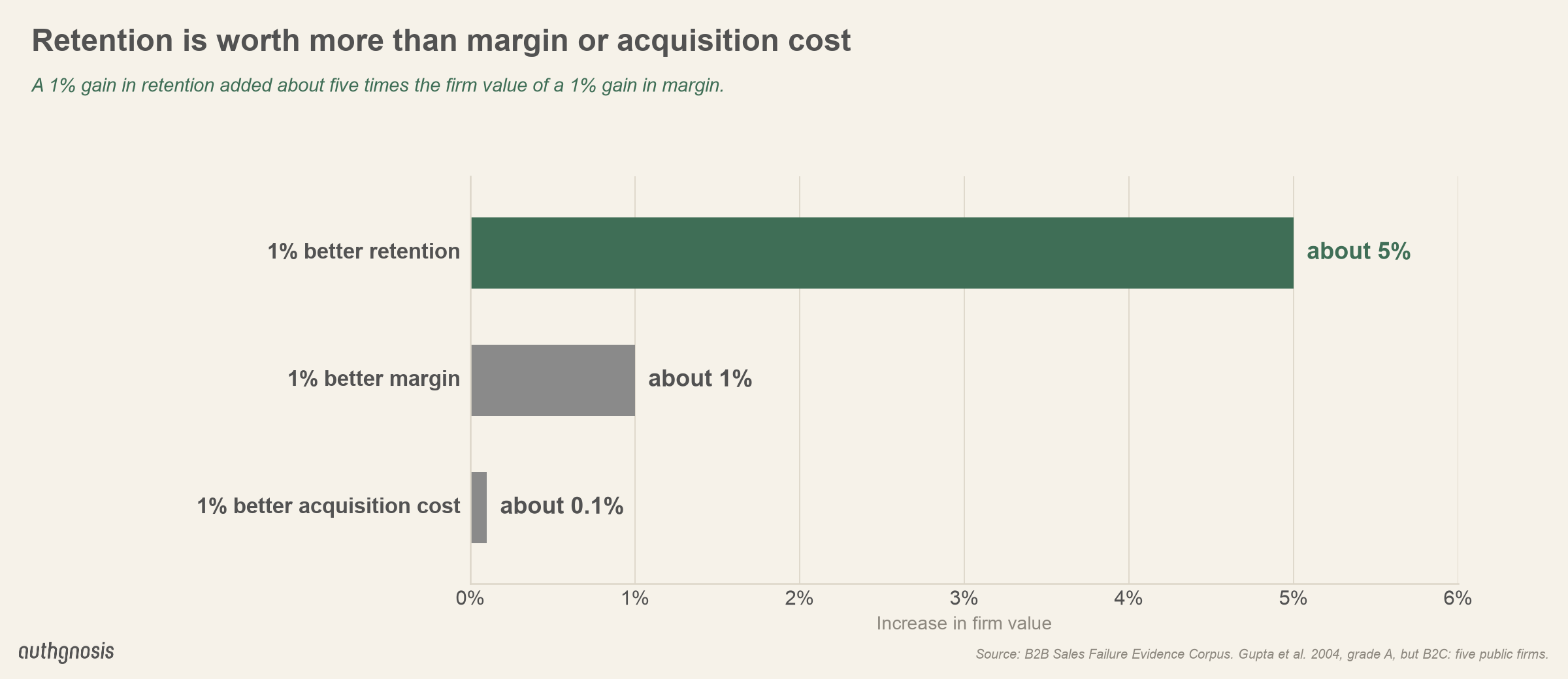
- Retention drives value: a 1% improvement in customer retention raised firm value about 5%, against about 1% for margin and 0.1% for acquisition cost (Gupta et al. 2004, grade A, B2C). Cutting defections by 5% raised profits 30 - 85% across three service businesses (Reichheld and Sasser 1990, grade C).
- Relationship quality matters most in B2B: in a meta-analysis, relationship quality had the strongest effect on objective performance. Relationship marketing worked better in business markets, and better when the relationship was with an individual person rather than the firm (Palmatier et al. 2006, grade A).
- Promoters renew: in B2B, promoters were 2 - 3 times as likely as detractors to renew and about twice as likely to consider more of the vendor's products (Bain & Company c. 2014). Their lifetime value runs 3 - 12 times that of detractors (Bain & Company, n.d., grade C).
- Top performers keep growing their base: top-quartile net retention held at about 110 - 120%. Teams that tied incentives to net retention reported less churn and downsell (ICONIQ 2026).
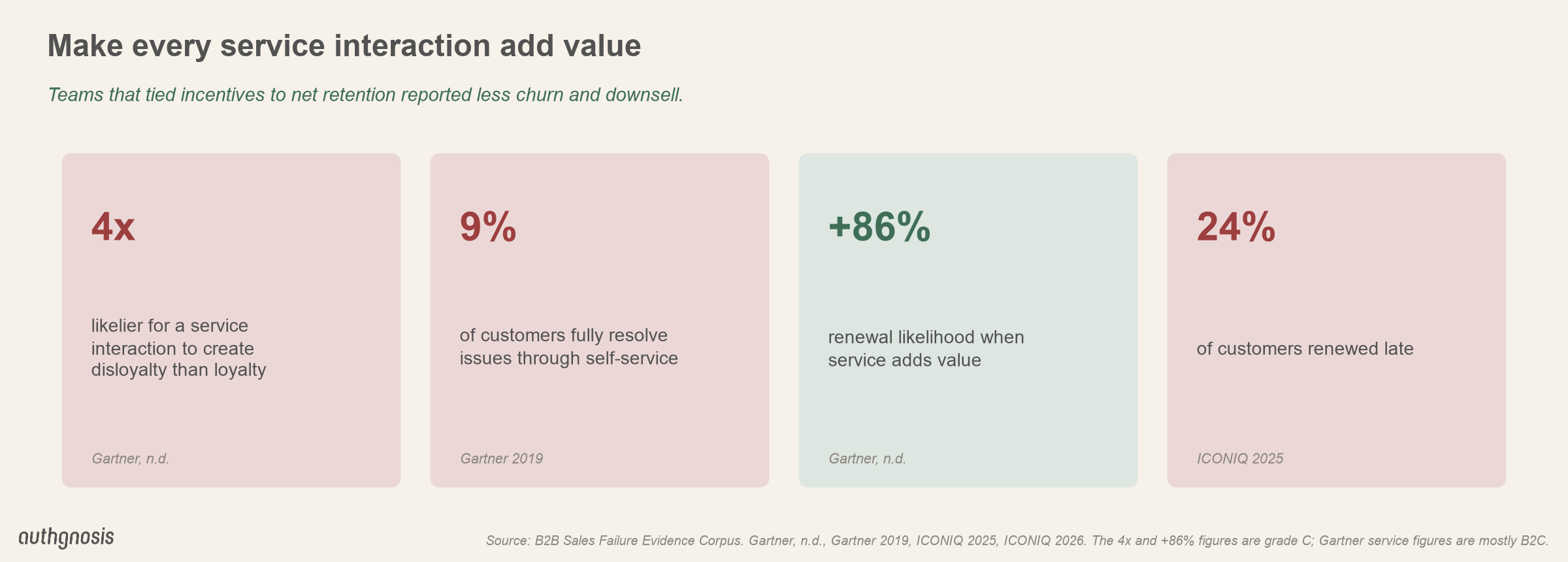
- Service that adds value renews: value added during a service interaction raised renewal or repurchase likelihood by 86% (Gartner, n.d., grade C).
Failure at Love
Failure here looks like:
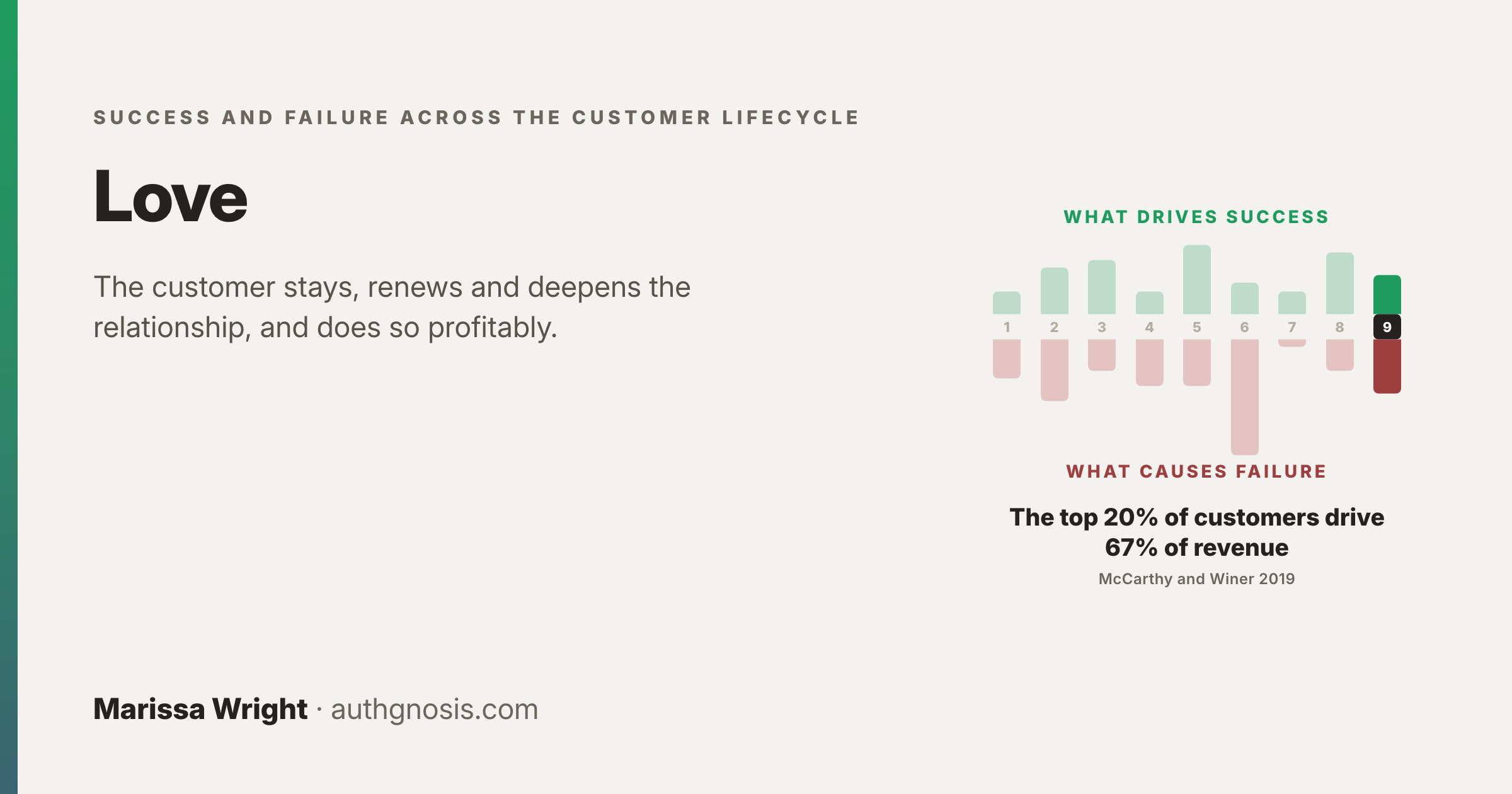
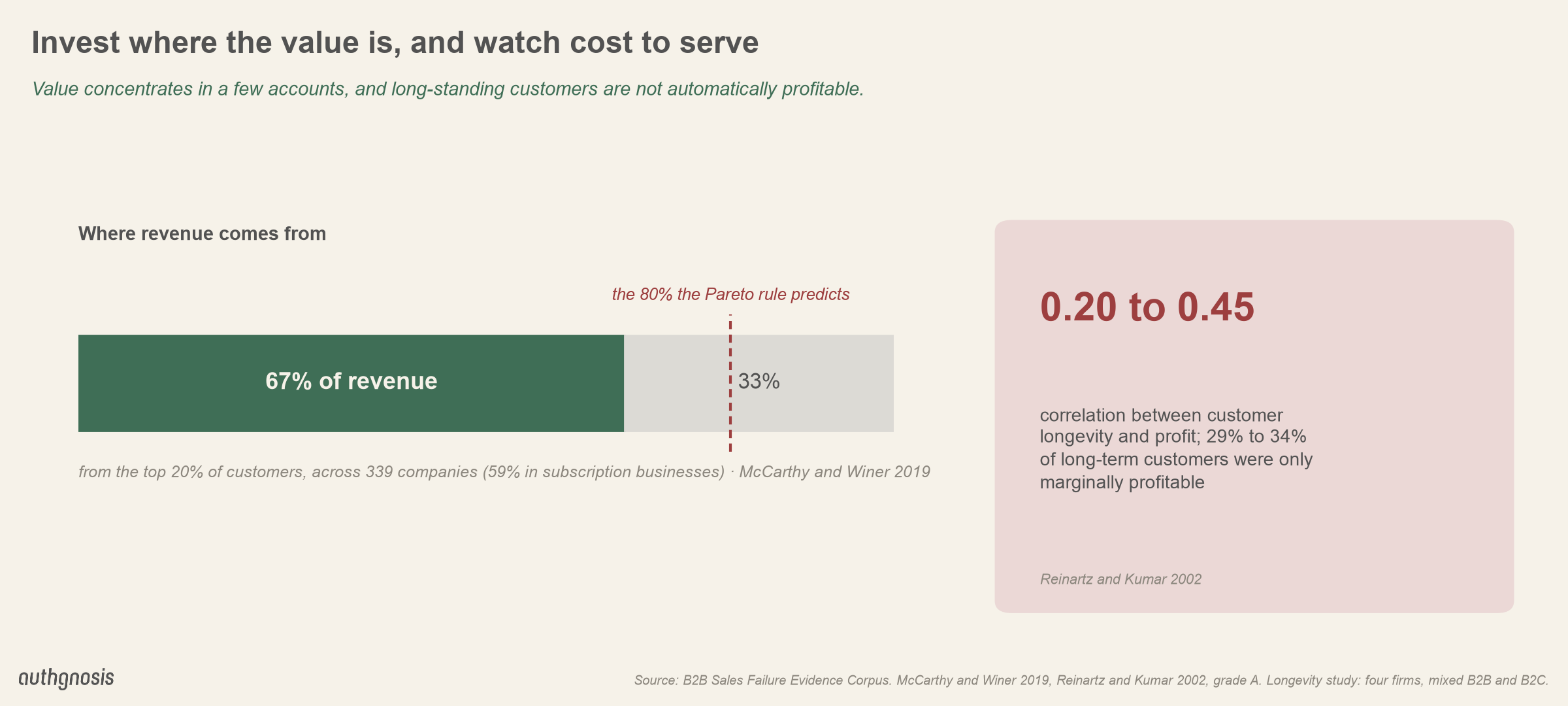
The first two failures concern where the value sits. The top 20% of customers drove about 67% of revenue across 339 companies (McCarthy and Winer 2019), and 29% to 34% of long-term customers were only marginally profitable (Reinartz and Kumar 2002).
- Account management effort shows diminishing returns: more account-management effort helps less and less in business markets, and its effect depends on the competitive context (Bowman and Narayandas 2004, grade A).
- Retention erodes quietly: median B2B SaaS net retention was 82% (ChartMogul 2025), and 24% of customers renewed late (ICONIQ 2025).
- The market moves: 49.5% of enterprise buyers switched software for better AI features, 32.0% in SMB (G2 2025).
Who owns what
- Keep a named person in the relationship (Sales, in SMB firms). Relationships with an individual are more effective than relationships with the firm (Palmatier et al. 2006). In an SMB services firm, the person who sold the work usually is the relationship. In larger firms with strong brand value and market leadership, that may not be the case. For SMBs, the rep stays visible after the sale and plans how the relationship transfers to Customer Success and introduces Marketing to leverage the success story.
- Manage renewals from value evidence (Customer Success or account management). Start the renewal conversation early and base it on the success measures, not the contract end date. That goes at the 24% late-renewal rate (ICONIQ 2025).
- Invest where the value is (Leadership). Revenue concentrates in the top 20% (McCarthy and Winer 2019), and account effort has diminishing returns (Bowman and Narayandas 2004). Leadership decides which accounts are worth deep investment and which should be served efficiently, using an account-profitability view on the management dashboard. Losing one key account hurts far more than the averages suggest.
- Watch cost to serve, not just tenure (Leadership, with account owners). Long-standing customers aren't automatically profitable (Reinartz and Kumar 2002). Account owners flag scope creep, unbilled work and discounting on long-standing accounts, and Leadership sets the strategy to correct unprofitable customers at renewal. 29% - 34% of long-term customers were only marginally profitable, and at the B2B service provider studied, loyal customers cost more to serve (Reinartz and Kumar 2002, grade A).
- Make every service interaction add value (Customer Success and Delivery, with Sales on key accounts). Given the 4x disloyalty risk (Gartner, n.d.), Customer Success uses each post-sale contact with Key Stakeholders to show progress or bring a new idea, and owns escalated problems end to end rather than routing them into a queue. On key accounts, the rep joins these contacts to keep the named relationship described above. Only 9% of customers fully resolve issues through self-service (Gartner 2019), and value added during a service interaction raised renewal or repurchase likelihood by 86% (Gartner, n.d.).
- Measure advocacy, but choose the metric carefully (Customer Success, with Marketing). Promoters renew more (Bain & Company c. 2014), but question whether NPS is the right measure. A simple satisfaction question at each value review may be enough to start, and it feeds straight into Share stage’s request for referrals, reviews, testimonials, and case-studies.
- Pay for retention, not just new logos (Leadership). Incentives tied to net retention went with less churn and downsell (ICONIQ 2026). This is an organizational governance strategy, not a rep behaviour.
Where Love fits in the AISDALS/L lifecycle
Love is the ninth and final of the nine stages described in The Nine Stages of the AISDALS/L Enterprise Sales Lifecycle. Integrating Sales Processes and a CLTV-Focused Customer Lifecycle sets out why the lifecycle is built around customer lifetime value, and Exit Criteria, Forecast Quality, and a CLTV Growth Flywheel covers the CLTV growth flywheel that retention sustains. The Sales Process-Customer Lifecycle CRM Visualization shows the process behind every stage.
How I can help
Through my Authgnosis consulting practice, I design and implement integrated sales, marketing, and customer success processes in your CRM system. I bring over 25 years of revenue leadership experience, data-evidenced research, best-in-class processes and methodologies, and my hands-on development and integration skills to plug pipeline leakage, reduce customer churn, and enable dependable revenue forecasts. If you would like to discuss your sales, marketing, and customer delivery challenges, reach out to me here.