
This post is part of Success and Failure across the Customer Lifecycle, which tests each stage of the AISDALS/L customer lifecycle against 172 data points from 98 primary sources. The lifecycle itself is set out in the series that begins with Integrating Sales Processes and a CLTV-Focused Customer Lifecycle.
The design decisions that prevent regret, such as success criteria, concurrence and the MAP, can be captured in the CRM’s sales process, and the measurement that proves customer-realized value comes afterwards. Most SMB firms (and many larger firms as well) lack the systems and cross-functional processes to manage this post-sale stage effectively.
Retention is a Sales and Customer Success outcome supported by Marketing. The findings that sales conduct shapes most directly, closing pressure (Rackham 1988), the buyer's decision confidence (Gartner 2021) and how promises are handed to delivery (Gartner 2025), are all set before or at contract signature.
This makes a strong argument against the common split where Sales closes a deal and hands off the consequences of a customer who felt pressured to close without clarity on the success criteria for Customer Success to cope with.
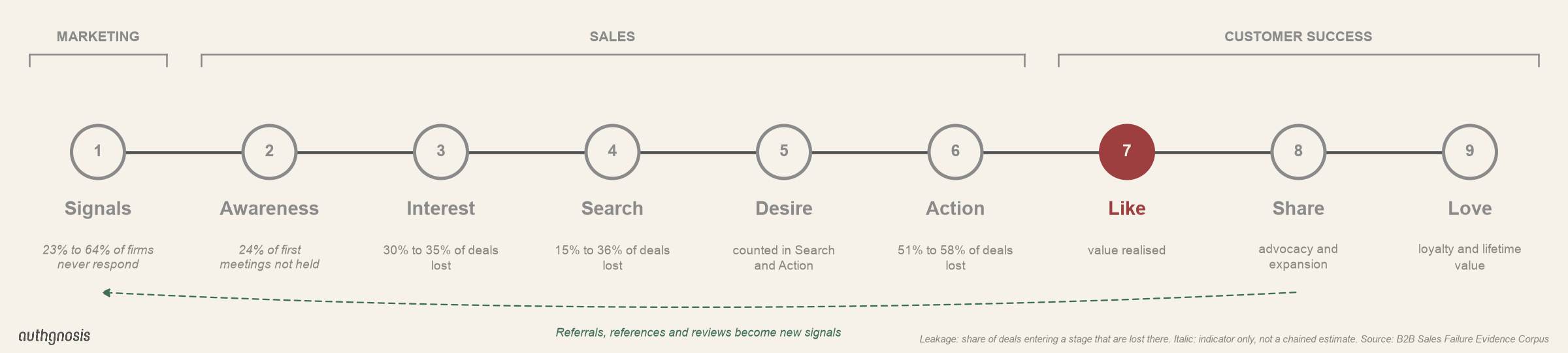
Expansion and retention economics follow at Share and Love. A 1% retention gain is worth about 5% of firm value (Gupta et al. 2004). Firms at 130%+ net retention (NRR) grow 50% against 21% for those at 100 - 110% (SaaS Capital 2025). Median SMB-skewed SaaS net retention is 82% (ChartMogul 2025). The Like stage is the gate those numbers depend on.
Net Retention Rate (NRR) Measures Expansion
Expansion from the customers who stay can outweigh what you lose from those who shrink or leave. An example:

You lost three of your ten clients either entirely or in part, and still earned 15% more from the group, before any new customer was signed. That's why firms at 130%+ grow so much faster (SaaS Capital 2025): the customer base grows on its own, and new sales add on top.
Gross Revenue Retention (GRR) Surfaces Churn
GRR uses the same calculation as NRR, but leaves out expansion, so it can never exceed 100%. It shows how well you hold on to revenue. In the example, GRR is ($1M − $200K − $50K) ÷ $1M = 75%. The two together tell the story: a 75% GRR with a 115% NRR means expansion is covering real churn, which is fragile.
Success at Like
The customer gets the value they were promised, recognises it, and is glad they chose you:
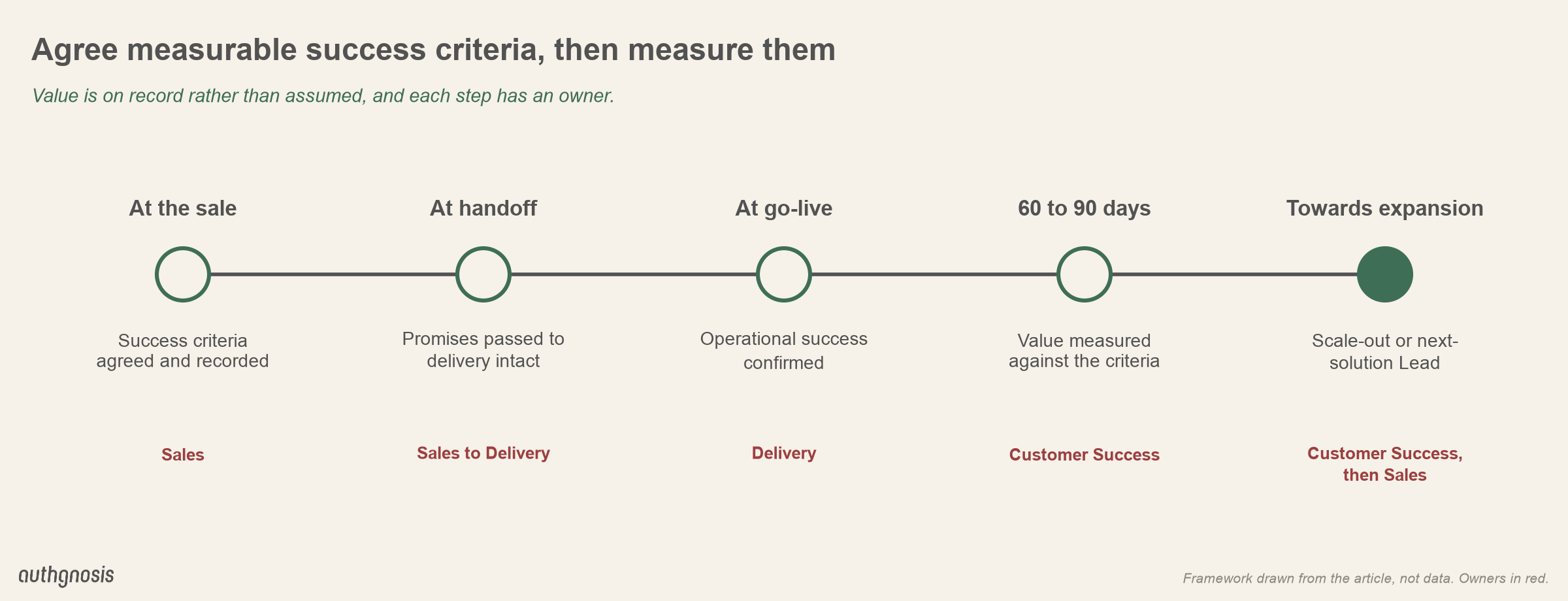
- At the sale: the success criteria agreed in Financial Discovery are the standard the customer will judge you against later;
- At handoff: the promises made during the sale are passed to delivery intact;
- At go-live: operational success is confirmed;
- 60 - 90 days after go-live: value is measured against the success criteria.
- Towards expansion: the scale-out conversation and the next solution hypothesis lead to a new phased or whitespace expansion Lead.
Failure at Like
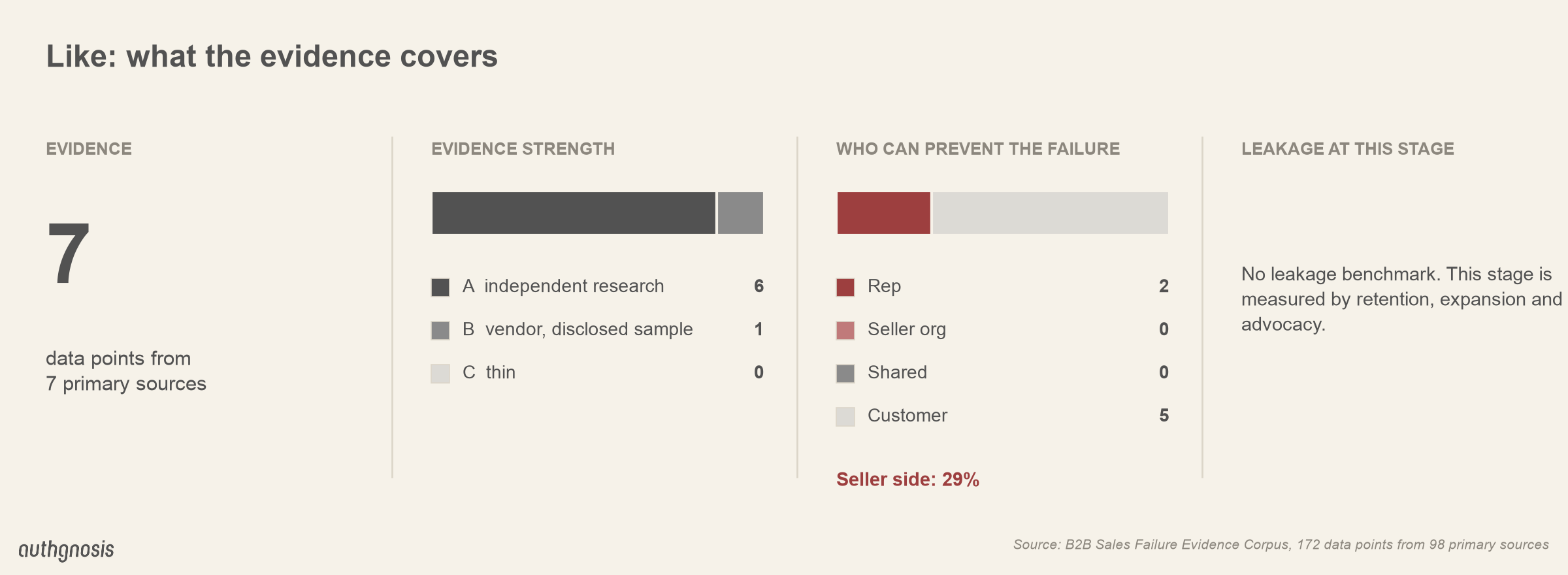
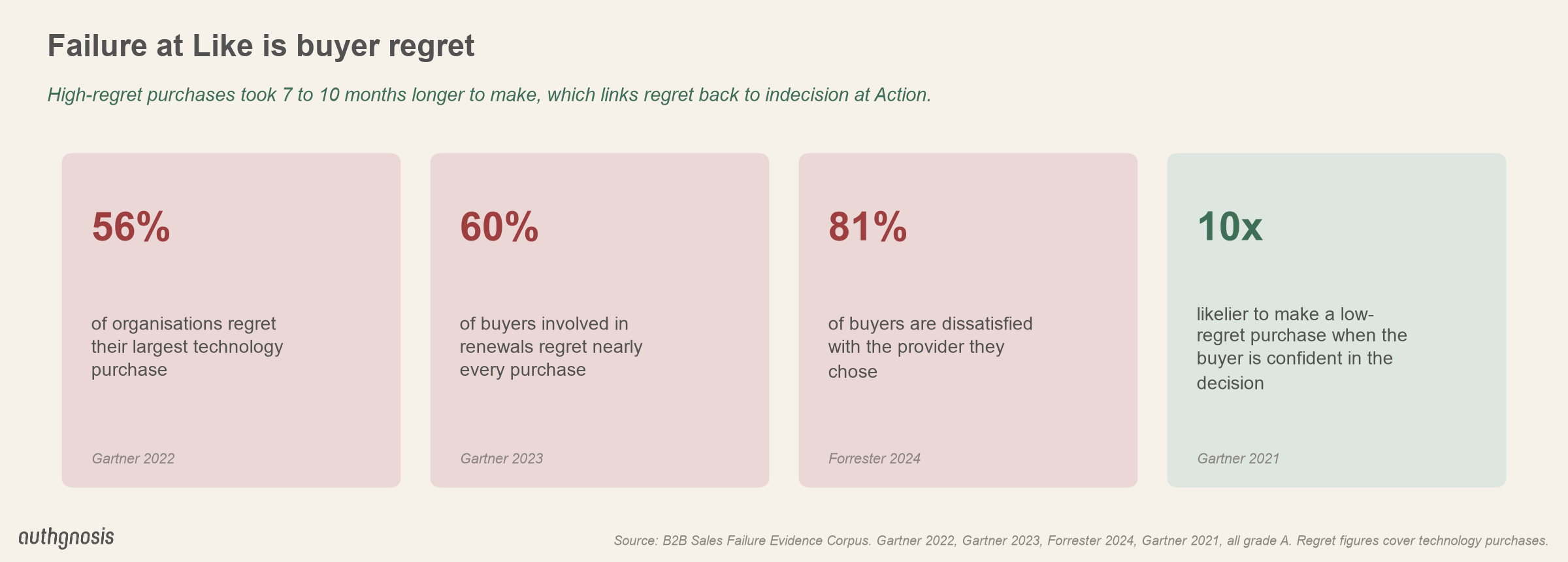
Failure here is buyer regret, and the evidence is grade A and consistent:
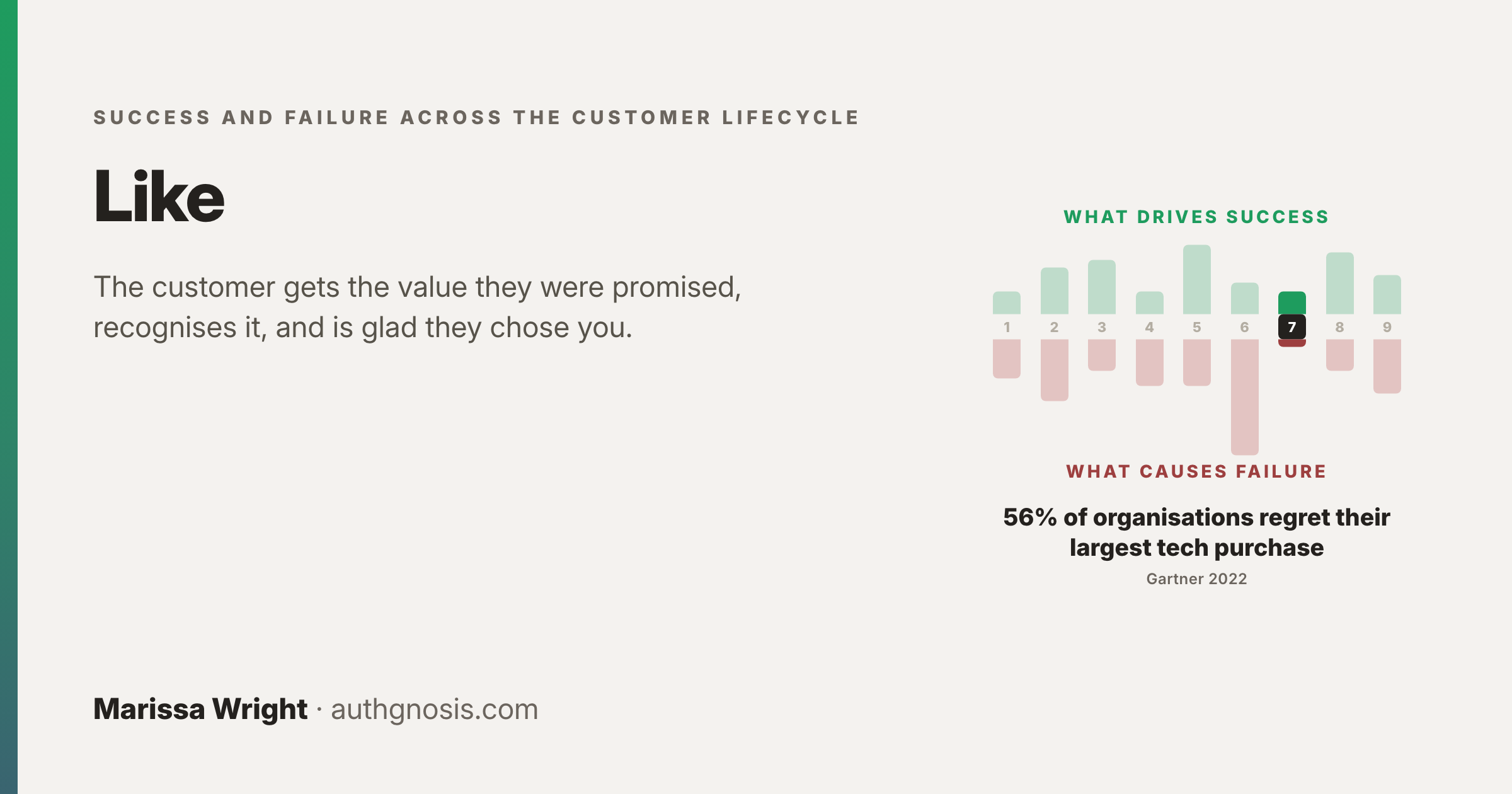
The regret is widespread: 56% of organisations had high regret over their largest technology purchase in the past two years (Gartner 2022), and the renewal and satisfaction measures point the same way.
- A gap between promised and realised value blocks growth with existing customers (Gartner 2025).
The 7 - 10 month delay links back to Action: long, indecisive purchases are also the ones buyers later regret.
Who owns what
Sales, Customer Success, delivery and Marketing each own part of this stage. In an SMB firm delivering professional services as part of the sale, one person may wear several of these hats: the seller often stays involved after the sale and sometimes delivers the work themselves or through a services delivery partner. The roles are still different, so each lever below names its owner:
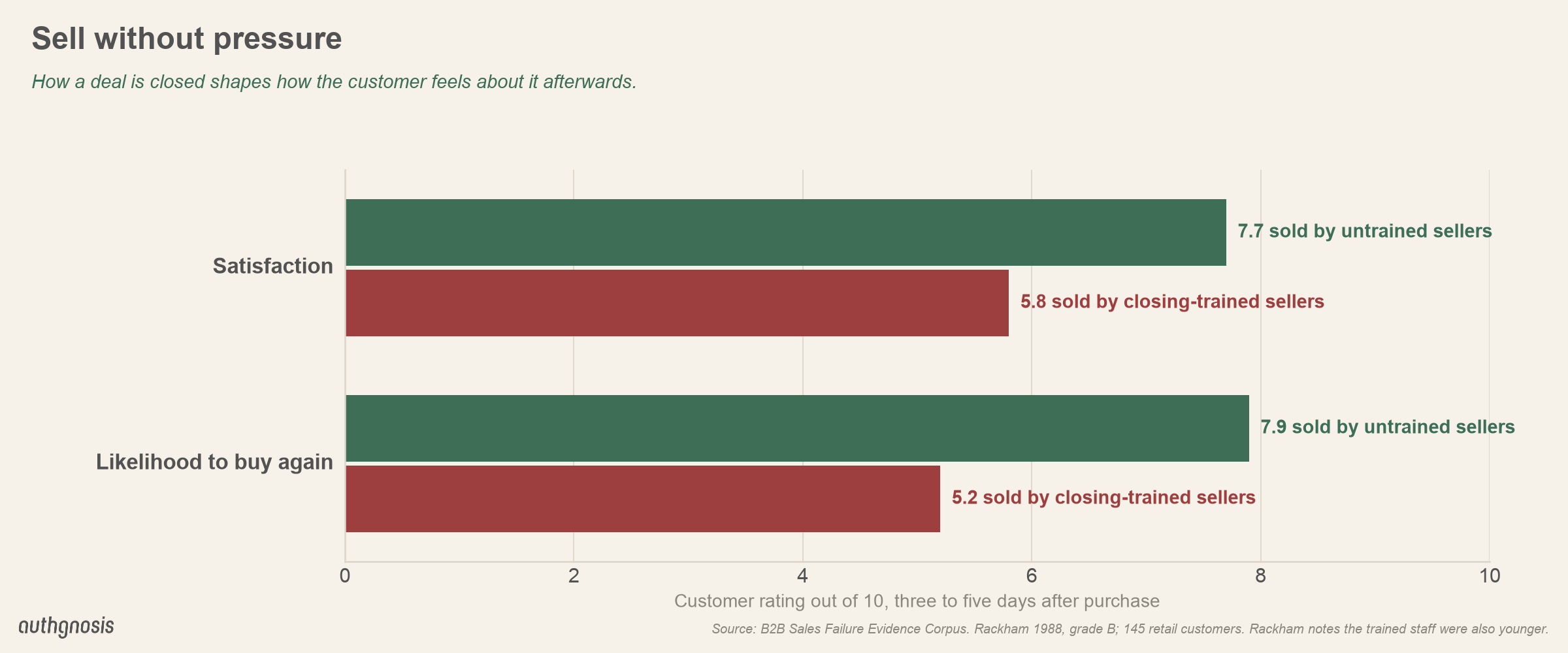
- Sell without pressure (Sales). Customers sold by closing-trained sellers rated their satisfaction 5.8 out of 10, against 7.7 for customers sold by untrained sellers (Rackham 1988). How the deal is closed shapes how the customer feels about it afterwards. Getting continuous stakeholder concurrence via a MAP is an ideal method to avoid being surprised later.
- Build the customer's decision confidence before they sign (Sales). Confident buyers are 10 times likelier to make a low-regret purchase (Gartner 2021) and twice as likely to report a high-quality deal (Gartner 2026). Regret prevention starts at Action.
- Agree measurable success criteria, then measure them (Sales, Delivery, Customer Success). Sales agrees the success criteria with the customer during the sale and records them in the CRM. Delivery confirms operational success at go-live, and Customer Success measures performance against the criteria at 60 to 90 days, so the value is on record rather than assumed.
- Hand over the promises, not just the contract (Sales) (Gartner 2025). At handoff, the rep briefs delivery on what was promised, to whom, and why it mattered to each stakeholder. A value gap usually opens at the handoff if not done correctly.
- Stay in the relationship after the sale (Sales). Trust in the seller, and indirectly in the salesperson, predicts anticipated future business (Doney and Cannon 1997). This is the other side of the Action finding (Doney and Cannon 1997): trust doesn't decide the current purchase, but it does shape the next one. A rep who leaves at contract signature gives that up - light touches with key stakeholders by the rep during delivery can promote this trust that carries into CLTV expansion efforts.
- Raise problems before the customer does (Customer Success, with Marketing). Service is about four times likelier to create disloyalty than loyalty, and only 9% of customers fully resolve issues through self-service (Gartner, n.d.; Gartner 2019). Where service adds value, renewal likelihood rises 86% (Gartner, n.d.). Customer Success owns issue resolution and early warning. Marketing can monitor external and internal signals of delivery failure alongside Customer Success, and the CRM surfaces risk to the account's rep and to management.
- Turn realised value into the next opportunity (Customer Success, then Sales). Once Customer Success confirms value, the rep begins a scale-out conversation for phased expansion of the current solution, or names the next solution hypothesis for whitespace expansion. Customer Success-sourced opportunities have the highest win rate of any source (ICONIQ 2026), and 48% - 63% of new ARR comes from expansion as companies scale (KeyBanc and Sapphire Ventures 2024).
Where Like fits in the AISDALS/L lifecycle
Like is the seventh of the nine stages described in The Nine Stages of the AISDALS/L Enterprise Sales Lifecycle. Integrating Sales Processes and a CLTV-Focused Customer Lifecycle sets out why the lifecycle is built around customer lifetime value, and Exit Criteria, Forecast Quality, and a CLTV Growth Flywheel covers how realised value feeds the CLTV growth flywheel. The Sales Process-Customer Lifecycle CRM Visualization shows the process behind every stage.
How I can help
Through my Authgnosis consulting practice, I design and implement integrated sales, marketing, and customer success processes in your CRM system. I bring over 25 years of revenue leadership experience, data-evidenced research, best-in-class processes and methodologies, and my hands-on development and integration skills to plug pipeline leakage, reduce customer churn, and enable dependable revenue forecasts. If you would like to discuss your sales, marketing, and customer delivery challenges, reach out to me here.