
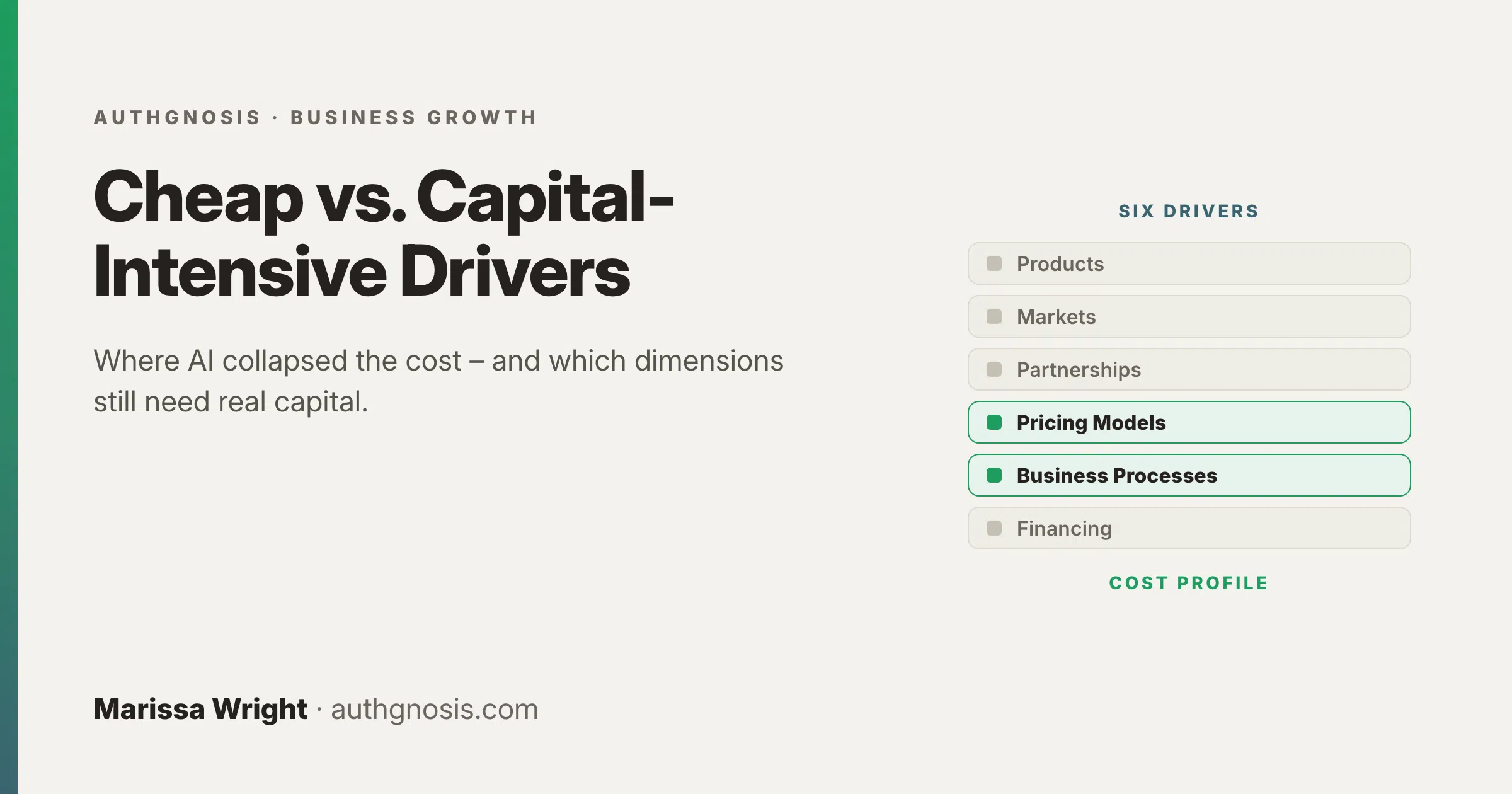
Cheap growth levers versus capital-intensive ones
| Cost profile | Drivers | Detail |
|---|---|---|
| Low cost / high leverage | Pricing Models; Business Processes & automation (AI-enabled); much of Product development (AI-assisted) | Designing a pricing model is a thinking exercise. AI now makes workflow automation, analytics, and even software development achievable at a fraction of the cost of two years ago. Highest ROI per dollar of runway. |
| Moderate | Partnerships; Market/segment expansion | Partnerships often avoid capital outlay by borrowing a partner’s relationships, but cost founder attention. New-market GTM takes spend but not always heavy capital. |
| Capital-intensive (and shrinking) | Hardware components in hybrid HW/SaaS; large-scale infrastructure; the raise itself | The truly capital-hungry items are narrowing. And in Canada, non-dilutive grants (SR&ED, IRAP) can offset a real share of even these. Canadian EBC/SBVC tax incentives can offset investor risk by 70%. |
The cheapest dimensions, pricing and (now) process automation, are also the ones most often left on the table, which leads straight to the next question.
Related drivers: Business processes, Products, and Financing.
Working with Authgnosis
Authgnosis is my AI-native business growth consulting practice.
I’ve turned the Six Drivers framework into a Growth Diagnostic Checklist: a section-by-section guide covering all six drivers plus the talent layer and a “Fulcrum” assessment.
It’s the prerequisite information I need to map a company’s current state, desired future state, and co-create a growth strategy that identifies the one or two moves that will move your growth needle fastest.
Get the Authgnosis Growth Diagnostic Checklist
The full section-by-section diagnostic, free. If you would like this analysis applied to your business, that is my Strategic Growth Plan engagement.
Sources: Boardman, Shapiro & Vining (2004), JSME 1(2); Andrew von Nordenflycht (2010); Canadian funding per SR&ED (Budget 2025) and NRC-IRAP (2025–26).