
Every growth driver pushes on your competitive position
This series set out to answer a question founders and operating executives ask constantly and rarely get a structured answer to: how do I grow this business?
Boardman, Shapiro & Vining define the purpose of strategy narrowly: a company exists to generate returns above its cost of capital.
In founder language, that is sustainable margin and defensible unit economics, and it means growth counts only when each new dollar of revenue is worth more than it costs to win and keep.
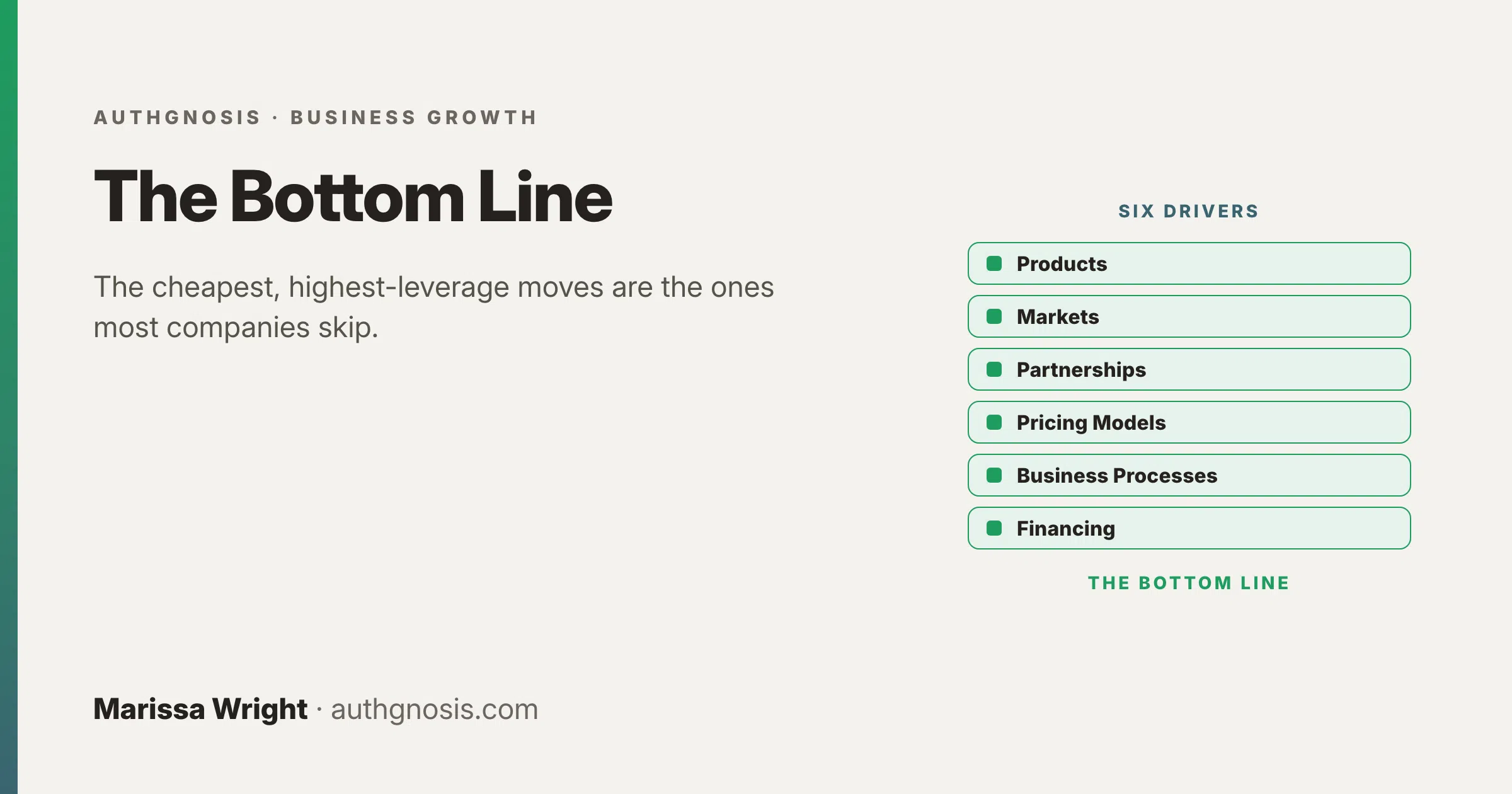
That definition is what gives these Six Drivers their structure. Products, markets, partnerships, business and pricing models, business processes, and financing are the dimensions your company can move, and each one pushes on your competitive position.
Invest in one and you can produce growth. Invest in the right combination in the right order and you can build a position competitors cannot easily take from you. Invest out of order, or in a dimension the organization is not yet able to support, and the same money destroys value.
Four separate analyses converge on the same short list
The series examined the Six Drivers four different ways, and the four do not rank them alike.
- Products rank highest, because nothing compounds without product-market fit.
- Business processes rank next, because process advantage is embedded in systems and culture and is the hardest thing on the list for a competitor to copy.
- Pricing models and business processes are the most independent moves, available next quarter without preconditions.
- Market expansion is the most dependent, because expansion multiplies whatever unit economics already exist, including negative ones.
- Designing a pricing model is a thinking exercise rather than a capital expense
- AI tooling has moved process automation and much of product development within reach of small teams.
- A pricing change reaches margin immediately
- A workflow automation can pay back in weeks
- Product-market fit and process-as-a-system are long-term investments.
The four rankings overlap on the same two drivers:
- Pricing models and business process automation sit near the top of all of them, and they are also the two dimensions founders most reliably skip, for the same reason: neither produces a launch moment.
- Non-dilutive financing is the third. For a Canadian firm, the Scientific Research and Experimental Development tax credit (SR&ED) and the National Research Council’s Industrial Research Assistance Program (NRC-IRAP) cost neither equity nor debt: Budget 2025 raised the enhanced SR&ED expenditure limit to $6 million, putting up to roughly $2.1 million a year in refundable credits within reach of qualifying companies.
For most early- and growth-stage technology firms, cost is no longer what separates them from their highest-leverage moves: the binding constraints are diagnosis and sequence.
Order of execution (sequence) is set by your binding constraint
In every failure the series examined, the idea was workable and the order was wrong.
- Quibi and Homejoy scaled before the advantage was real.
- MoviePass and Boeing moved a cheap and fast dimension in a value-destroying direction.
- WeWork poured capital into a loop that did not work, which brought the outcome forward without changing it.
The successes respected the order: Figma, Slack, Stripe, Dropbox and Mailchimp each built on a dimension their organization could support, then extended from it.
What sets the order is the constraint, and the constraint is seldom the largest opportunity.
Three maturities determine it:
- How complete the product is against what the buyer needs to succeed
- How far the category has travelled along the adoption curve
- Whether the organization can serve the buyer it is selling to today.
Growth compounds when all three point at the same buyer, and the least advanced of the three sets the ceiling.
Business maturity moves slowest, which is why it is the most common point of failure, and why the failure often surfaces only after a period of apparent success.
Boardman, Shapiro & Vining call the “honest-assessment” step the Fulcrum and note that it is exactly where teams fall off. That matches my experience: most companies can list their opportunities without effort but cannot describe their constraint.
Special Case: Firms that sell expertise rather than a product run the same drivers with different weights. Business processes become knowledge management, financing inverts because the core assets can leave at any time, and talent retention operates as a growth constraint rather than a staffing question.
Where to start
The sequence that follows is consistent for most early- and growth-stage firms:
- Sharpen margin and free up time with the cheap, independent dimensions, pricing design and AI-enabled process automation
- Build durable advantage through product-market fit and process systems
- Extend that advantage through disciplined market expansion and partnerships, reputation-builders early and channel partners once demand is proven
- Fund the loop with capital matched to the risk and horizon of what is being built, tapping non-dilutive sources before giving up equity.
What that sequence requires is an accurate read of where you stand and the discipline to act in order.
There are two ways to get the read:
- You can run the diagnosis yourself, using my Growth Diagnostic Checklist: the section-by-section guide I work from, covering all six drivers plus the talent layer and the Fulcrum assessment.
- You can hire me to do it, whether that is pressure-testing a growth strategy, designing a pricing model, building market intelligence platforms, implementing AI-enabled go-to-market (GTM) automations and analytics, developing a partner strategy, or preparing to raise capital.
Related drivers: Pricing models, Business processes, Financing, and Partnerships.
Working with Authgnosis
Authgnosis is my AI-native business growth consulting practice.
I’ve turned the Six Drivers framework into a Growth Diagnostic Checklist: a section-by-section guide covering all six drivers plus the talent layer and a “Fulcrum” assessment.
It’s the prerequisite information I need to map a company’s current state, desired future state, and co-create a growth strategy that identifies the one or two moves that will move your growth needle fastest.
Get the Authgnosis Growth Diagnostic Checklist
The full section-by-section diagnostic, free. If you would like this analysis applied to your business, that is my Strategic Growth Plan engagement.
Sources: Boardman, Shapiro & Vining (2004), JSME 1(2); Andrew von Nordenflycht (2010); Canadian funding per SR&ED (Budget 2025) and NRC-IRAP (2025–26).