
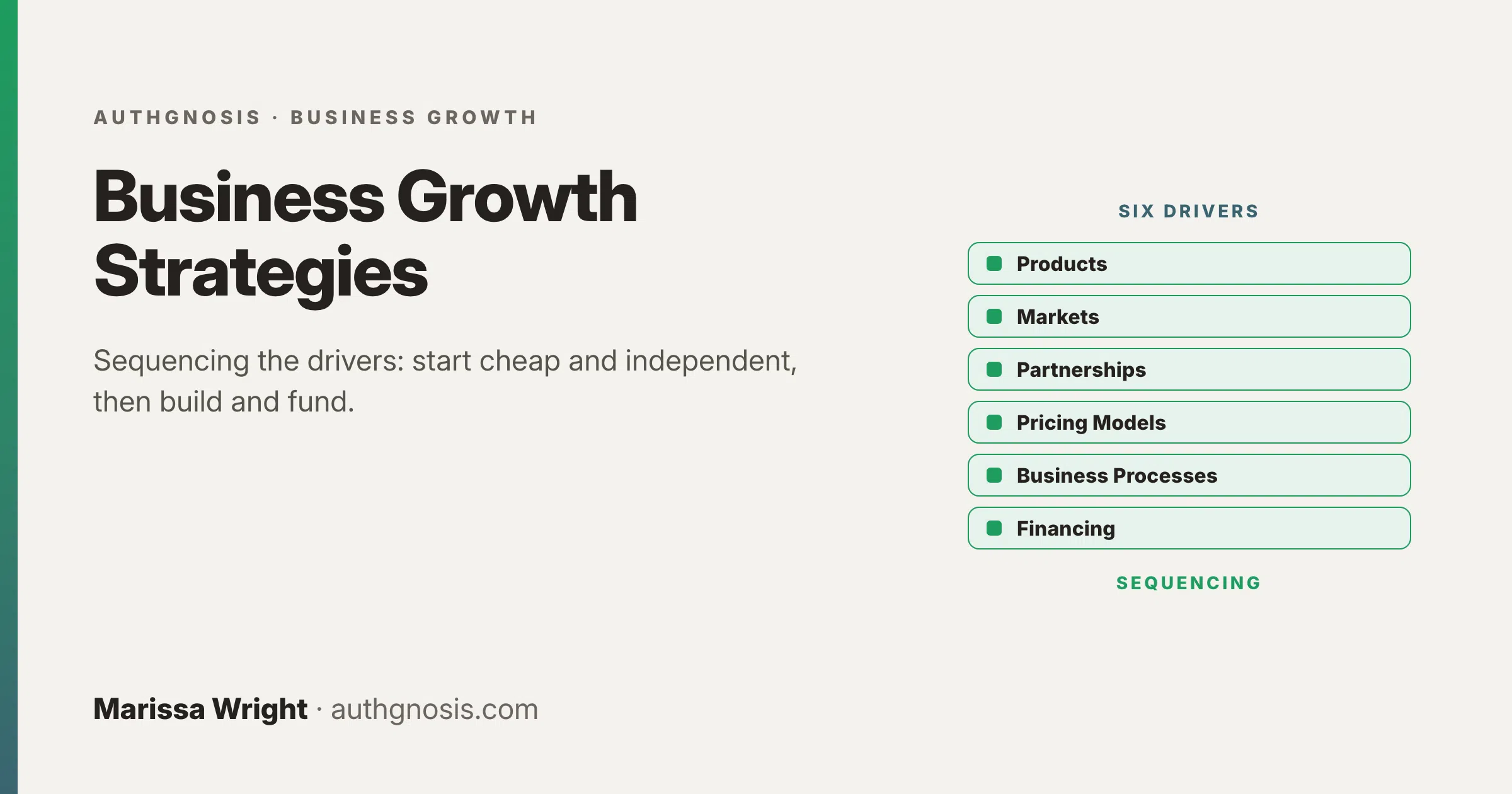
How to sequence a business growth strategy
The short version is:
- Start with the cheap, independent, fast dimensions, pricing design and AI-enabled process automation, to sharpen margin and free up cash and time.
- Build sustainable advantage through product-market fit and process systems (slower, but defensible, and cheaper to build than they used to be).
- Extend that advantage through disciplined market expansion and the right partnerships: reputation-builders early, channel partners once demand is proven.
- Fund the loop with capital matched to the risk and horizon of what you’re building, and tap non-dilutive grants before giving up equity.
Every failure above broke one of these rules:
- Quibi and Homejoy scaled before the advantage (or the unit economics) were real
- MoviePass and Boeing invested in a fast/cheap dimension in a value-destroying way
- WeWork over-fueled a broken loop. Every success respected the sequence.
The bigger picture is more complex: when I develop a strategic growth plan for a client, I follow the Boardman/Shapiro/Vining Framework.
Related: the six drivers – Products, Markets, Partnerships, Pricing models, Business processes, Financing – and how they depend on each other.
Working with Authgnosis
Authgnosis is my AI-native business growth consulting practice.
I’ve turned the Six Drivers framework into a Growth Diagnostic Checklist: a section-by-section guide covering all six drivers plus the talent layer and a “Fulcrum” assessment.
It’s the prerequisite information I need to map a company’s current state, desired future state, and co-create a growth strategy that identifies the one or two moves that will move your growth needle fastest.
Get the Authgnosis Growth Diagnostic Checklist
The full section-by-section diagnostic, free. If you would like this analysis applied to your business, that is my Strategic Growth Plan engagement.
Sources: Boardman, Shapiro & Vining (2004), JSME 1(2); Andrew von Nordenflycht (2010); Canadian funding per SR&ED (Budget 2025) and NRC-IRAP (2025–26).