
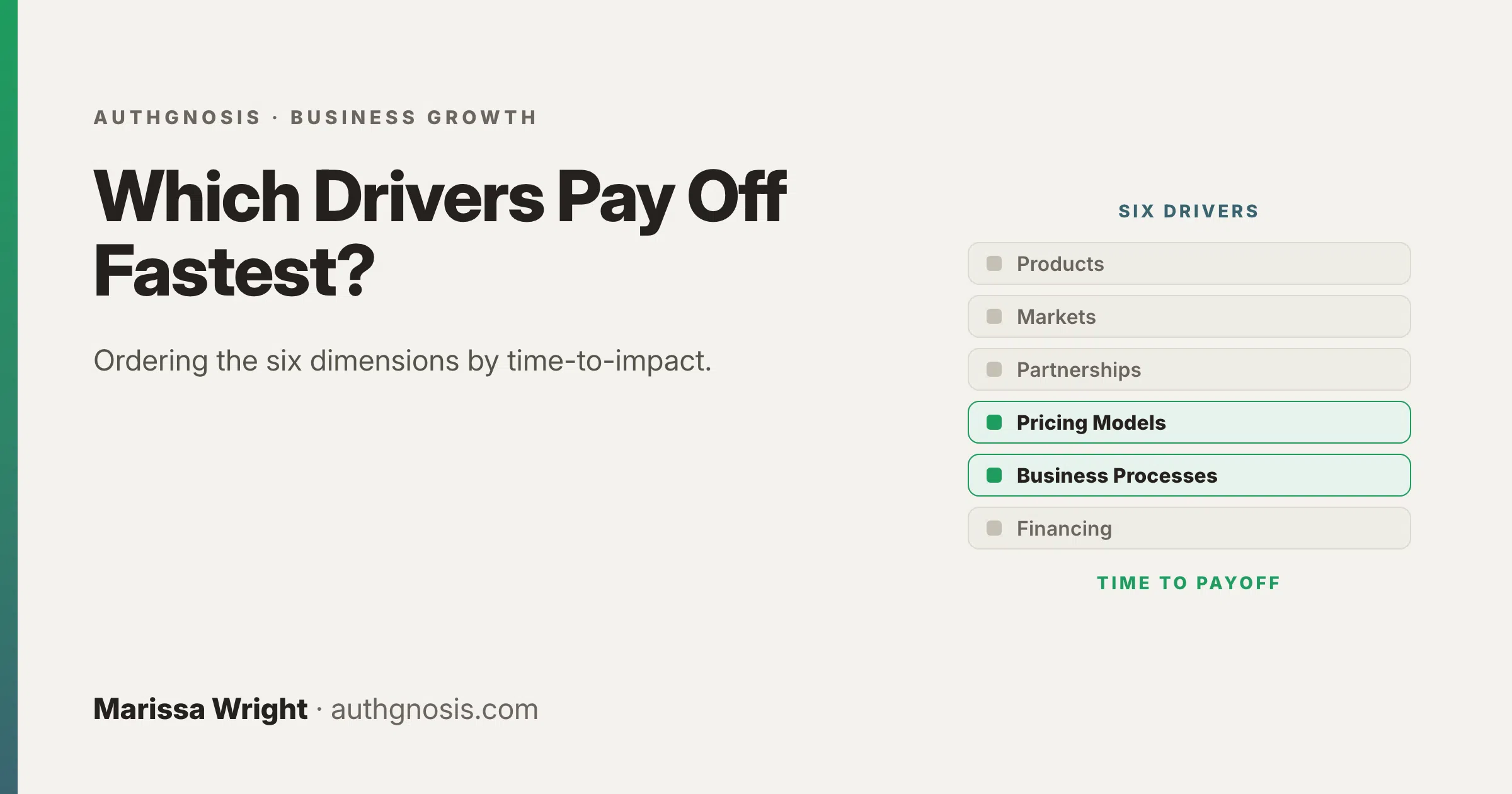
| Time horizon | Drivers | Why |
|---|---|---|
| Short-term (weeks–months) | Pricing Models; a financing injection; AI-enabled process automation; some distribution partnerships | A pricing change hits margin immediately; capital lands at once; a workflow automation can pay back in weeks; a platform integration can open a channel quickly. |
| Medium-term (quarters–year+) | New-segment/market entry; reputation-building partnerships; non-dilutive grant cycles | Land-and-expand ramps; community/association credibility compounds; grant applications take time but cost no equity. |
| Long-term (years) | Product-market fit into a sustainable product; process as a system; a real moat | Figma and Stripe compounded advantage over years; Toyota’s system took decades. The most sustainable edges are the slowest to build. |
Founder Guidance
Use the fast, cheap dimensions (pricing, process automation, targeted or non-dilutive financing) to fund the slow ones (product, process-as-a-system, reputation).
The trap is doing only the fast dimensions: you get a short-term bump with no sustainable position, which is the Quibi and MoviePass pattern in different forms.
Related drivers: Pricing models, Business processes, and Financing.
Working with Authgnosis
Authgnosis is my AI-native business growth consulting practice.
I’ve turned the Six Drivers framework into a Growth Diagnostic Checklist: a section-by-section guide covering all six drivers plus the talent layer and a “Fulcrum” assessment.
It’s the prerequisite information I need to map a company’s current state, desired future state, and co-create a growth strategy that identifies the one or two moves that will move your growth needle fastest.
Get the Authgnosis Growth Diagnostic Checklist
The full section-by-section diagnostic, free. If you would like this analysis applied to your business, that is my Strategic Growth Plan engagement.
Sources: Boardman, Shapiro & Vining (2004), JSME 1(2); Andrew von Nordenflycht (2010); Canadian funding per SR&ED (Budget 2025) and NRC-IRAP (2025–26).