
How it grows the business: Process advantage is the most sustainable and hardest-to-copy source of margin, because it’s embedded in systems and culture, not a single feature a competitor can clone.
What’s changed, and why this is now a bargain dimension. The cost of automation has dropped through the floor. AI tooling makes it possible to build workflow automations, analytics, and process improvements that simply weren’t feasible for a small company even two years ago, and to do it at a fraction of the old cost.
Work that once required a data team or a six-figure systems integration is now affordable and accessible to early- and growth-stage firms. That moves business-process design and automation from an expensive, back-burner project to one of the highest-ROI, lowest-cost dimensions a founder can invest in, which is exactly why it’s so often overlooked.
Business Process Analysis
The Current State
I spend most of my time on RevOps business processes: Sales, Marketing, Professional Services, and Customer Success motions. The first step is mapping out the current state, which you can see an example of in the mapping of a complete RevOps sales process and customer lifecycle below - there are hundreds of steps from end-to-end.
Future State
From that initial current-state, I begin looking for process optimization opportunities, beginning with the Sales process, and map it out with the ideal future-state. The process below became ~100 steps (far too many to manually manage - but it gets better...keep reading!).

Implementation
This provides me with a roadmap to implement the process - for RevOps, the CRM is the source-of-truth and is ideally suited as a home for managing revenue process flows. Check out an interactive model of my own CRM implementation of an Enterprise Sales Process and Customer Lifecycle.
In the figures 3 and 4 below, you can see the real-world implementation of the future state in Microsoft Dynamics 365 CRM Sales Professional - at this point the total number of steps are down 15% to 85 steps - still too many to manually manage, but stay tuned...it gets better!
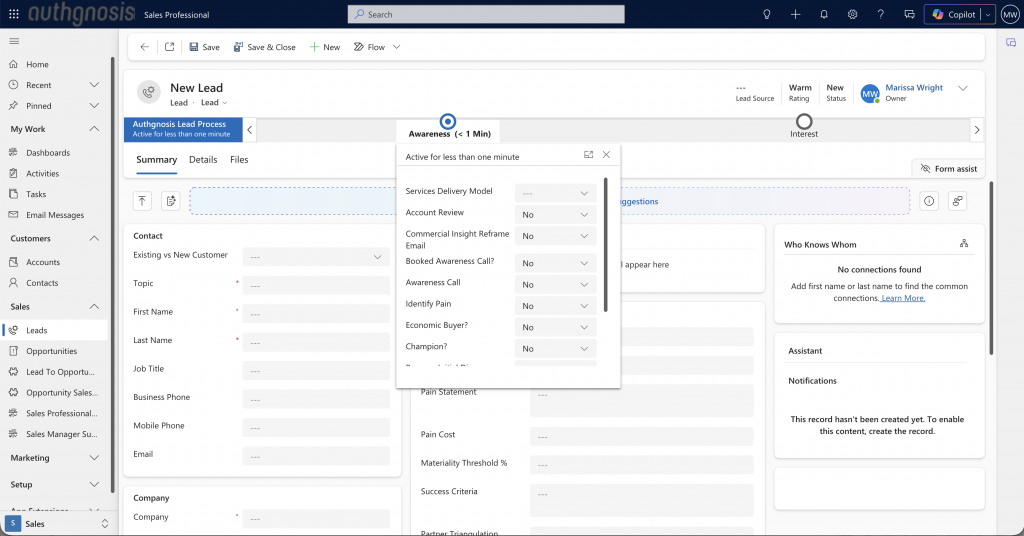

Once in CRM, I'm now able to use Microsoft's Power Automate and AI Builder to reduce the number of tasks, and almost eliminate the need for salespeople to manually manage the process flow entirely.
- Microsoft PowerAutomate - monitors external buyer-readiness signals and scores marketing-qualified leads (MQLs) that are automatically routed to Sales for qualification, and generates Tasks for salespeople based on the Activities required for each Stage in the process.
- Microsoft AI Builder - assesses quality of data collected by the Sales team to prepare email templates, generate meeting preparation documents, and surface incomplete or garbage data for management oversight
Only 54% of the Steps in the process require Tasks or Activities. The benefits of these optimized, automated, and AI-native workflows are:
- No need for salespeople to manually manage the Lead and Opportunity process - 100% automated by Activity completions
- ~50%+ process efficiency gain reducing salesperson
- Automatic process compliance
- Complete tracking and root-cause diagnostic of pipeline leakage
- Predictive deal-failure analysis enabled by time between Activities, Steps, and Stages
- Continuous improvement of forecast reliability
- Continuous-loop of CLTV-focused customer whitespace expansion
- An average of 7 Activities per Stage to Close easily managed across a large enterprise sales cycle
- End-to-end integration of the AISDALS/L customer lifecycle mapped against a CRM-managed sales process and the four most popular sales methodologies: MEDDPICC, Challenger, Sandler, and SPIN
The advantages I bring to my clients are 44 years in Sales and Marketing with 25 years in a senior leadership role, and the deep technical skills to move them from concept-design-implementation-operations.
Process Success Story: Stripe
Stripe turned developer experience and reliability into a moat: clean APIs, obsessive documentation, and operational rigor that made it the default payments layer for a generation of startups.
That’s a process advantage: rivals could copy the feature set and still not match the experience.
Anchor comparison: the Toyota Production System (JIT, Kaizen) delivered quality and efficiency that competitors studied for decades and still couldn’t replicate.
Process Failure Story: Boeing
The common growth-stage killer: doubling the team before codifying how the work is done, so quality, onboarding, and culture dilute. Boeing’s 737 MAX is the extreme cautionary tale: it outsourced critical software to contractors paid as little as $9/hour while shedding senior engineers, and the process failures behind MCAS contributed to two fatal crashes and a grounding.
Cutting process cost without protecting process integrity destroys value at any scale.
Authgnosis Services: I assess my clients’ current-state revenue-side processes, identify inefficiencies and gaps, design and implement process automations including AI-native process automation and analytics, and create executive dashboards to surface critical process KPIs. I document, analyze, identify integration points, create their future-state processes, and implement them across Sales and Marketing tooling, with their CRM systems as the source-of-truth.
Working with Authgnosis
Authgnosis is my AI-native business growth consulting practice.
I’ve turned the Six Drivers framework into a Growth Diagnostic Checklist: a section-by-section guide covering all six drivers plus the talent layer and a “Fulcrum” assessment.
It’s the prerequisite information I need to map a company’s current state, desired future state, and co-create a growth strategy that identifies the one or two moves that will move your growth needle fastest.
Get the Authgnosis Growth Diagnostic Checklist
The full section-by-section diagnostic, free. If you would like this analysis applied to your business, that is my Strategic Growth Plan engagement.
Sources: Boardman, Shapiro & Vining (2004), JSME 1(2); Andrew von Nordenflycht (2010); Canadian funding per SR&ED (Budget 2025) and NRC-IRAP (2025–26).