
This is where the rubber hits the road: my proposed integration of the MEDDPICC, Challenger, Sandler, and SPIN sales methdologies with a modern marketing customer lifecycle ideally suited to large enterprise selling. This integration enables Sales and Marketing teams to align to a company's business plan that invariably is based on maximizing acquired customer market share and their share of the sellable solution footprint within each customer.
Each stage carries a defined set of salesperson Actions, Decision Points, and Exit Criteria that is designed to track in a company's CRM system and drive Forecast quality. The diagram below lays out that mapping in full.
Click the Design Map's PDF image below in the top right to expand or download the PDF version.
Signals
Before a single seller is engaged, demand is sensed.
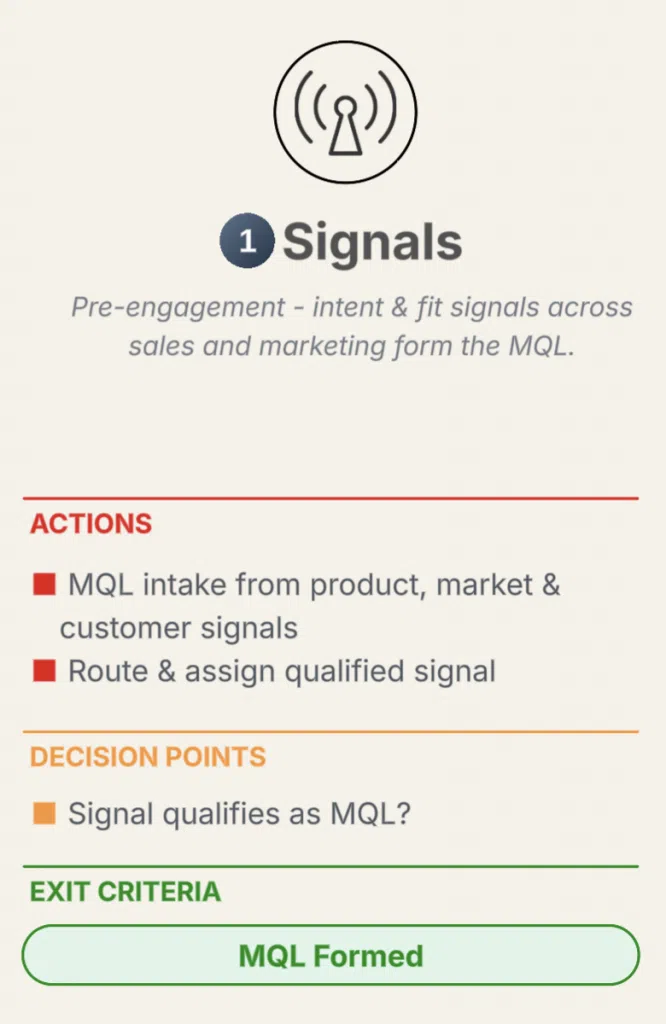
Product, partner, and market signals: intent data, partner-sourced interest, and customer activity across the portfolio, are collected and resolved into a Marketing Qualified Lead. The exit criterion is simple but disciplined: a qualified MQL is formed, or the signal is set aside.
Awareness
Sales receives the MQL and engages the prospective decision-makers.
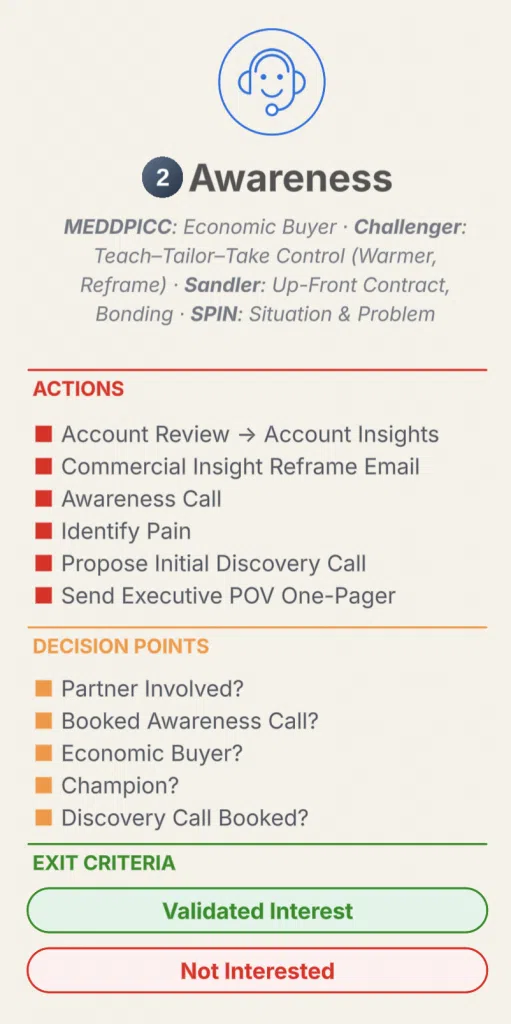
The seller reviews the account, delivers a commercial-insight reframe, runs an awareness call, and works to identify pain, an economic buyer, and a champion before proposing an initial discovery call.
The decision gates: Economic Buyer? Champion? Discovery call booked? – force qualification early. The stage exits as Validated Interest or Not Interested. Cleanly disqualifying here is a feature, not a failure.
Interest
The seller and the customer build a shared Mutual Action Plan, run initial discovery, and qualify material pain.

Gates test for real pain, customer agreement to the MAP, and a booked discovery workshop. The exit is a Sales Qualified Lead, or Unqualified.
Search
This is the technical and economic evaluation stage the old funnels ignore.
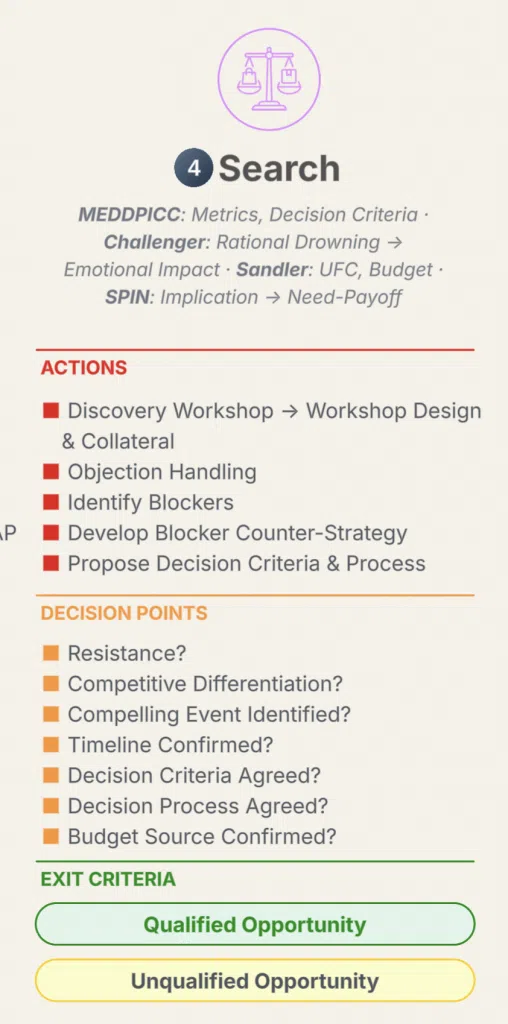
The team runs a discovery workshop, handles objections, identifies blockers, develops a counter-strategy against competitors, and proposes decision criteria and a buying process.
The decision gates are dense by design: Competitive differentiation? Compelling event identified? Timeline confirmed? Decision criteria and process agreed? Budget source confirmed? The exit is a Qualified Opportunity (or Unqualified, flagged as caution).
Desire
Now the customer genuinely wants the solution, and the work turns to proving and pricing it.

Technical drafts and partner syncs, an economic proposal, a champion-led proposal review, final proposal collaboration, and economic-buyer alignment all converge here.
Gates confirm technical and economic buy-in and budget. This stage produces three pass milestones in sequence: Technical Win, Economic Win, and a Sales Forecasted Opportunity, the point at which the deal earns a place in the committed forecast.
Action
The transaction. MAP sync, key-stakeholder consensus, paperwork and timeline confirmation, a virtual close, and the legal and procurement hand-offs.
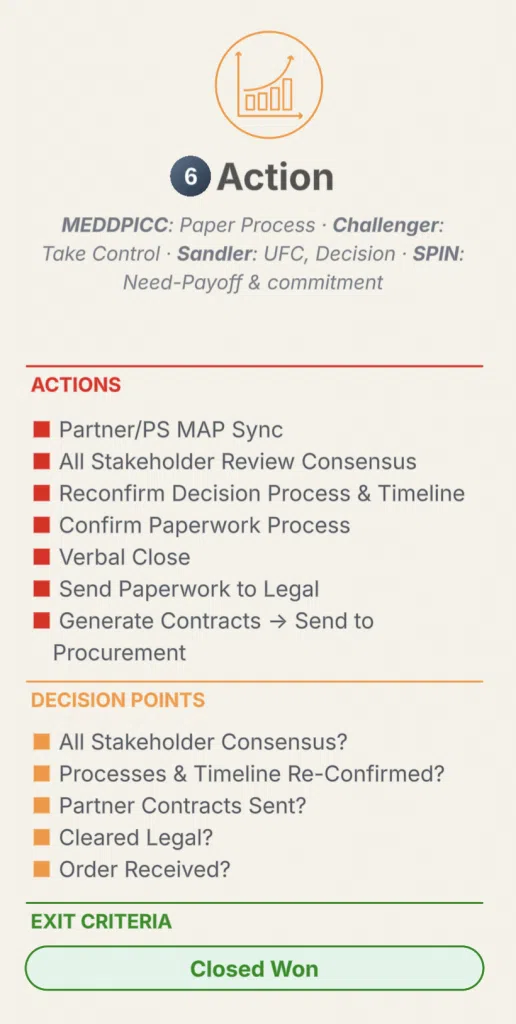
Gates verify consensus, legal clearance, and order receipt. The exit is Closed-Won. Critically, this is where lifecycle ownership begins shifting from Sales toward Customer Success.
Like
Post-sale, value has to be realized, not just promised.
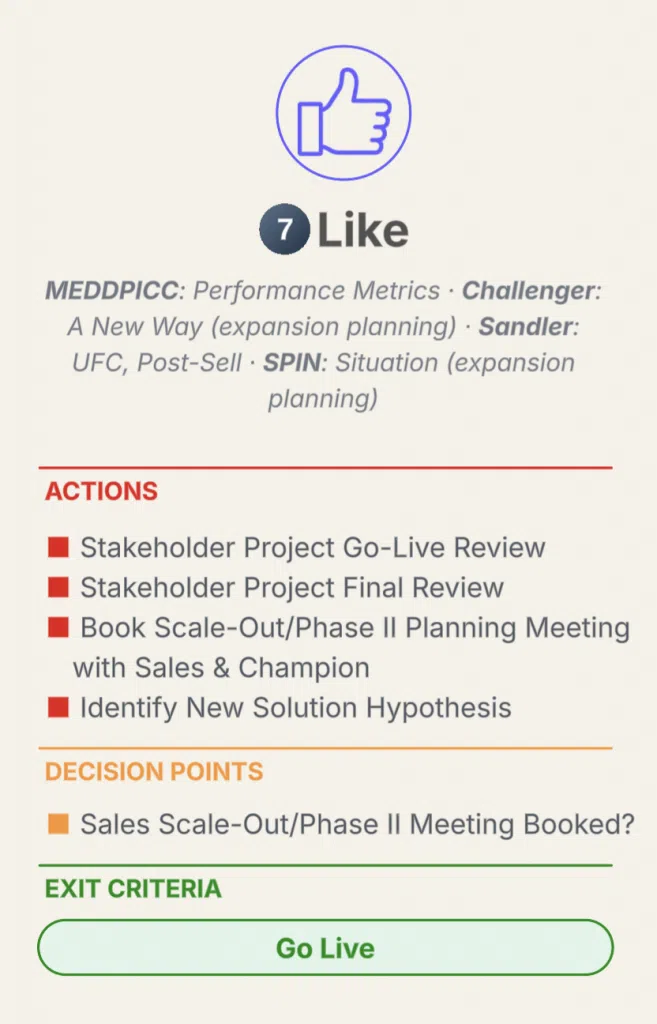
The seller stays close through go-live and final project reviews, books champion scale-out planning, and identifies the next solution hypothesis. The exit is a validated Go-Live: the customer is live and seeing value.
Share
Satisfied Innovators and Early Adopters become a channel.
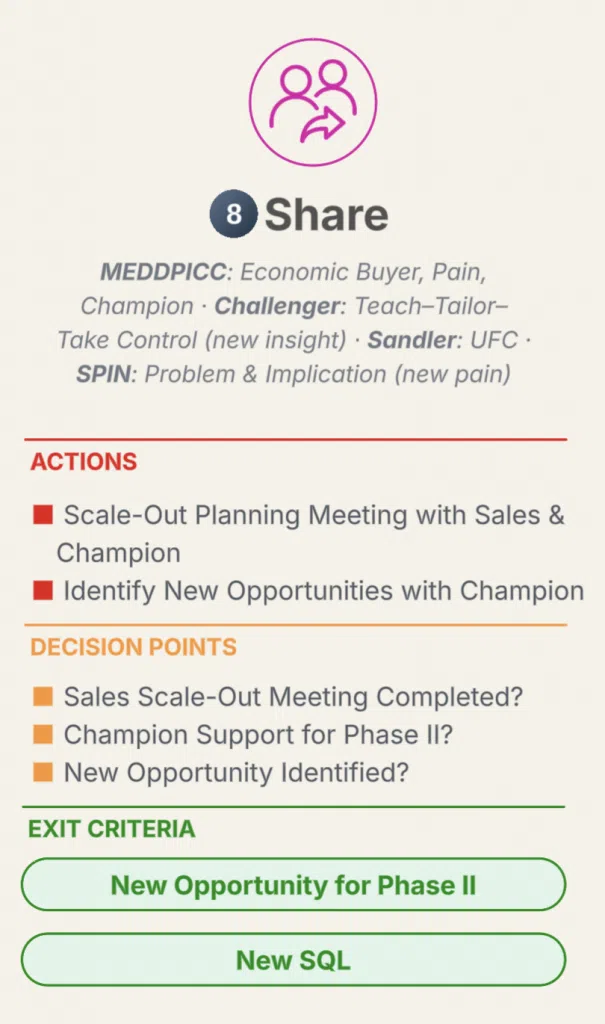
The team runs scale-out planning, identifies new opportunities with the champion, and converts advocacy into pipeline. The "exit" is Start New Sales Process: a fresh Phase II opportunity or a new SQL inside the account that expands into customer whitespace and grows CLTV.
Love
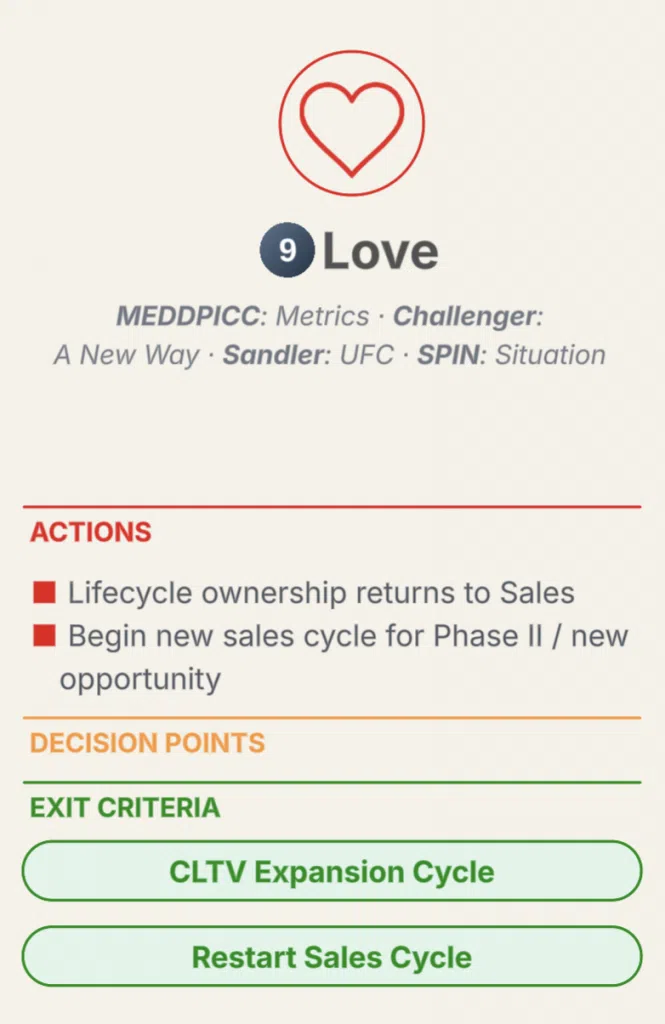
Lifecycle ownership returns fully to Sales for expansion. The account is now a loyalty and CLTV growth anchor, and Sales begins prospecting the next expansion opportunity which loops the whole model back to Signals.