
Exit criteria are the foundation of forecast quality
Forecast quality is the operational heart of the whole model. Every stage contains critical decision points and ends in an Exit Criteria representing a Stage where the completed critical decision points contribute to each Stage and automate forecast quality when rendered in a CRM system:
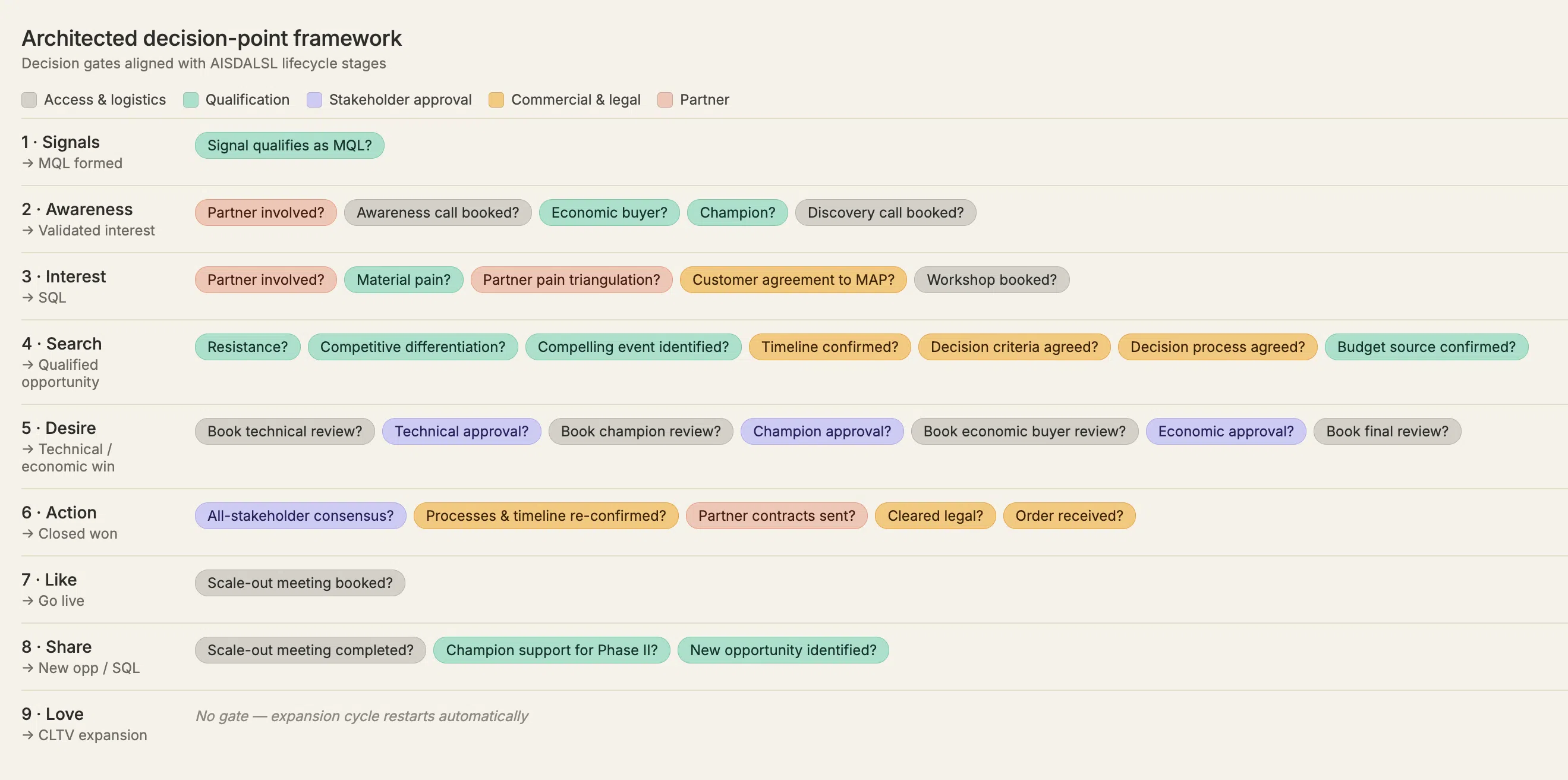
Validated Interest, Sales Qualified Lead, Qualified Opportunity, Technical Win, Economic Win, Closed-Won are measured evidence-based gates against critical events within each stage.
Critical channel partner events can be managed by direct Sales reps or channel partner managers for co-partner deals; channel-led deals can be updated in a partner CRM portal for maximum visibility.
Improving Forecast Quality
The primary goals for all Sales leaders are:
- Deliver dependable forecasts to the organization
- Grow booked and recognized revenue, ACV, and CLTV
- Minimize the expense-to-revenue ratio
- Minimize the average sales cycle period
- Hire and retain great talent for their teams
The primary goals of Marketing leaders are:
- Scale Signal monitoring across markets
- Create Awareness
- Nurture and Identify early Interest (MQL)
- Nurture and support Sales' SQL conversion to Opportunities
- Nurture and support Sales' Opportunities through to close
- Monitor Customer Success signals through deployment
- Minimize friction for prospective buyers, partners, and existing customers
- Improve organizational scale through customer self-service and self-support
- Publicize success
- Nurture existing customers to new MQLs that grow the company's solution footprint
If a Marketing leader delivers on all of their goals but cannot deliver quality convertible MQLs, their days are numbered. If a Sales leader delivers on all of their goals but cannot deliver dependable forecasts, their days are numbered. The key to delivering forecast quality is through a repeatable RevOps "flywheel":
- Creating a Customer Lifecycle funnel mapped to each of its Stages, in parallel to your Sales Process funnel
- Establishing Exit Criteria for each Stage in the Sales Process and Customer Lifecycle (e.g., integrated MEDDPICC/Challenger/Sandler/SPIN, and AISDALS/L)
- Adding common customer Decision Criteria for each Stage that must be met to exit and proceed to the next
- Adding Pipeline Leakage KPIs for each Stage in the Sales Process and Customer Lifecycle funnels
- Refine your Decision Criteria within each Stage to address leakage
- Surface the integrated Sales Process and Customer Lifecycle into MQL, SQL, and Opportunity processes in the CRM
- Track all Sales and Marketing activities against each Stage in the Sales Process and Customer Lifecycle
- Create Lead and Opportunity Pipeline Leakage Reports by Stage and Activity to monitor what activities are contributing to wins and the absence of those activities to losses
- Surface the Pipeline Leakage and Sales & Marketing lifecycle KPIs to the CRM dashboard
In this way, Sales and Marketing leaders can quickly diagnose Pipeline Leakage and velocity from MQL to close to MQL in a continuous flywheel, plug the Activity holes causing leaks, remove unnecessary Activities causing friction in the Exit Criteria, and optimize Sales and Marketing efficiency.
Mapping to the Management Dashboard
Once this sales process and customer lifecycle is mapped in to CRM Sales and Marketing workflows, the measureable activities drive the dashboard, and forecast quality is tracked, with the ability to drill down to each deal and expose the events and
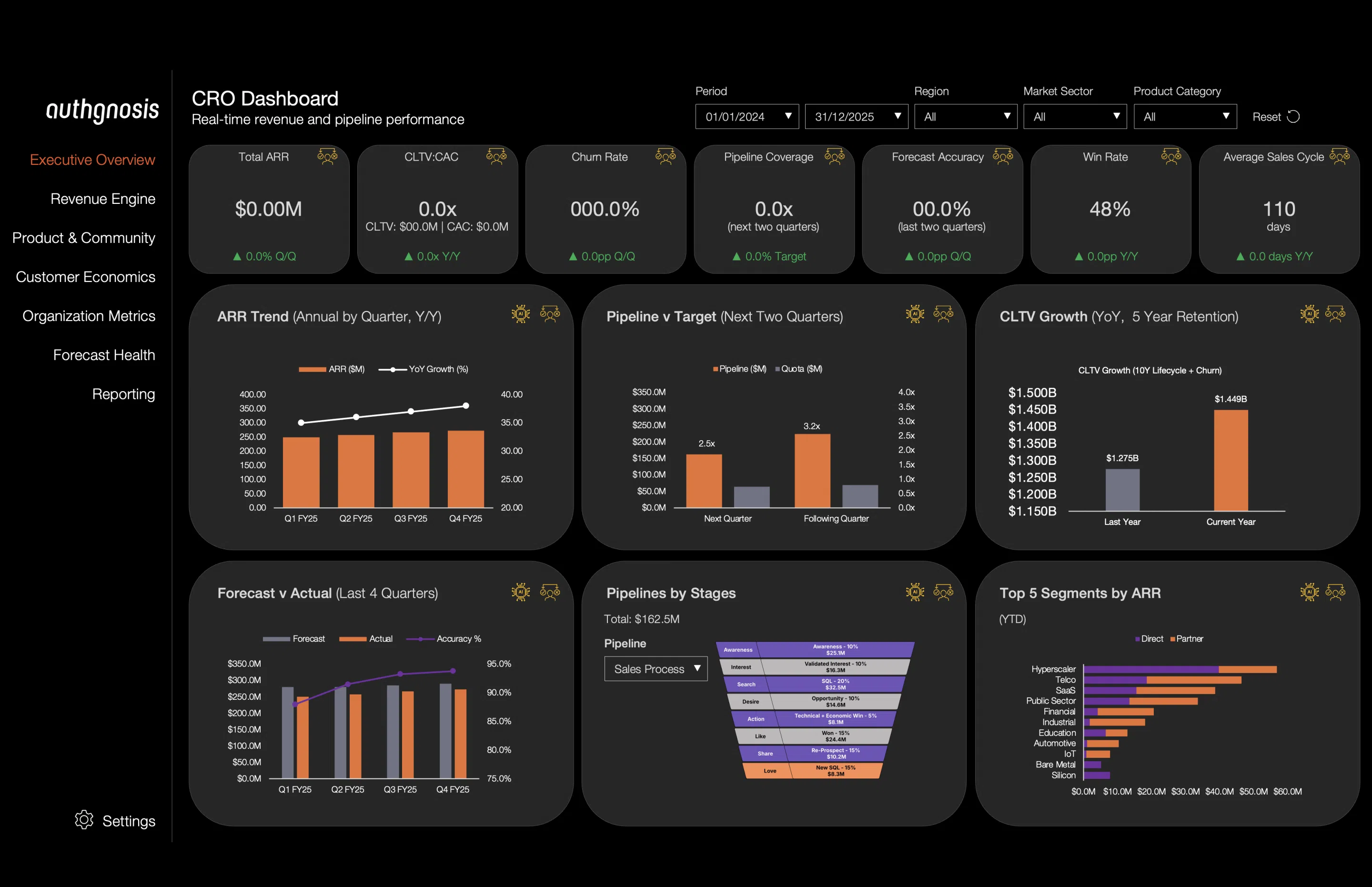
A forecast is only as trustworthy as the criteria met behind each stage transition. When a deal advances because a defined, observable milestone was met.
When deals advance on seller optimism, the forecast becomes fiction. Documenting a sales and customer lifecycle process this way is powerful: it converts "I think this will close this quarter" into "this deal has cleared these seven gates, and here is the evidence." That is the difference between a forecast you defend in a board meeting and a forecast you have to apologize for.
A well-documented process with hard exit criteria also makes coaching possible. When a deal stalls, you can see which gate it failed and why, and you can intervene with the right play instead of a "beatings will continue until morale improves" approach to performance management.
The loop is the flywheel: A Transition from ACV Funnels to CLTV Growth
The most important property of AISDALS/L is that it doesn't end. Love returns lifecycle ownership to Sales and loops back to Signals, and the entire product, partner, and market-sector signal apparatus that started the cycle now fires inside the installed account, sensing the next expansion. A linear funnel optimizes a single transaction. AISDALS/L optimizes a relationship, and the relationship is where enterprise economics live: land, adopt, realize value, advocate, expand, repeat.
This is the punchline, and it comes down to the metric you want to optimize.
Measured on Annual Contract Value, the first deal looks like the finish line, and a funnel that ends at "Action" looks complete.
Measured on whitespace growth and increasing Customer Lifetime Value within an existing customer, that same deal is the starting line. A funnel that ends at "Action" is systematically under-managing the most valuable part of the business: the renewal, expansion, and advocacy flywheel that compounds CLTV and recruits the next cohort of buyers through the Share motion.
AISDALS/L creates a cross-functional flywheel with a managed process: with named owners, defined actions, and hard exit criteria, rather than an accident that happens to good products.