
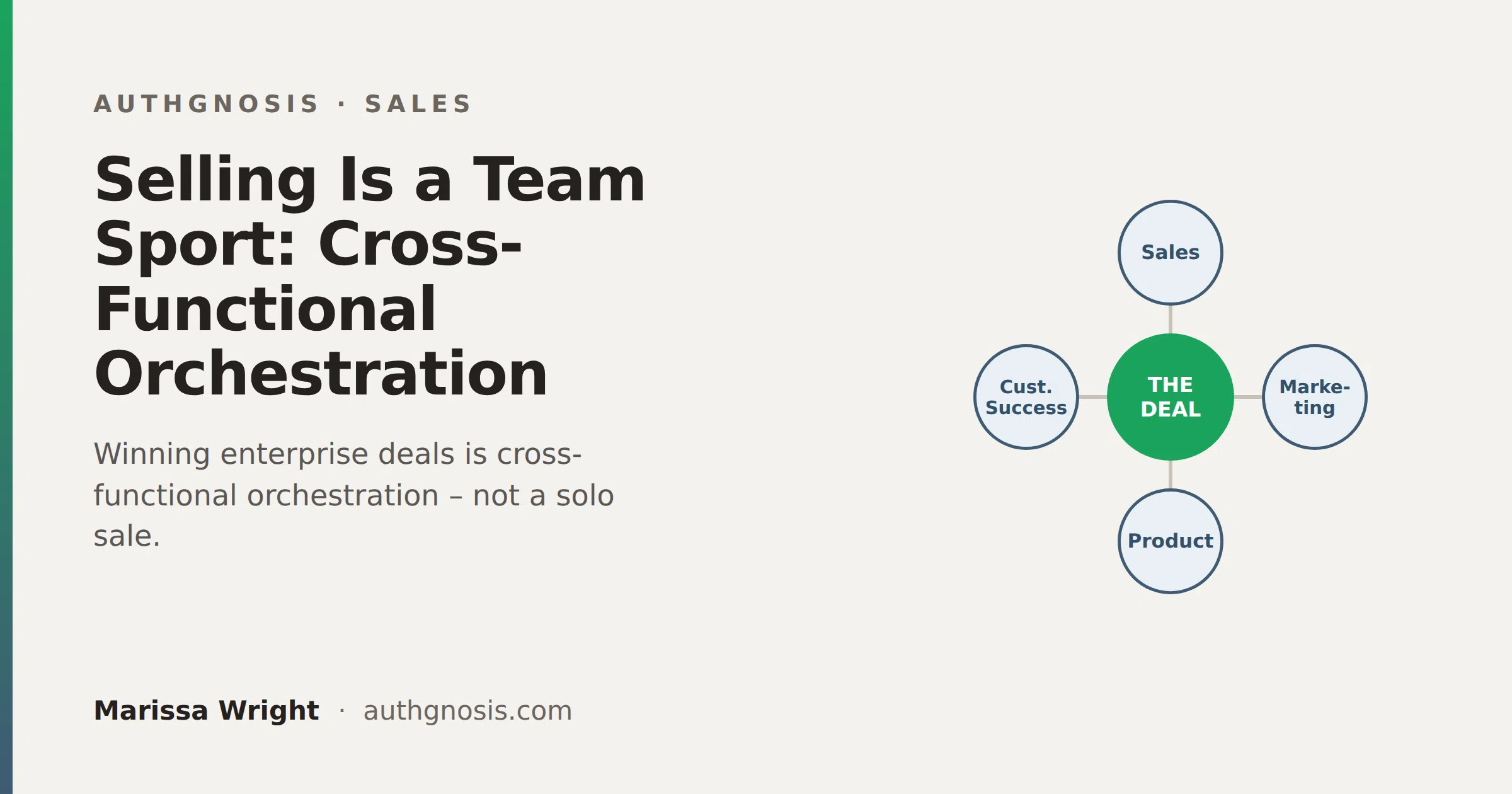
Enterprise technology is never sold by Sales in isolation, and this integrated model makes the supporting cast explicit. In an enterprise SaaS context, cross-functional teams commonly run alongside the Sales lane, each engaging where they create the most leverage.
Field Engineering owns technical credibility through the middle of the cycle: Search, Desire, and Action. Its resources (FE managers and engineers) run technical syncs, design sessions, and workshops, and produce the Statement of Work and technical design artifacts that turn interest into a Technical Win and, ultimately, into realized value.
Partner or Internal Professional Services teams provide delivery capability and co-sell reach. Whether a systems integrator partner or an internal professional services organization, this lane participates in technical calls, project scoping, discovery workshops, and MAP syncs in parallel with Sales, and is the bridge between a signed contract and a successful deployment.
Marketing is not a top-of-funnel function that hands off and disappears. In this model it runs the length of the lifecycle as a structured Sales campaign support loop of its own: Upstream Sensing → Strategy → Message → Action → Downstream Sensing with its own exit criteria at each stage.
Customer Success takes primary lifecycle ownership across Like, Share, and Love: deployment and integration, validation, go-live, and the stakeholder reviews that drive adoption and value realization, until ownership transfers back to Sales for expansion.
The customer's experience with the seller is the sum of cross-functional teams' motions, and the model makes their hand-offs and their shared exit criteria explicit rather than improvised.
Marketing's two jobs: nurture demand, and watch for risk
Two of Marketing's contributions deserve special emphasis.
- Marketing co-ordinates with Sales to nurture prospects through the entire cycle, not just before the hand-off.
In the model, Marketing's Campaign Support at each Stage runs from Awareness through Action:
- Awareness and reframe campaigns
- Interest-development campaigns
- Search-support campaigns
- Desire campaigns
- Deal-stage air cover
Downstream Sensing reads engagement signals back in, and its stage-by-stage completeness ("Awareness," "Interest," and so on) measure whether the nurture actually moved the prospect. Marketing becomes a measured partner in pipeline progression, not a lead vending machine.
- Marketing becomes a digital-signals monitoring partner for Customer Success across the Like, Share, and Love stages. Let me be precise about ownership, because it's easy to overstate: Customer Success owns the customer outcomes: health, adoption, renewal, and risk remediation.
Marketing does not own the outcomes. What Marketing owns is the online listening apparatus, and that is a genuinely distinct and under-used capability.
Marketing can correlate signals the outcome owners rarely see in one place, including:
- A cluster of support cases logged in the CRM
- Identifiable customer stakeholders searching the site
- Participating in solution-related online forums
- Downloading documentation about a particular problem or workaround
Read together, these are the early-warning system: a spike in friction-related searches and support activity from an account's stakeholders is a churn risk surfacing before the renewal conversation; a surge of interest in adjacent capabilities is an expansion signal.
That is why, in the LSL (Like–Share–Love) stages, Marketing is not a bystander but a critical sensing partner to Customer Success, and the same listening apparatus feeds the PR, case studies, and reference content that turn a satisfied customer into the market signal that powers the Share motion. Advocacy, in this model, is engineered, not hoped for.